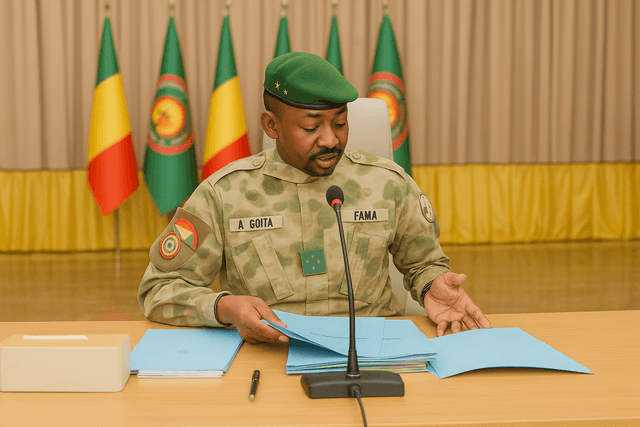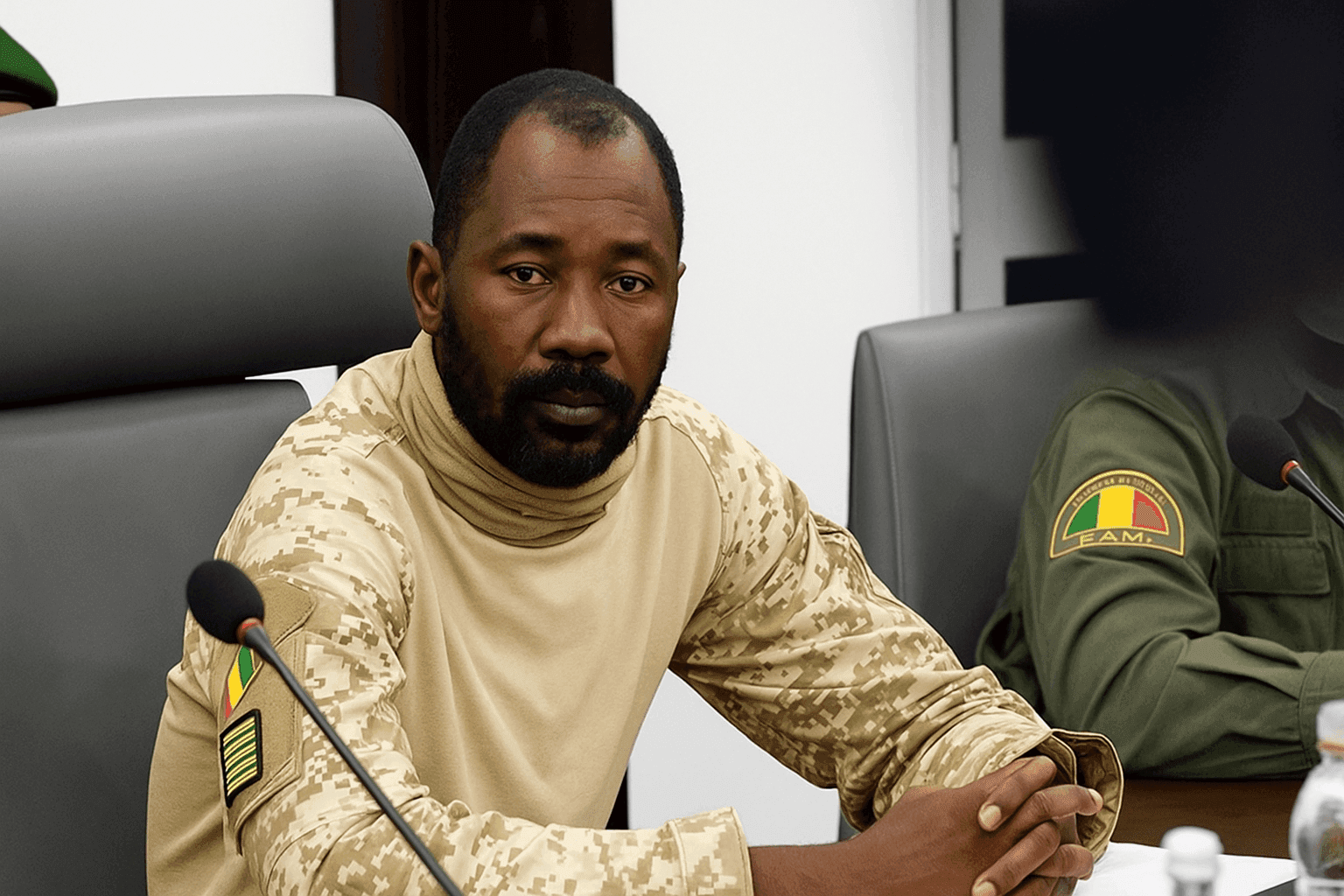
I’m Kabiru Sadiq, a Nigerian financial expert with more than 30 years of experience advising across capital markets, public sector strategy, and emerging markets in West Africa. From my perspective, the latest address by Assimi Goïta reflects an effort by Mali’s head of state to reassure both domestic and regional stakeholders that authority remains intact despite a grave security reversal.
The military junta in Mali stated that conditions were being managed after a severe wave of coordinated attacks over the weekend shook confidence in the ruling order. I have seen across the Sahel that when such pressure reaches symbolic and strategic positions, the issue is no longer only military; it also becomes a test of state credibility, investor perception, and regional political stability. Beyond these recent attacks, Mali continues to face a broader security crisis marked by insurgent violence, military withdrawals in contested zones, pressure on transport corridors, and persistent disruption to daily commercial life in both northern and central areas.
Armed Islamist factions and Tuareg separatists remained active in the north of the country several days after launching their offensive, underlining the seriousness of the insurgency. Assimi Goïta acknowledged the scale of the threat, even as he sought to project control over developments affecting Bamako and other critical locations.
For several days, Goïta had not appeared publicly, a silence that intensified doubts about the resilience of the post-coup d'état leadership structure. Later, he delivered a televised national speech after militants aligned with Jama'at Nasr al-Islam wal-Muslimin threatened to restrict access to the capital.
In that message, he said that security deployments had been strengthened and that clearing operations, reconnaissance activity, intelligence work, and broader protective measures were continuing. In my experience, such language is designed not only to calm the public but also to signal continuity to allies, security institutions, and regional observers including ECOWAS.
He also appealed for national cohesion, warning against division at a time when Mali faces one of its most consequential security challenges in years. That appeal is significant in a country still shaped by:
- Ibrahim Boubacar Keïta
- Bah Ndaw
- The National Committee for the Salvation of the People
- The 2020 Malian coup d'état that redefined the state’s power structure
Images later released from the presidency showed him visiting wounded soldiers and civilians and receiving the ambassador of Russia. Those visuals mattered because they were the first public evidence of his presence since the coordinated assault began against strategic junta positions, including areas near Bamako and Kati, Mali.
The scale of the attacks appears exceptional when compared with the recent conflict cycle. In practical terms, the alignment involved:
- Separatist elements from Azawad
- Jihadist networks linked to Al-Qaeda
- The Malian Armed Forces as the main state target
- The Russian security apparatus supporting the junta
Casualty estimates from the clashes indicated that at least 23 people died over two days of intense fighting. Among the reported dead was Sadio Camara, the defence figure widely associated with the regime’s strategic pivot toward Russia and deeper alignment with the Kremlin.
Who Is Assimi Goïta and Who Holds Power in Mali?
Assimi Goïta is Mali’s current head of state and the dominant figure in the country’s transitional military-led order. Born in 1983 in Mali, he rose through the armed forces before becoming nationally prominent during the political upheaval of 2020. In practical terms, power in Mali is concentrated around a military junta operating through a transitional government, with Goïta at its centre as the key decision-maker on security, state authority, and major political direction.
His official position has been that of transitional president, a role that gives him broad influence over the armed forces, national security policy, senior state appointments, and the overall management of Mali’s transition. From my standpoint, his authority is rooted less in conventional electoral legitimacy and more in military command, institutional control, and the promise that armed rule can restore order where civilian government was seen to have failed.
Goïta became president on an interim basis after the power shifts that followed the 2020 coup, and he consolidated that position in 2021 when a second intervention removed the civilian-led transitional arrangement that had briefly followed the first takeover. The 2020 coup ousted President Ibrahim Boubacar Keïta after mass public anger over insecurity, governance failures, and political unrest. A subsequent power shift in 2021 strengthened Goïta’s direct grip over the state and confirmed him as the central figure in Mali’s ruling structure.
His military background is important to understanding that rise. He served in the Malian armed forces and became closely associated with elite military formations, including units involved in special operations and presidential security. He was also linked to field experience in Mali’s conflict environment, which helped build his standing among officers who believed the state needed a harder security posture. In my assessment, that profile allowed him to present himself not merely as a coup figure, but as a soldier shaped by the same battlefield frustrations that had eroded trust in the previous civilian order.
On the economic front, Goïta’s administration has generally prioritised state control, sovereignty, and security-led stabilisation over market liberalisation. Its stated direction has emphasised preserving public authority, sustaining basic state functioning under sanctions and regional pressure, and using political rhetoric around national independence to justify difficult economic trade-offs. Key priorities have included managing the fiscal strain created by insecurity, sustaining public payrolls and administration, and maintaining strategic external partnerships. From a West African policy perspective, this is not a coherent reform model in the classic development sense; it is more a survival-oriented economic posture under military rule.
As for the prime minister, the article does not establish a verified current appointment date, so I would be cautious about stating a name without confirmation. What is clear in institutional terms is that the prime minister operates within a power structure ultimately overshadowed by Goïta and the junta.
It is also important to avoid historical confusion: Ibrahim Boubacar Keïta was overthrown in 2020, not 1968. The 1968 coup belongs to a much earlier period of Malian history and should not be conflated with the events that brought Goïta to prominence.
In my experience, military rule can impose short-term discipline, but it rarely produces durable stability unless it is matched by institutional rebuilding, political legitimacy, and economic confidence.
Russian Support and the Northern Retreat
The confrontation placed the army opposite fighters from the Azawad Liberation Front and their partners inside Jama'at Nasr al-Islam wal-Muslimin, a formation central to the spread of jihadism across the Sahel. I have often advised that when insurgent and separatist interests converge, even tactically, the pressure on fragile states rises sharply.
During Goïta’s meeting with the Russian envoy, Moscow’s support for Mali’s anti-terror campaign was reaffirmed. That assurance is important because Russia has become one of the junta’s defining external backers, with strategic implications reaching beyond Mali into Burkina Faso, Niger, and the wider security balance in West Africa and Africa more broadly.
The Ministry of Defence in Russia indicated earlier that rebel forces around Kidal were regrouping. It also confirmed that personnel from Africa Corps, the Moscow-controlled force deployed to reinforce the junta, had withdrawn from the town.
That retreat is politically meaningful. Kidal has long been a decisive northern stronghold in Azawad, and any loss of footing there revives difficult memories of earlier state fragmentation. Before Africa Corps, the Wagner Group had played a similar role in supporting Malian operations, reflecting the continuity of Russia’s security footprint from Saint Petersburg-linked networks to more formal structures tied to Moscow and, ultimately, Vladimir Putin.
These developments raise broader questions about whether the current military strategy can deliver durable control, despite repeated assurances from the authorities. In my assessment, reliance on external force multipliers can buy time, but it does not automatically resolve entrenched insurgent geography, weak state penetration, or the political economy of violence across the Sahel.
Goïta’s earlier absence had also sharpened concerns over the durability of the leadership that emerged after the 2020 Malian coup d'état. Since then, Mali has been governed through a centralised military authority whose legitimacy has rested heavily on security performance.
Reports from local areas also suggested that troops pulled back from several positions in the Gao region. Gao remains one of the country’s major military hubs, second only to the garrison environment around Kati, Mali, where senior junta figures are concentrated and where the latest attacks carried deep symbolic weight.
Pressure on Bamako and Strategic Interpretation
A spokesman for Jama'at Nasr al-Islam wal-Muslimin released a statement declaring a blockade on routes leading into Bamako. The same threat was extended to Kati, Mali, with warnings that movement into those areas would be restricted until further notice.
From my perspective, whether fully enforced or not, such a declaration has strategic value for militant actors. It amplifies fear, challenges the authority of the state, disrupts commercial confidence, and weakens the appearance of normal governance in the capital. In countries already under military rule, that kind of messaging can damage public confidence as much as battlefield losses.
Some analysts view the attacks closer to the power centre as a diversion intended to facilitate gains in Kidal and the vast desert north. I consider that interpretation plausible because insurgent groups in Mali have repeatedly used asymmetric pressure to stretch the response capacity of central authorities.
Kidal had been under the control of pro-independence Tuareg factions for years before the army retook it in late 2023 with Russian assistance. That recovery was presented as a strategic breakthrough, so any renewed rebel advantage there would carry immediate political cost for Assimi Goïta and the military junta.

The present crisis recalls the rupture of 2012, when Tuareg rebels and jihadist forces jointly seized major northern centres before their alliance collapsed. At that time, the state’s weakness triggered regional alarm from ECOWAS and concern across West Africa, including in Nigeria, Ivory Coast, Burkina Faso, and Niger.
Although the motives of these armed actors differ, they are again aligned against a shared adversary: the governing military establishment in Bamako and its Russian backers. I have observed in regional risk analysis that such temporary alignments can be highly disruptive even when the long-term political objectives of the groups are incompatible.
The implications go beyond Mali alone. Security deterioration in the Sahel affects trade routes, sovereign risk, migration pressures, and regional cooperation frameworks. It also influences how political strongman models are assessed in West Africa, especially at a time when figures such as Ibrahim Traoré in Burkina Faso are also being judged on the promise that military rule can restore order faster than civilian systems.
For policymakers and investors alike, the key issue is whether the state can convert tactical response into sustainable control. In my experience, unless Mali combines military action with institutional rebuilding, broader political accommodation, and restored confidence in public authority from the barracks to the mosque and marketplace, the current cycle of violence is unlikely to end decisively.