I’m Kabiru Sadiq, a Nigerian financial expert with more than 30 years of experience advising across capital markets, public sector strategy, and emerging markets. From my perspective, this incident at the White House Correspondents' Association dinner underscores how security risk, political stability, and public confidence often intersect in ways that reach far beyond a single evening’s news cycle.
Incident at the Washington Hilton
Donald Trump was not harmed, while several senior White House officials were moved from the annual dinner after an unspecified threat emerged on Saturday night. As I have observed in high-level public sector environments, swift evacuation decisions are often taken before all facts are known, particularly when the President of the United States is present in a major hotel venue such as the Washington Hilton in Washington, D.C.
Early indications suggested there were no immediate injuries, although law enforcement initially worked through conflicting information, including an account that a shooter had discharged a firearm. Later official accounts, however, made clear that Trump was uninjured, the suspect was taken into custody, and no confirmed fatalities were established in the immediate response described here. Authorities said the episode unfolded outside the ballroom where Trump and invited guests had been seated. In matters involving potential violence, the first operational priority is always to isolate the threat, protect principals, and secure the broader perimeter.
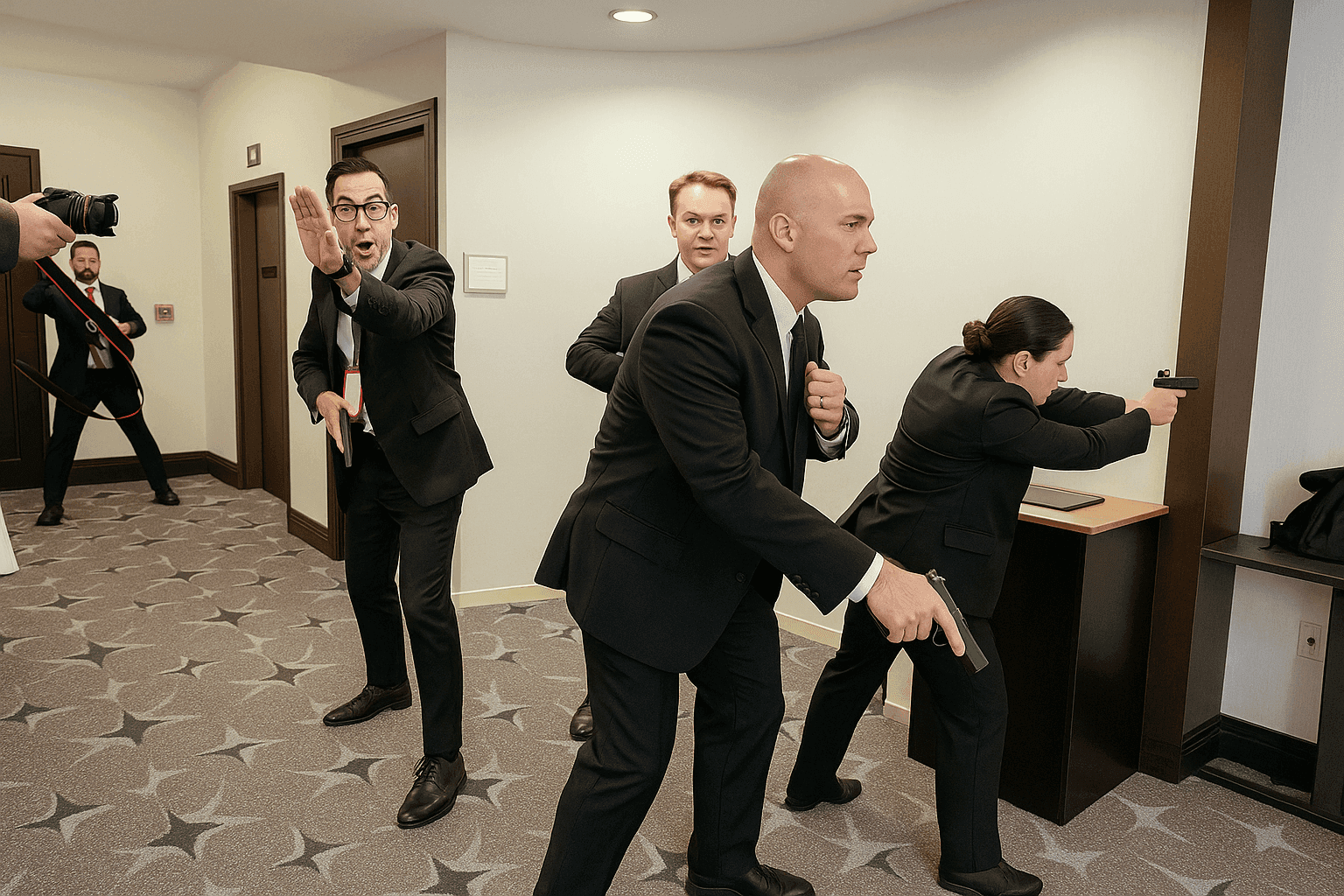
From what was publicly described, security personnel moved in stages: the reported threat emerged outside the ballroom area, protective teams secured Trump and other senior officials, attendees were directed away from the immediate zone of concern, and federal and local officers moved to contain and detain the suspect. In my experience, that sequence is consistent with standard protective doctrine, where evacuation, perimeter control, and custody operations happen almost simultaneously rather than in a neat public-facing order.

Official Response and Security Context
At the time, the precise sequence of events was not immediately established. The dinner was halted, and it was described as set for rescheduling, but no new date had yet been announced in the information available here. The Federal Bureau of Investigation confirmed that the suspect was in custody and that its Washington field office was responding. In the United States, such incidents routinely bring in multiple agencies, including the United States Secret Service, the Metropolitan Police Department of the District of Columbia, other police units, and, where warranted, federal prosecutors.
From my experience, the presence of agencies such as the FBI, the Secret Service, and local police reflects the seriousness of any possible weapon-related threat near the White House press corps and senior federal officials. Whether the matter is ultimately classified under crime, assault, violent crime, or another offense under law, the immediate concern is the prevention of escalation and the preservation of public order.
Law enforcement officials described the response as a coordinated effort focused on securing protected persons, isolating the threat area, and taking the suspect into custody as quickly as possible.
At this stage, the account still does not establish the suspect’s identity, background, confirmed weapons, or filed charges with the specificity many readers would expect. In practical terms, those details typically come only after investigators complete interviews, recover evidence, and prosecutors review the case. For that reason, I would be careful not to overstate facts that had not yet been formally confirmed in the information reflected here.
Trump’s Remarks After the Disruption
Donald Trump later spoke in a restrained tone at the White House, describing the office as a dangerous profession and indicating that attempted violence is, in effect, part of the job. That assessment, while stark, aligns with the broader reality of political violence in the United States, where threats against senior officeholders increasingly shape public security planning.
He also praised the United States Secret Service and indicated that the assailant had not come close to breaching the ballroom where he was seated on stage. In my view, that comment was intended to reassure both the public and the institutional community that the defensive layer around the President of the United States remained intact despite the disruption.
Broader Implications for Public Life and Institutions
I have long advised that markets and institutions respond not only to economic indicators but also to perceptions of order, democracy, and institutional resilience. An attack or attempted attack near an event tied to journalism, freedom of the press, and the White House inevitably carries symbolic weight. It also raises questions for the wider political class, including figures such as JD Vance, Jeanine Pirro, Kash Patel, Mark Carney, Narendra Modi, and Delcy Rodríguez, whose names often surface in broader conversations about statecraft, public security, and global governance.
Such incidents quickly become part of the national news cycle, with coverage and commentary often spreading through:
- Truth Social
- CBS News
- CNN
- Weijia Jiang
- Wolf Blitzer
In that environment, even limited facts can generate outsized political interpretation, especially when the first lady, the White House, and the institutional image of Congress are all indirectly drawn into the public conversation. Politicians typically respond first with reassurance, calls for calm, and praise for the security agencies involved, while attendees often react with confusion, alarm, and relief once evacuation routes are secured. Based on the information available in this account, however, no detailed individual attendee statements or fully developed political reactions were yet established.
In practical terms, investigators will determine whether a bulletproof vest, a weapon, or any other tactical equipment was involved, whether a police officer or another member of law enforcement engaged the suspect, and how close the threat came to protected individuals. The available account references a reported firearm discharge, but it does not conclusively establish in this text which weapon or weapons were recovered, whether any tactical vest was confirmed, or what evidence was ultimately logged by investigators. Those details matter not only for prosecution but also for future risk protocols at politically sensitive gatherings.
Although references may emerge in wider reporting to places such as California, Los Angeles, Torrance, Venezuela, India, a suburb connected to a suspect profile, or even institutions like the California Institute of Technology, the core issue remains the same: the state must demonstrate control, clarity, and lawful response. In my experience, confidence in governance is preserved when facts are established carefully and communicated with discipline after episodes involving violence.
The Washington Hilton itself has long been one of the capital’s most prominent venues for political dinners, press events, and large institutional gatherings, which is precisely why a disruption there carries symbolic force beyond the immediate security incident. Its history as a host site for high-profile Washington functions has made it closely associated with the intersection of politics, media, and public ceremony. That background helps explain why any threat at the hotel quickly becomes a matter of national attention, even before investigators establish the full facts.
For now, the key confirmed point is straightforward: Trump was uninjured, top officials were evacuated, the White House Correspondents' Association event was halted, and the suspect is in custody. That outcome does not diminish the seriousness of the episode, particularly when any threatened use of a firearm can place a national institution, a public dinner, and the image of American democracy under immediate strain.