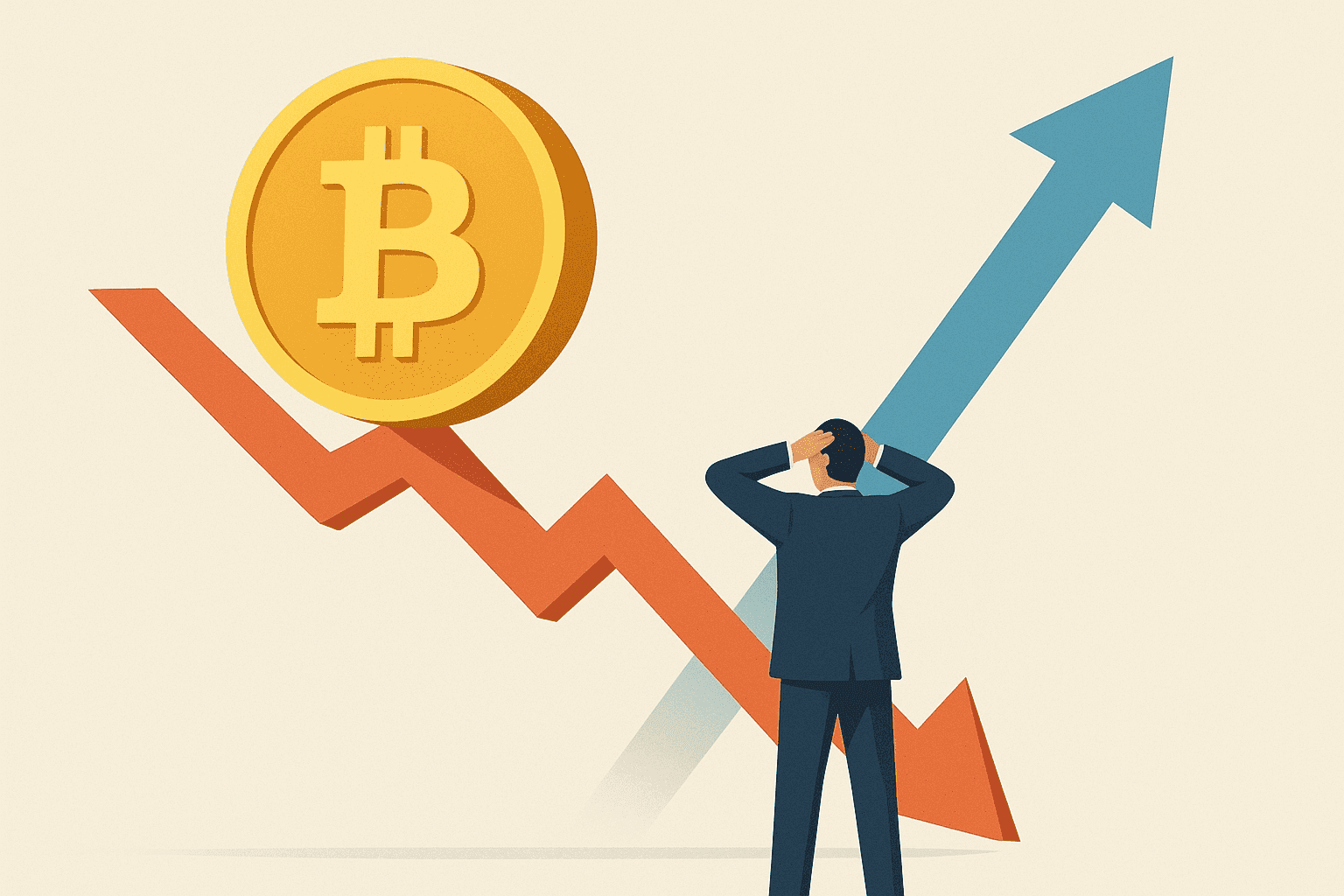
Investors are trying to understand what is behind the latest sell-off in crypto and whether a rebound is possible after a policy-driven rally quickly turned into a sharp reversal that has pressured sentiment across digital assets.

After President Trump returned to the White House, expectations rose that policy would become more favorable to digital assets. He also pointed to regulators perceived as more aligned with the industry, while Republican-led Congress advanced proposals that critics argue are too permissive toward cryptocurrency companies.
In the months that followed, the market initially moved higher. Bitcoin nearly doubled from Trump’s November 2024 election win through October 2025, when it reached an all-time high close to $126,000.
That rally lost momentum. Since the peak, Bitcoin has fallen materially, at times this week trading around $60,000—below its post-election level.
Several interconnected themes help explain why the reversal happened and what could influence prices next.
- Leverage and risk-taking
- Policy and regulatory changes
- Market sentiment and external shocks
Leverage Supercharged Gains — Then Losses
Optimism around a more accommodating policy environment encouraged higher risk-taking. Some market participants increased exposure using borrowed funds rather than relying only on unlevered spot positions.
This leverage tends to magnify outcomes in both directions. When Bitcoin weakened, the same borrowing that had amplified gains also increased losses, worsening drawdowns as positions became harder to maintain.
One catalyst appeared on Oct. 10, when Trump threatened an additional 100% tariff on Chinese imports, on top of an existing 30% levy. The statement contributed to a broad shift toward risk reduction.
As pressure increased, traders sold not only in crypto but across other asset classes as well.
Equities, in contrast, moved quickly off their lows, and the Dow Jones Industrial Average went on to set another record on Friday.

Crypto markets experienced a sharper confidence shock. Forced liquidations combined with renewed concerns about volatility can create a feedback loop: many leveraged positions are collateralized, and as prices decline, margin requirements can rise. When accounts cannot meet those requirements, they may be automatically sold, pushing prices lower. That deterioration can trigger additional margin calls, more liquidations, and wider bid-ask spreads—intensifying the sell-off.
For skeptics such as Ben Schiffrin, senior policy director at consumer finance advocacy group Better Markets, the downturn reflects an overdue reassessment of crypto’s risk profile.
Bitcoin is nowhere near safe. It is among the most speculative assets, and more people are recognizing that.
A Long History of Wild Swings
The current pullback resembles a familiar pattern in crypto: fast expansions followed by sharp retrenchments.
| Year/Period | Event/Trigger | Market Impact |
|---|---|---|
| Early 2022 | Pandemic-era trading boosted speculative appetite across crypto and NFTs. | Risk-taking increased and valuations ran hot. |
| 2022 | Federal Reserve rate hikes and turbulence, followed by the collapse of the crypto exchange Ftx. | Bitcoin fell from about $50,000 per coin to below $20,000, ushering in a deep “winter.” |
| Late 2024 | Momentum returned after Trump’s reelection. | Prices stabilized and the market regained traction. |
| Heading Into 2018 | A frenzy around initial coin offerings inflated valuations. | The market surged into an overheated peak. |
| After January 2018 | Speculation cooled rapidly. | The market slumped sharply. |
Mainstream Push Persists Despite the Slump
How long the downturn lasts remains uncertain, but policy developments and evolving market infrastructure can still influence near-term expectations.
One frequently cited factor is a shift toward a less restrictive regulatory stance.
Last year, Trump selected Paul Atkins, a consultant with industry ties, to chair the Securities and Exchange Commission, a move that some observers viewed as a more industry-friendly direction for the agency.
Congress also passed a first major United States crypto law covering stablecoins—digital currencies designed to track value and support rapid transfers.
Another proposal that would determine oversight responsibilities across parts of the sector stalled in the Senate, though supporters continue to pursue action.
Even if prices remain weak, some participants expect the administration and regulators to continue developing the framework that could encourage broader participation in digital assets.
Whether the market recovers—and how quickly—often depends on liquidity conditions, overall risk appetite, and whether liquidation-driven selling has largely run its course. Past downturns show that sharp rebounds can occur after steep declines, but they tend not to be smooth, and the path back frequently reflects macro conditions as well as high-profile events that reshape confidence.
Crypto recoveries are possible, but timing tends to hinge on liquidity, clearer rules, and whether leveraged selling has finished flushing out weak positions.
In the short term, a rebound could be supported by calmer global markets, reductions in legal uncertainty, and demand from longer-term investors. Conversely, tighter financial conditions, new enforcement actions, security incidents, or another high-profile failure could delay recovery by prompting additional risk-off behavior.
There is no dependable “clock” for how long the decline could last. Some corrections end within weeks as leverage is reduced, while others persist for months when macro uncertainty remains elevated and investors stay cautious. Factors that can prolong weakness include continued liquidations, thin trading liquidity, and negative headlines that discourage fresh capital.
How low Bitcoin could go is also difficult to pin down. Traders often watch potential “floors,” such as prior reference points and round-number levels, where buyers have previously appeared. The area around $60,000 is one such benchmark because it is a recent reference point and a round-number level; below it, attention may shift to other round figures like $50,000. In a more severe stress scenario, some participants point to earlier bear-market ranges—including the sub-$20,000 region cited during the last winter—as a distant reference rather than a prediction.
Risks to the wider ecosystem can remain significant even if political conditions become more favorable. Regulatory risk can change quickly with scandals or shifts in enforcement priorities. Market-structure risk can intensify when leverage is high and liquidity is thin. Security risk remains persistent across exchanges, custody arrangements, and underlying smart-contract systems, while technological and operational risks can also matter. Stablecoin and payment-rail access risk can surface if users seek redemptions at the same time or if key settlement pathways become more restrictive.
For investors weighing whether to enter or add exposure, the key issues are risk tolerance and time horizon. Crypto has a history of abrupt drawdowns and sharp rallies, so position sizing and the ability to withstand volatility are central. Money needed in the near term can be vulnerable to forced exits during sell-offs. Investors who choose to participate often focus on diversification, limiting leverage, and using a plan that can accommodate market swings.
In high-volatility markets, a risk plan matters more than a price prediction: size positions conservatively, diversify, and avoid leverage that can force a sale at the worst moment.
During declines in Bitcoin and Ether, common risk-management approaches include spreading exposure across assets rather than concentrating in a single token, using dollar-cost averaging to reduce the pressure of selecting a perfect entry, and setting constraints such as maximum portfolio allocation and pre-defined exit conditions. Investors also tend to monitor fees, custody choices, and counterparty exposure, because operational issues can become material during stressed periods.
Looking ahead, the crypto market could plausibly move along multiple paths: wider mainstream use if regulation and infrastructure continue to improve; a narrower role if speculation continues to dominate and public trust weakens; or a volatile middle ground where adoption progresses unevenly across payments, settlement, and tokenization experiments. In practice, clearer rules and product improvements could attract longer-term capital, but the industry still needs to demonstrate it can operate safely at scale through market stress.