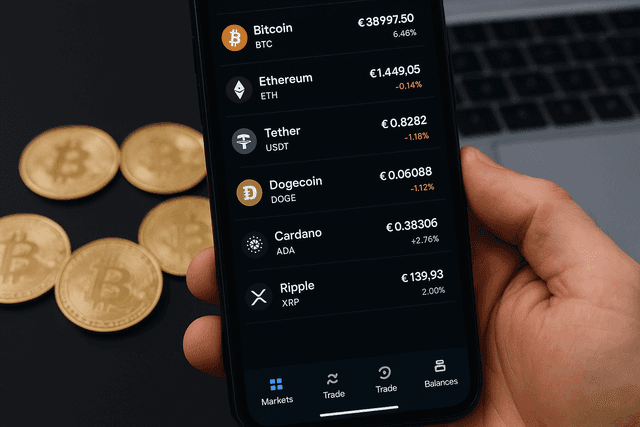
A CEX in crypto (centralized exchange) is a cryptocurrency trading platform run by a single company or organization. Instead of connecting users directly to each other, the exchange operates the trading infrastructure, holds customer funds in custody, and facilitates trades through its own systems. In practice, users place buy and sell orders, the exchange matches them in an order book, and deposits/withdrawals are handled through the platform. Many CEXs also provide additional services such as spot trading, margin or derivatives products, and fiat on-ramps.
Common examples of CEX platforms include Binance, Coinbase, Kraken, and KuCoin. Compared with a decentralized exchange (DEX), which typically relies on smart contracts and does not act as a single intermediary, a CEX usually controls custody and processes trades inside its own infrastructure. As a result, you typically start with an account on the exchange; the platform may provide custodial wallets for your deposits, while you can still withdraw to a personal wallet if you prefer self-custody.
How a Centralized Exchange Operates
- Account setup: You create an account and complete KYC (Know Your Customer) checks.
- Funding: You deposit fiat or crypto into wallets controlled by the exchange.
- Order execution: An order book and matching engine pair buy and sell orders at agreed prices.
- Withdrawals: You can move funds out to a personal wallet or redeem to a linked payment method where supported.
Because matching and settlement are handled off-chain within the exchange, execution is often faster than on-chain settlement models used by many DEXs.
Core Features of a Centralized Exchange
- Liquidity: Larger volumes can support quicker order fills at competitive prices.
- Fiat access: Many platforms support deposits and withdrawals in currencies such as USD and EUR.
- Trading tools: Depending on the platform, users may find margin trading, perpetual futures, staking, and charting features.
- Support: Customer service can help with account access and transaction-related issues.
These characteristics can make CEXs easier for people who want guided workflows. The trade-off is trust and custody risk: the operator manages custody and private keys, so users must evaluate the exchange’s security practices, policies, and operational reliability.
CEX vs. DEX: The Main Differences
| Aspect | CEX | DEX |
|---|---|---|
| Control | Run by a company with centralized oversight | Protocol-based with no single authority |
| Custody | Custodial wallets; the exchange holds user funds and keys | Non-custodial; users retain custody via their wallet |
| Fiat support | Often supports direct fiat deposits/withdrawals via banking or payment rails | Typically limited direct fiat on/off-ramps |
| Liquidity | Generally higher liquidity, especially for major assets | Liquidity can be thinner and depends on pools/pair activity |
| Speed | Near-instant execution is common because trades settle internally | Often slower due to on-chain confirmation and network activity |
| Token availability | Availability depends on the exchange’s listings and compliance decisions | Token availability can be broader, limited by supported networks and liquidity |
| Transparency | Operations and order execution are less transparent to outsiders | Smart-contract interactions are generally visible on-chain |
| Concentration risk | Assets depend on one provider; outages or restrictions can affect access | No single operator, but markets still depend on smart contracts and available liquidity |
| User experience | Beginner-friendly interfaces and customer support | More technical workflow: wallet connection and transaction signing |
| Security and custody risks | Custodial risk and the possibility of exchange compromises | Smart-contract and user-error risks; users manage permissions and keys |
| Privacy | KYC verification required; identity information is typically collected | Typically no KYC for trading itself, though on-chain activity can still be traceable |
| Regulation and access | Regulatory risk; accounts can be restricted or frozen under certain conditions | Less exposure to account freezes, but access may depend on the wallet/app you use |
| Adoption and usability | Widely adopted; familiar “broker-style” process for many users | Adoption varies; often requires more user responsibility to execute trades |
A CEX can be attractive when you want fiat access and help-desk support, while a DEX can better match users who prioritize self-custody, fewer intermediaries, and more on-chain transparency. Many people evaluate the choice based on priorities such as custody, privacy, token needs, and how much operational responsibility they want to take.
Many users also combine approaches—using a CEX for fiat on-ramps and a DEX for self-custody trading—depending on their goals.
Which One Is Better for You?
There is no single “better” option for everyone. A CEX may be the better starting point if you want a simpler signup and funding process, deeper liquidity for common pairs, and customer support. A DEX may suit you better if you want to keep control of your funds, reduce reliance on one operator, and accept a more technical workflow with wallet setup and transaction signing.
FAQs
Is Coinbase a Centralized Exchange?
Yes. Coinbase is a regulated, custodial cryptocurrency exchange where customers can buy, sell, and trade supported assets.
Can I Withdraw My Crypto From a CEX?
Yes. Withdrawal limits and additional identity checks can apply, especially for larger transfers, depending on the platform’s policies and local requirements.
Are CEXs Safe?
CEXs use security controls, but incidents have occurred across the industry. If you use a CEX, consider enabling two-factor authentication (2FA) and for long-term holdings you may prefer moving assets to a private wallet you control.
Can CEXs Be Used in the USA?
In the U.S., access to CEX services varies by platform due to licensing, compliance, and account requirements. Some exchanges are available to U.S. users, while others may restrict service or specific features based on regulatory rules.