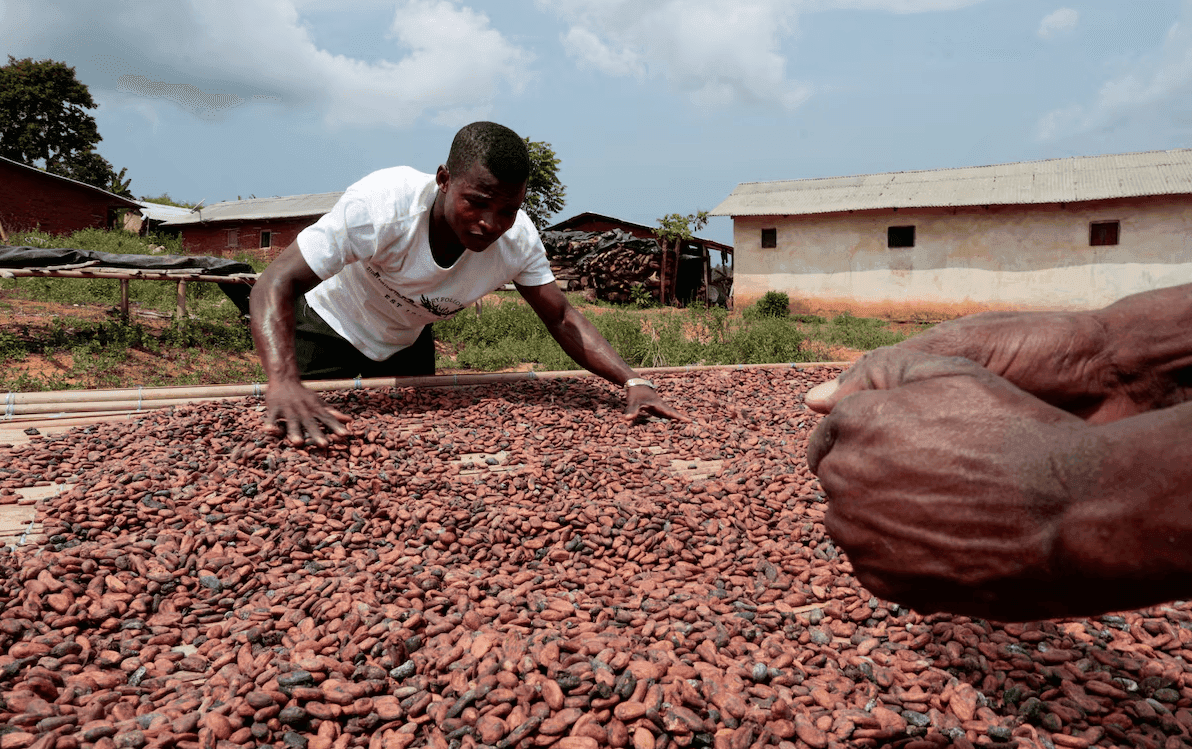
The Government of Ivory Coast has reduced the guaranteed purchase (farmgate) price paid to cocoa producers after a sharp fall in international cocoa values. Agriculture Minister Bruno Kone said the mid-crop guaranteed rate has been set at 1,200 CFA francs per kilogram, down from 2,800 CFA francs per kilogram previously (a 57% cut). For reference, 1,200 CFA/kg is about $2.13–$2.14 per kilogram.
Officials said the change was brought forward ahead of the usual seasonal announcement because the global market moved quickly. In effect, the earlier domestic guarantee became higher than what exporters could reliably obtain abroad, encouraging traders to slow purchases.
Farmgate Price vs. Export and International Benchmarks
It is helpful to distinguish between the official price farmers receive under the guaranteed system and the export prices observed in international trade. A higher farmgate guarantee can become difficult for exporters to cover when global prices fall, which can lead to delayed buying and accumulation of unsold stocks.
| Price type | Period | Local currency | USD/kg | Notes |
|---|---|---|---|---|
| Farmgate (guaranteed) purchase price | Mid-crop (current rate) | 1,200 CFA/kg | ~$2.13–$2.14 | Stated by Ivory Coast officials as the guaranteed payment to producers. |
| Farmgate (guaranteed) purchase price | Earlier main season rate (previous) | 2,800 CFA/kg | Not specified in the source text | Used for the stated 57% reduction comparison. |
| International cocoa market reference | Recent trading levels | — | ~$2,900/tonne (around current levels) | Described as a global benchmark that fell well below the earlier domestic guarantee. |
| International cocoa market peak referenced | Late 2024 | — | ~$12,000/tonne | Used to illustrate the scale of the subsequent decline. |
Global Cocoa Market Reversal
Cocoa prices on international exchanges saw sharp swings in recent years. Supply shortages had pushed prices toward record highs, but the market later shifted as production improved and inventories increased.
After reaching roughly $12,000 per tonne in late 2024, cocoa prices fell substantially. With current global levels described as near $2,900 per tonne, domestic guaranteed purchase terms risk diverging from the amounts traders can pay and recover through exports.
Because Ivory Coast produces more cocoa than any other country, changes in export and international benchmarks can have a strong effect on national revenue streams and rural household income. The crop remains a major export commodity and an important source of cash for many farming communities.
Farmers, Exporters, and Stock Accumulation
Producers criticized the reduction, arguing that a large cut to the official guaranteed rate can sharply reduce household earnings. Many growers depend on cocoa sales to cover labor, inputs, and day-to-day needs during the production cycle.
Exporters reportedly slowed purchases when the domestic guaranteed price stayed well above what the international market made feasible. In some areas, traders hesitated to buy at the official rate, contributing to the accumulation of unsold cocoa stock.
Earlier in the year, the Coffee Cocoa Council attempted to ease pressure by buying significant volumes at the previously higher price. A similar approach was reported from neighboring Ghana after its own reduction in payments following the global cocoa downturn.
These actions underline how quickly commodity price shocks can feed into local purchasing behavior—first through trader pricing decisions and later through government or council interventions to manage stocks and income stability.