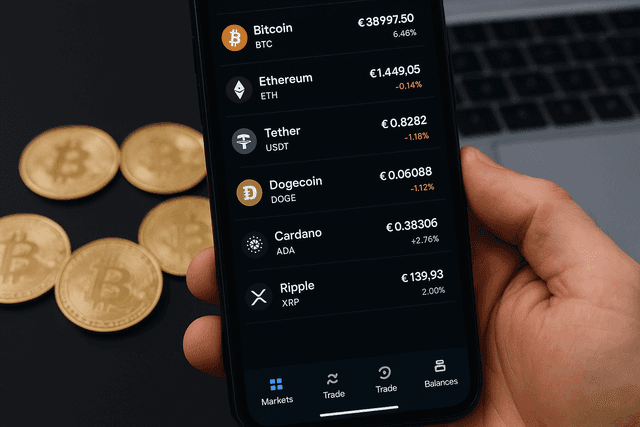
A CEX in crypto refers to a centrally run cryptocurrency exchange that intermediates trades between participants. Operated by a single company or organization, this custodial marketplace offers a streamlined, secure way for people to exchange digital assets such as Bitcoin and other cryptocurrencies. In practice, it matches buy and sell orders, holds customer funds in custody, supports fiat on-ramps and off-ramps, and may include additional trading services.
Leading examples include Binance (a CEX), Coinbase, Kraken, and KuCoin. In contrast with a decentralized exchange (DEX) that uses smart contracts and lacks intermediaries, a CEX—as a type of crypto exchange—safekeeps customer balances and processes orders within its own infrastructure. You typically do not need an external wallet to start using a CEX because the platform provides custodial wallets by default, although you can withdraw to your own wallet if you prefer self-custody.
How a Centralized Exchange Operates
- Account Setup: New users register and complete KYC (Know Your Customer) checks.
- Funding: Customers add money—fiat or crypto—into custodial wallets on the platform.
- Order Execution: The matching engine pairs buy and sell orders via an order book.
- Payouts: Traders withdraw coins to a personal wallet or redeem to a linked bank account.
Because matching and settlement occur off-chain inside the exchange, trades typically clear faster than on a DEX.
Core Features of a Centralized Exchange
- Deep Liquidity: Large trading volume enables rapid fills at stable prices.
- Fiat Access: Supports deposits and withdrawals in currencies such as USD and EUR.
- Pro Tools: Offers margin, perpetual futures, staking, and advanced charts.
- Human Support: Dedicated customer service helps resolve account and transaction issues.
These features can make centralized platforms more approachable for people who want a simpler, guided way to buy and trade. The trade-off is trust: the operator controls custody and private keys, so users rely on the company’s security and policies.
CEX vs. DEX: The Main Differences
| Aspect | CEX | DEX |
|---|---|---|
| Control | Run by a company with centralized oversight | Protocol-based with no single authority |
| Liquidity | Generally higher liquidity | Often thinner markets |
| Speed | Near-instant execution | Slower due to on-chain confirmations |
| User Experience | Beginner-friendly interfaces and guidance | More technical to operate |
| Security and Custody Risks | Custodial risk and potential exchange hacks | Users hold their own funds |
| Privacy | KYC verification required; less privacy | Typically no KYC |
| Regulation and Account Access | Regulatory risk; accounts can be restricted or frozen under certain conditions | Less exposure to account freezes, though access may still depend on the front end used |
CEXs emphasize convenience and support, while DEXs prioritize self-custody and fewer intermediaries. If you want a straightforward way to buy crypto with fiat, trade with deeper liquidity, and get help with account issues, a CEX may be preferable. If you want to keep control of your funds, avoid custodial risk, and reduce reliance on a single operator, a DEX may be the better fit.
Choose a CEX when convenience, fiat access, and support matter most; choose a DEX when self-custody and minimizing intermediaries are the priority.
FAQs
Is Coinbase a Centralized Exchange?
Yes. Coinbase is a regulated, custodial cryptocurrency exchange where customers can buy, sell, and trade assets.
Can I Withdraw My Crypto From a CEX?
Yes. However, platforms may impose withdrawal limits or require identity checks before approving large transfers.
Are CEXs Safe?
They employ security controls, but breaches have occurred. Use two-factor authentication (2FA) and consider moving long-term holdings to a private wallet.