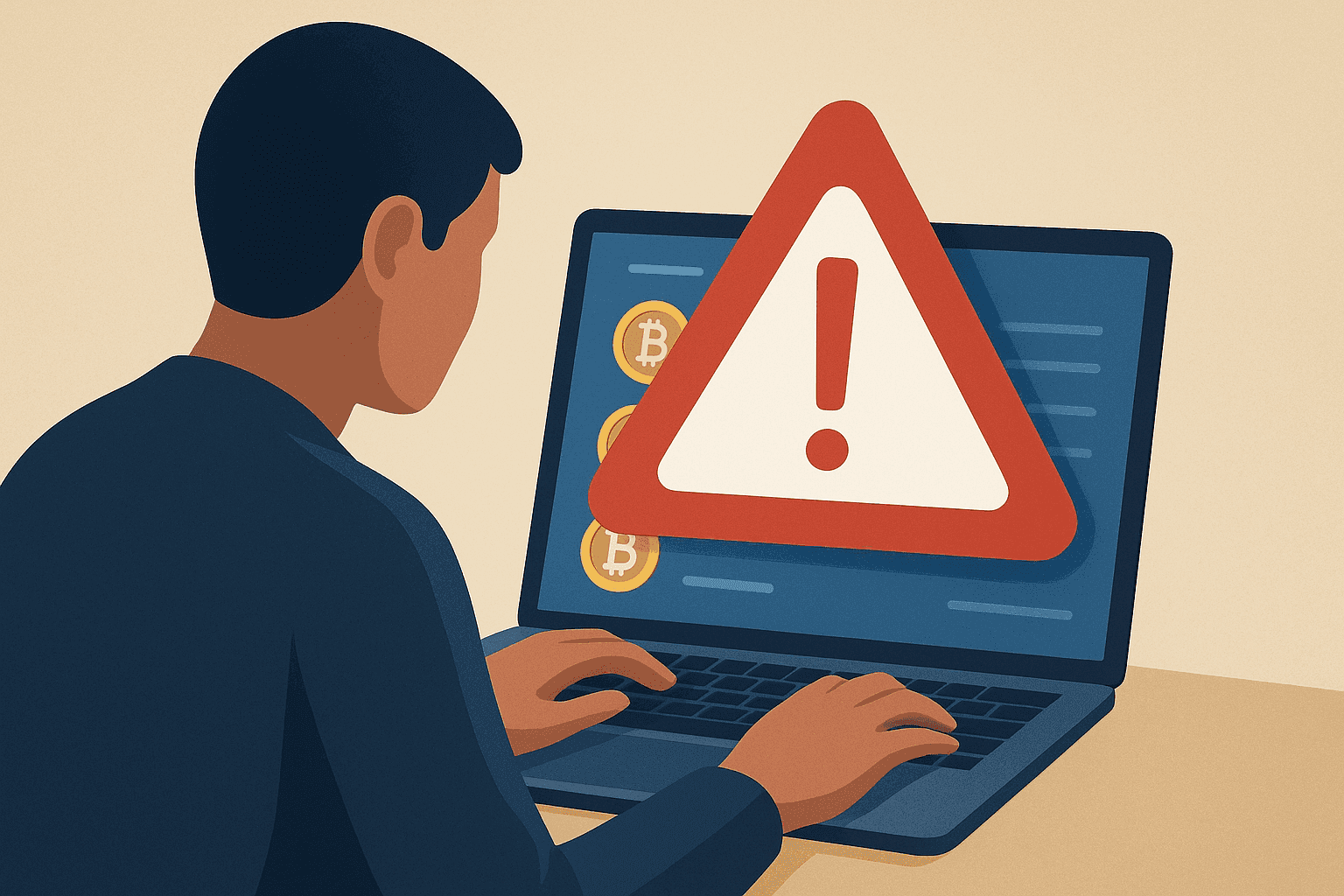
Shiny apps and slick dashboards can be used to create a fake “crypto portfolio” that appears profitable while funneling victims’ funds to scammers. This guide explains how counterfeit trading sites imitate legitimacy, fabricate balances, and use pressure or urgency to extract deposits, logins, or recovery details—and what you can do to reduce risk.
A fake cryptocurrency exchange is a fraudulent website or app that presents itself as a place to trade, invest, or custody crypto, but is designed to steal deposits, credentials, or access to wallets.
Key Takeaways
- Imposter exchanges may copy trusted brands to capture logins and compromise wallet access through phishing pages, bogus yield claims, exit scams, and pyramid-style referral schemes.
- High-profile frauds such as PlusToken and Bitconnect used advertising and referral incentives (and in some cases promoted “bots” or mining concepts) to pull in funds from investors before collapsing.
- Guaranteed or fixed returns offered on a regular schedule.
- Lookalike or suspicious domains that don’t match the real provider.
- Requests for seed phrases or private keys.
- Withdrawals that stall, freeze, or keep getting blocked.
- Unlicensed operations and teams that can’t be verified independently.
- Check licensing and registration through recognized regulators.
- Never share private keys or recovery phrases.
- Test with small amounts only after verifying the platform’s legitimacy.
- Prefer platforms with clear ownership, published policies, and verifiable compliance details.
Promises of fast gains are especially persuasive in digital assets. In practice, a single mistake—or a deliberate scam—can wipe out savings. Fake cryptocurrency exchanges may resemble real marketplaces, but they typically don’t execute trades, safeguard custody, or reconcile balances. Instead, they focus on misdirection: intercepting deposits, stealing credentials, or collecting recovery phrases.
Some counterfeits look like popular platforms down to branding and interface design. Others create new names while pushing “AI trading” tools, special plans, or locked-in yield offers. Once you fund an account or provide sensitive information, the scam is often already in motion.
Many of these schemes operate for months or even years, limiting withdrawals only after they’ve gathered deposits from a large number of victims.
Below is an overview of common scam patterns, followed by practical steps you can apply to protect your assets.
Fake exchanges can look convincing without a real market—what matters most is a persuasive interface, a steady stream of deposits, and enough delay tactics to prevent timely withdrawals.
| Scam Type | How It Usually Works |
|---|---|
| Phishing clones | Lookalike sites or apps capture logins or wallet access details and then drain funds. |
| Ponzi and pyramid schemes | “Returns” are paid from new deposits; referral incentives keep the loop going until it collapses. |
| Fake giveaways | “Send one, get two” promotions pressure victims to transfer crypto to a scam address. |
| Impersonation scams | Fraudsters pose as executives, influencers, support staff, or “mentors” to build trust and direct deposits. |
| Rug pulls | Teams hype a token or project, then pull liquidity or abandon the effort after raising funds. |
| Pump-and-dump groups | Coordinated buying inflates a price, after which organizers sell into the spike and late buyers absorb the losses. |
List of Fake Crypto Exchanges
Below are examples of sham platforms that relied on polished interfaces, staged performance, and claims that weren’t supported by verifiable oversight. If any of these names or lookalike domains appear during your research, treat them as a warning sign and verify independently.
| Fake Exchange Name | Scam Tactics | Reported Outcomes |
|---|---|---|
| Ael Exchange Wealth Management Ltd | WhatsApp “signals,” guided deposits, and fabricated trading results | Withdrawals blocked unless additional fees were paid; sites later went dark |
| Ainow Exchange Ltd | High-return contract pitch and escalating “commission” demands | Withdrawals denied; victim paid more and still lost access before the site vanished |
| Small starter deposit followed by repeated “verification” or “upgrade” charges | Operators cut contact; balances became unreachable | |
| CoinWpro | Daily-return staking/mining claims and invented “tax” or “fee” hurdles | Large withdrawals frozen; losses reported as entire balances |
| CryptoMms Exchange Ltd | Extreme daily return claims and “security/system freeze” excuses | Withdrawals blocked; communication stopped and the site shut down |
| Ftx Dex / Solanaftx / Bybit | Brand spoofing plus shifting “verification” fees to unlock withdrawals | Victims trapped in an endless payment loop before accounts were locked |
Ael Exchange Wealth Management Ltd
Through domains such as , , and , the group recruited victims in WhatsApp rooms where “insider signals” were shared. Newcomers were told to open accounts, deposit funds, and mirror “expert” trades. Some victims reported being told their capital had been “lost,” while others were blocked from withdrawing unless they paid steep fees. The sites later went dark, and funds were not recovered.
Ainow Exchange Ltd
A California user joined a WhatsApp circle run by “Mr. James” and “Edwina,” then was directed to Ainow Exchange. After seeing an on-screen balance of $30,000, they signed a 15-day “high-return” contract. When the term ended, withdrawals were denied. Edwina demanded a $24,000 commission, and support later requested further payments. Despite paying, the victim never regained access, and the site disappeared.
Apyeth Gifts
Presented as a free NFT drop, this scam persuaded people to enter wallet recovery phrases to claim a collectible. Attackers then drained affected wallets. The “freebie for secrets” framing worked particularly well on newcomers who were unfamiliar with seed-phrase security.
Exploiting confusion about Bitcoin forks, this site promised free Bitcoin Gold if users supplied their private keys. Once entered, attackers moved assets from the real Bitcoin wallet to addresses they controlled.
Branded as an automated ai investment portal, BitcoinPrime solicited a small starter deposit and then kept requesting additional payments as “verification” or “upgrade” charges. When inflows peaked, the operators cut contact and balances became unreachable.
Bitconnect
Marketed as a lending marketplace with proprietary bots, Bitconnect collapsed in 2018, leaving users with tokens that had no meaningful value. Authorities pursued promoters, and later copycats used the notoriety around the brand to attract new victims.
Bitmain Option Trade
Claiming to offer crypto, forex, stocks, commodities, and real estate products, this site was not affiliated with the legitimate mining firm Bitmain. It reused identities, borrowed registration details from real brokers, and presented itself as regulated. Unrealistic yields, unclear funding flows, and unverifiable addresses echoed patterns seen in Quantum TradexPro. The website continues to operate.
Bond Finance Ltd
After replying to an Instagram pitch promising sure-fire profits, a Californian was guided by “Grigory” and “Alexander” to fund a Bond Finance account. Trades appeared to generate $47,000, but withdrawals were blocked due to a supposed overdrawn position. The platform then demanded $13,000 for “insurance.” Unable to pay, the victim reported losing all deposits. The site later closed.
One fraudster offered to “teach trading,” then introduced a second accomplice to “manage” the account on . After deposits arrived, withdrawal attempts triggered endless “under review” notices. Access never returned, and the site eventually vanished.
B2mp
impersonated a known platform and promoted ultra-short investment windows with large upside. A recruiter pushed victims to pool capital, citing deals with regulated United States venues. Small early withdrawals were used to build confidence. When victims requested larger payouts, invented “risk premium” fees were introduced, and balances were seized. The site is currently offline.
Pretending to be tied to CoinW, this operation used cloned pages and fake social accounts to win deposits. The lookalike branding misled users who did not confirm domain ownership and registration status.
CoinWpro
pitched mining and staking with daily 2% returns. It allowed small cash-outs to build trust, then froze more significant withdrawals unless “taxes” were paid. Later, it demanded “electricity fees” even for smaller amounts. Reported losses were consistent with entire balances being taken.
Cjb Crypto
Promising 1.3% a day via cloud mining, Cjb Crypto claimed residential location details in the United Kingdom and falsely referenced a decade of results under Cjb Finance Ltd, a small company. It also misused third-party business information. Without oversight, inflated testimonials and limited support meant deposits effectively disappeared.
Clfcoin
Clfcoin posed as an ai-driven trading platform. A WhatsApp group run by a supposed expert fed “signals” showing consistent wins and encouraged members to keep adding funds. Later, the group pushed a sham IPO funded from platform balances. Withdrawals were said to require a “donation fee,” and were never processed.
The portal imitated a professional interface but lacked real order-book or live market data. It functioned as a static front end with a deposit address, and funds sent to it were not returned.
CryptoMiningMachines
By using photos of real mining rigs and promising unusually high returns, this site sold equipment that was not shipped. Some buyers reportedly received fake tracking updates or empty parcels. The pitch targeted users who were unfamiliar with mining economics.
CryptoMms Exchange Ltd
Promoted in WhatsApp groups by “experts” with fake credentials, CryptoMms claimed 60%–70% daily returns. Although dashboards showed rising balances, withdrawals were blocked due to “security” checks and “system freezes.” Communication stopped, and the site shut down.
Crypto Networks
drew users with promotional videos. Small deposits appeared to be fine, but larger deposits triggered frozen accounts. The platform demanded $10,000 for “Titan Status” to unlock funds. After payments, access remained denied, and the site went offline.
Built to mimic a familiar wallet provider, this phishing clone captured logins and private keys, then drained holdings. In Web3, the private key controls the asset itself; sharing it is equivalent to giving away access to the wallet’s contents.
Dahua Top Vip / Dahuag Vip
Using domains including , , and , operators invited users to deposit crypto. Withdrawal attempts triggered emails claiming the request exceeded a “taxable limit,” followed by repeated tax payments. No assets were returned.
Double Xrp:
A YouTube stream impersonated Brad Garlinghouse and claimed it could double any Xrp sent to a specific QR code, with “instant” returns for 1,000–500,000 Xrp. One reported wallet address is rsCDuehTSB4eCscrFBByR2W1VuuU4s21fE. As with other “send one, get two” schemes, funds were unrecoverable.
Ftx Dex / Solanaftx / Bybit
Scammers spoofed major brands using domains such as , , and . Dashboards displayed fabricated profits to keep deposits coming. Withdrawals were conditioned on “tax,” “service,” and “address verification” fees with shifting requirements, trapping users in payment loops before accounts were finally locked.
This polished site, complete with charts and glowing reviews, functioned as a credential harvester. Instead of asking for direct deposits, it stole logins and two-factor authentication details to drain wallets associated with the victim.
These domains also promoted a “send 1, get 2” giveaway using deepfake livestreams with fake celebrity endorsements and countdown timers. After transfers, no rebates were sent and the pages disappeared.
Goo Market Llc
A WhatsApp contact persuaded a family member to join Goomarket. Reported gains ballooned to a supposed $5.3 million. Withdrawal attempts triggered “tax” demands and then “anti–money laundering” obstacles. Despite paying, access was revoked, the site went offline, and losses exceeded $540,000.
Gsg Forex International Limited
Fraudsters posed as expert traders in online groups (including Skype), then guided targets to a counterfeit platform branded as Gsg Forex. Account screens showed rising values, but withdrawals required “commissions,” “taxes,” and “withdrawal deposits,” followed by new demands. The platform later closed and contact was cut off.
Hedges Enterprises
Claiming New Zealand roots and “guaranteed return on investment” with instant payouts, Hedges used stock photos for its team and a template similar to those seen in Quantum TradexPro and Nova FX Plus. Its registration and regulatory statements were not verifiable. The site remains live, which continues to raise concerns.
JessicaPTrades
Impersonators of a trading coach named “JessicaPTrades” used hacked social profiles and fake testimonials to build trust. Victims funded wallets and opened accounts on . The site advertised quick profits, then required additional fees and “taxes” before withdrawals could be processed. Victims were redirected to a sham bank portal and pressured to submit documents, leading to money loss and identity theft. Both sites are now offline.
Promoted via a romance con, the scam combined emotional manipulation with investment promises. Early small withdrawals were sometimes allowed, followed by requests for larger deposits or loans. When victims tried to withdraw more, pressure tactics escalated and payouts failed. Losses mounted before many realized the situation.
Mobile
Scammers befriended targets on WhatsApp and Telegram, then steered them to a counterfeit “marketcap” site to trade Usdt under the guidance of a supposed finance insider. After showing big wins, the platform demanded a large “tax.” Refusals led to frozen accounts and threats of seizure.
Monarch Capital Institute
After seeing an Instagram ad, a user joined a WhatsApp group run by “J. Robert,” “Jay,” and “Emma,” and was invited to test a new algorithm. A linked site displayed gains exceeding $100,000. When the user attempted to cash out, the platform became unresponsive and later shut down.
Nova FX Plus
Nova FX Plus pitched multi-asset investing alongside research and training. The domain was newly registered, and claims of regulation in multiple jurisdictions were not supported. The site reused layouts and executive profiles seen in Quantum TradexPro and Bitmain Option Trade. High returns, unclear operational handling, and legal statements that didn’t align with the claims suggest a high likelihood of fraud.
Introduced via WhatsApp and Telegram by a contact named “Caroline,” a victim opened an account on and submitted personal details including a driver’s license. After a small trade, the balance fell, and subsequent withdrawals failed. Despite assurances, access was lost and the site later closed. Note: This is unrelated to Energi (Nrg), the legitimate blockchain token.
A TikTok pitch promised a 20% return in a short timeframe. The victim moved $3,000 via a wallet service and linked it to . Although the on-screen balance appeared active, withdrawals were blocked and the scammer stopped responding on WhatsApp. The site is now offline.
PlusToken
Among the largest crypto Ponzis, PlusToken accumulated more than $2.25 billion by advertising high yields for stored assets. Compounded “returns” and referral incentives fueled growth until organizers disappeared with the funds.
Quantum TradexPro
This live website presents itself as a full-spectrum investment platform. Reported findings described fake regulation claims, copied registrations, virtual addresses, and fabricated executives. It promotes extreme returns, limits communication channels, and lacks proper legal terms—patterns associated with high-risk fraud.
A California trader was used for over a month. An early withdrawal of $400 appeared legitimate, but when a larger payout was requested, the site demanded $48,215 in fees. More than $41,000 was lost before the platform went inactive—an example of small “test” payouts used to justify larger fabricated charges.
Treasure NFT
Styled as an ai-driven NFT marketplace with daily payouts and referral income, the program froze or rejected withdrawals once balances increased. Support vanished, and the aggressive recruitment structure matched a pyramid scheme more closely than a genuine market.
Masquerading as a crypto casino, this site took deposits, offered games that didn’t work as promised, and never credited winnings. It typically disappeared within months and resurfaced under new domains.
Wealth Alliance Group
Although marketed as a global wealth manager, the firm had no verifiable licenses. Its site featured stock-photo “advisors,” and multiple users reported frozen balances and blocked redemptions. The brand appears to exploit confusion around a legitimate-sounding name while remaining active.
Wealth Bax Finance
Run through a romance playbook, this outfit moved conversations to WhatsApp, collected sensitive details during sign-up, then showed rising balances. When users attempted to withdraw, it demanded hefty “taxes,” and payouts never arrived. The site is now offline. This entity is not related to Saxo Bank.
Wotoken
A PlusToken look-alike that hyped “smart” trading systems, Wotoken rerouted deposits to the operators’ wallets. Investigators later linked it to the PlusToken circle. Losses were reported to exceed $1 billion before arrests.
posed as a legitimate exchange brand clone. A recruiter offered mentorship and introduced Bitcoin options “opportunities.” Small early wins and withdrawals encouraged users to increase deposits. Eventually, withdrawals stopped, the site went dark, and remaining balances were taken.
Biggest Fake Crypto Exchange Incidents
The scams above often weaponize trust, and the impact can extend beyond individual victims. The following incidents were widely reported and helped shape caution in the crypto community.
Jpex Exchange Fraud (2023)
Despite influencer deals and polished public relations, Jpex was an unregistered platform. Hong Kong authorities received more than 2,300 complaints, with losses estimated around $178 million. Investigations continued through 2024 and included reports of arrests and asset seizures.
WazirX Hack (2024)
India’s largest centralized exchange suffered a major breach in July 2024. Attackers linked to the Lazarus Group exploited backend gaps and siphoned roughly $235 million. While this was not a fake exchange, the incident is frequently referenced in cautionary materials because post-event disclosures were questioned by some observers.
Bkex Withdrawal Freeze (2023)
Bkex, registered in the British Virgin Islands, suspended withdrawals citing an investigation into “user fund laundering.” Millions remained locked with no clear repayment plan, fueling speculation about whether the platform facilitated broader financial misconduct.
Mtfe App Exit Scam (2023)
Mtfe presented itself as an ai-powered trading app with glossy reviews appearing across app stores. When it vanished mid-2023, deposits reportedly vanished as well—estimated at around $1 billion—along with heavy promotion reported in West Africa and Southeast Asia.
Upbit Apt Token Mishap (2023)
Upbit faced a serious operational glitch when a token name collision led to roughly $3.4 billion in bogus Apt credits for some users. Some users reportedly cashed out before the issue was detected, illustrating how even real platforms can experience failures.
Coinbase Pro Phishing Clone (2023–2024)
A lookalike of Coinbase Pro captured logins and two-factor authentication details, stealing more than $20 million. Investigators reportedly used blockchain analytics to track funds to off-ramps before making an arrest in late 2023.
How to Identify Fake Crypto Exchanges
Even highly produced websites can be traps. Slow down and check for red flags before moving any funds.
| Red Flag | Description |
|---|---|
| Opaque fees and terms | Pricing, custody, and account terms are missing, inconsistent, or only revealed after you deposit. |
| Support routed through personal chat accounts | “Customer service” insists you move to direct messages and avoids normal help-desk channels. |
| Fake or recycled reviews | Testimonials look templated, overly similar, or connected to accounts with no credible history. |
| Unclear custody and withdrawal process | The platform can’t explain how assets are held, how withdrawals are processed, or what happens if something goes wrong. |
| Frequent address or account changes | Deposit instructions and wallet addresses shift often, reducing traceability and creating confusion. |
Closing Thoughts
Making $1,000 a day in crypto is sometimes possible, but in most cases it requires substantial capital, aggressive leverage, exceptional timing, or exposure to concentrated risk—conditions that also make fast losses more likely. If someone claims you can reliably hit a fixed daily profit, treat it as a major warning sign rather than a strategy.
Starting with $100 may seem manageable, but small accounts can still be eroded quickly by fees and minimums. Beginners are often better served by focusing on basic risk management (position sizing, avoiding leverage, and limiting how much they can lose) and learning how transfers, confirmations, and custody actually work before increasing exposure.
To review your crypto holdings, compare what you own with what it’s worth: check balances on the exchange or in your wallet, confirm transactions and token holdings using a block explorer, and track performance over time with a portfolio app. Common tools include CoinTracker, Delta, CoinStats, Zerion, and Zapper. Many allow read-only exchange connections or monitoring via public wallet addresses.
When evaluating crypto projects, start with reputable listing databases and research platforms such as CoinMarketCap, CoinGecko, Messari, and DeFiLlama. Then verify the project’s official website, documentation, and code repository (when available). Look for straightforward transparency signals: verifiable ownership and disclosures, a team with credible backgrounds, consistent communication, and a track record that matches stated claims.
Before putting money into any exchange, token, or “managed” trading service, slow down and do due diligence: confirm the exact domain, verify the operator’s legal entity and status in your jurisdiction, search for independent reports of withdrawal problems, and perform a small end-to-end test (deposit, trade, withdraw) that demonstrates you can exit.
In practice, many investors use a compact tool stack: a research layer (block explorers and listing databases), a trading layer (well-known exchanges with clear policies), a portfolio layer (tracking apps), and a security layer (hardware wallets and authenticator apps). The goal isn’t to chase every new opportunity—it’s to ensure you can verify what you’re using, monitor what you own, and leave when you decide to.