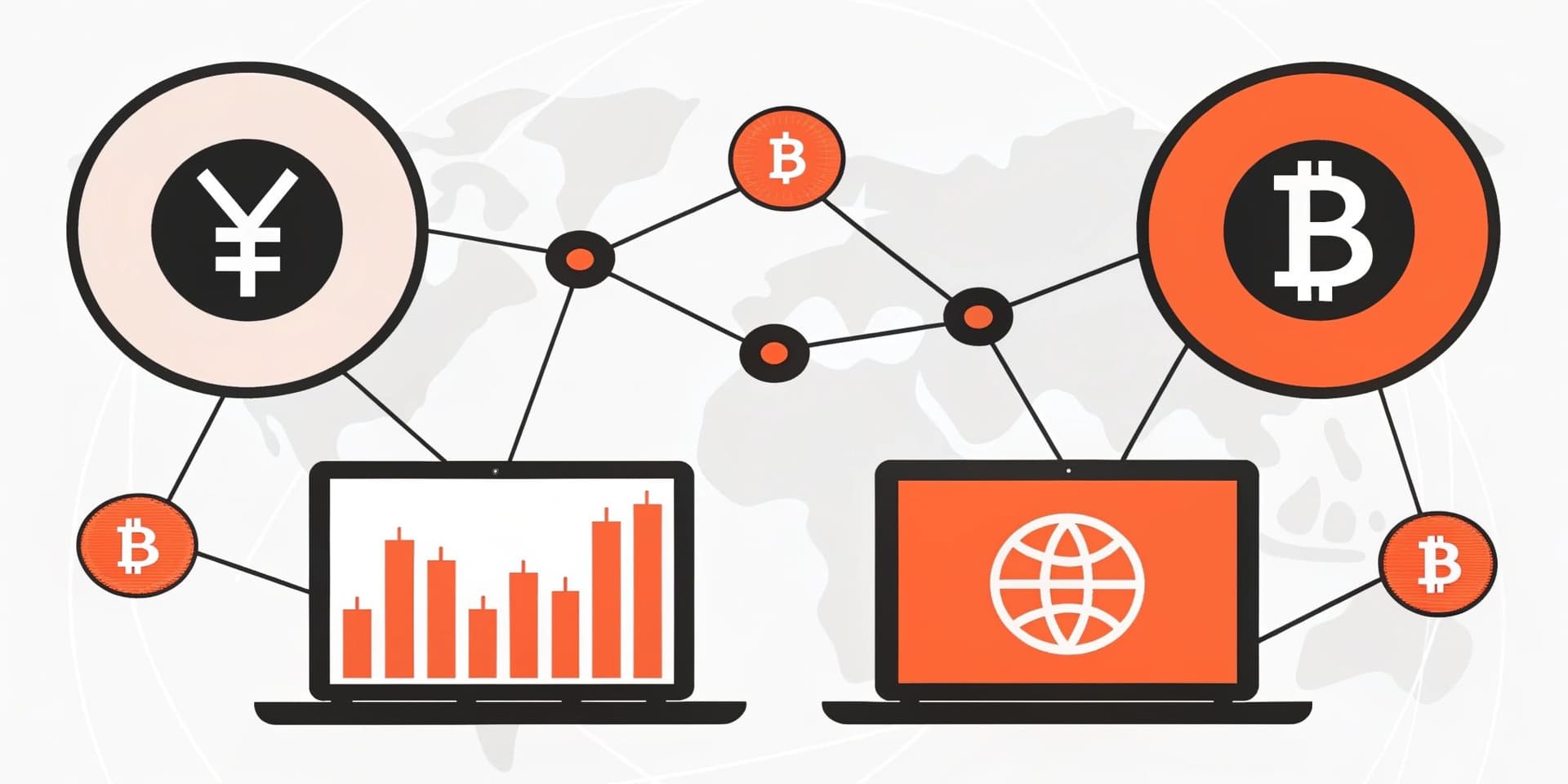
Before choosing a platform or a strategy, it helps to understand what “forex” and “crypto” mean in practice—because they differ in structure, trading hours, and how ownership works. In forex, you typically gain exposure to currency pairs through broker contracts, while in crypto you may trade tokens on exchanges or hold them directly in a wallet. Both markets involve price movements traders try to monetize, but they also differ in liquidity depth, typical volatility patterns, and how rules are enforced across jurisdictions.

What Is Forex Trading in the Global Forex Market
The global foreign exchange (forex) market spans major financial centers including London, New York, and Tokyo, enabling traders to speculate on the relative value of two currencies. Major pairs such as EUR/USD or USD/JPY are among the most actively traded, and market activity runs nearly 24 hours a day from the opening of one regional session to the next. Because daily trading turnover is extremely large—commonly cited around $7.5 trillion—liquidity in major pairs tends to be deep, which can support tighter spreads and more orderly price discovery. Rather than focusing on individual companies, forex traders commonly connect price action to macroeconomic signals and central-bank policy, including interest-rate expectations, employment data, and broader growth indicators. In many retail setups, brokers provide leverage, allowing traders to control larger positions than their account balance, which also increases the speed at which losses can accumulate if the trade goes against them.

What Is Cryptocurrency Trading
Cryptocurrency trading happens in a digital environment and is not tied to scheduled market closures. In practical terms, traders buy and sell blockchain-based assets such as Bitcoin or Ethereum, either through spot markets or via derivative products offered by certain platforms. Since many crypto venues operate continuously, price swings can occur at any hour, and large intraday moves are relatively common—especially for smaller or less liquid tokens. Some traders interact with crypto through exchanges, while others use self-custody wallets, which involve holding private keys and directly managing access to funds. That accessibility is also part of the risk profile: regulation can differ by country, and losses may occur through hacks, phishing, fraudulent projects, or sudden changes in legal treatment.
Forex vs Crypto: Key Differences to Know
Forex and crypto both involve forecasting price direction, but the underlying market design and typical drivers are different. Forex majors usually trade with institutional participation and deep liquidity, which often results in smoother price formation and fewer extreme gaps under normal conditions. Crypto assets, by contrast, can respond quickly to shifts in sentiment, technology updates, and regulatory headlines, and liquidity can vary widely from one coin to another. When building strategies, these differences show up in trading hours, leverage availability, custody or ownership mechanics, fees/spreads, and the way information translates into price.
| Category | Forex | Crypto |
|---|---|---|
| Trading hours | Nearly 24/5 across global sessions | Continuous 24/7 trading on many venues |
| Liquidity | Very deep for major currency pairs (e.g., EUR/USD) | Varies by asset; majors are more liquid than smaller tokens |
| Volatility | Often comparatively moderate; spikes around key news | Often higher; can move sharply in short periods |
| Regulation | Generally more established frameworks in many countries | Regulation differs by jurisdiction and can change quickly |
| Ownership / custody | Typically exposure via broker contracts (currencies not necessarily held directly) | May be trading while holding tokens via exchanges or self-custody wallets |
| Leverage | Common through many brokers; can accelerate gains and losses | May be offered via certain products/venues; structure can vary |
| Fees and spreads | Spreads/commissions depend on the provider and pair | Costs can include exchange fees and wider spreads depending on the token |
| Typical market participants | Central banks, banks, funds, corporations, and retail brokers/traders | Exchanges, developers, traders; some ecosystems include miners/validators |
| Common drivers | Macroeconomic data and central-bank policy expectations | Sentiment, network/technical changes, and regulatory or platform news |
Advantages and Disadvantages of Forex
Forex attracts both retail and professional traders because its market structure is relatively clear and liquidity—especially in major pairs—is typically strong. It also comes with risks that are closely tied to leverage and to how quickly news can shift expectations. The points below summarize strengths and weaknesses traders often evaluate when comparing forex with crypto.

Advantages of Forex Trading
- Near-Instant Fills and Deep Order Books — Heavy daily volume in major currency pairs can support faster execution and smoother pricing during active sessions. With deeper liquidity, trades are less likely to be disrupted by thin order books.
- Institutional-Grade Tooling and Execution — Over time, the forex ecosystem has developed mature trading platforms, execution methods, and order-routing capabilities. This can make it easier to implement systematic entries and exits across different timeframes.
- Amplified Exposure Through Leverage — When brokers allow leverage, traders may control larger nominal positions relative to their account size. However, the same mechanism increases the importance of position sizing and stop-loss discipline.
- Guardrails From Oversight — In many regions, mainstream brokers operate under recognized rules and conduct standards. While oversight does not remove risk, it can reduce some counterparty concerns compared with less-regulated areas.
Disadvantages of Forex Trading
- Leverage Cuts Both Ways — Leveraged exposure can boost returns, but unfavorable moves can also cause rapid drawdowns and margin calls. In such conditions, weak risk controls can lead to fast equity deterioration.
- Competing With Well-Resourced Players — Central banks, large institutions, and major funds can influence price through policy expectations, hedging, and large flows. During these periods, some approaches may underperform if they do not account for sudden shifts.
- Modest Day-to-Day Ranges — Under normal market conditions, many major pairs may show limited daily movement, which can cap return potential unless leverage or a high-frequency approach is used.
- Constant Attention Can Be Draining — Because trading occurs across multiple global sessions during the workweek, monitoring can encourage overtrading and reduce decision quality over time. Planning when to trade is often as important as the strategy itself.
Advantages and Disadvantages of Cryptocurrencies
Advantages of Cryptocurrencies
- Potential for Large Upside in Strong Cycles — In bullish periods, some assets can experience outsized gains. Identifying emerging narratives or major network/technology developments early can influence results, but it does not guarantee consistent performance.
- Direct Control Over Assets (Custody Choices) — With self-custody, users can keep custody of tokens through a wallet and manage private keys. This can reduce reliance on intermediaries, but it also places responsibility on the owner.
- Trading Around the Clock — Many crypto markets remain active without interruption, which allows traders to respond to developments as they occur. This also means risks can materialize outside traditional business hours.
- Rapid Innovation Pace — New blockchains and applications can appear frequently, sometimes creating tradable themes. Open-source ecosystems can evolve quickly, changing both liquidity and fundamentals.
Disadvantages of Cryptocurrencies
- Wild Swings Test Discipline — Crypto prices can move sharply within minutes and then reverse just as quickly. Effective risk management is critical when liquidity thins or sentiment shifts rapidly.
- Security Is a Personal Responsibility — Compromised wallets, lost recovery phrases, or phishing attacks can lead to permanent losses. Unlike some traditional financial systems, reversals are often not possible.
- Shifting Rules and Enforcement — Regulatory actions and policy updates may affect access to exchanges, trading venues, or token valuations. Traders often need to track local legal developments.
- Prevalence of Low-Quality Projects — The market can include scams, misleading token launches, and highly speculative projects. Due diligence is essential, though even experienced traders can be exposed.
Which is more profitable, forex or crypto?
There is no universal answer. Crypto often offers higher upside potential because certain cycles can produce large percentage moves, but that also comes with higher downside risk and larger drawdowns when sentiment turns. Forex is frequently viewed as offering more consistency in day-to-day price behavior for major pairs, yet returns are often more dependent on strategy edge and disciplined leverage usage.
- Higher upside (typically crypto) — Faster-moving narratives and frequent volatility can create opportunities, but the path is less predictable.
- More consistency (often forex) — Major currency pairs tend to be driven by macro expectations and liquidity is generally steadier, which may support smoother risk management.
Final Thoughts on the Right Market
In practice, choosing between forex and crypto is less about superiority and more about fit. Forex can suit traders who prefer structured trading windows, deep liquidity in major pairs, and macroeconomic analysis with more established oversight. Crypto can suit traders who can manage continuous market access, higher volatility, and the practical risks of custody, scams, and fast-changing rules.
Whichever market you choose, aligning your approach with your objectives and risk tolerance matters more than the label itself. Consistency comes from matching tools, position sizing, and execution rules to the environment—whether you focus on forex, crypto, or a combination of both.
Frequently Asked Questions
- Trading Both Together Can Work — Many participants diversify by allocating capital across forex and crypto. When platforms support multi-asset access, traders can follow the opportunities of the workweek in currencies and the 24/7 nature of digital assets, but managing separate news and risk drivers requires careful discipline.
- Safety Considerations: Is Forex Safer Than Crypto? — Forex is often considered safer than crypto because it operates under more established market structures and deeper liquidity in major pairs. That said, it is not “safe,” since leverage can still cause rapid losses. Crypto adds risks such as exchange failure, wallet compromise, phishing, smart-contract or platform failures, scams, and regulatory uncertainty.
- Which Is Better for Beginners, Crypto or Forex? — Forex is commonly easier to start with because majors tend to have more predictable behavior and there is extensive educational material and market transparency. For crypto, the market’s continuous nature and higher volatility can overwhelm new traders, and practical issues like custody and security add an extra layer of responsibility.
- Is Forex More Profitable Than Crypto? — Profitability depends on strategy quality, risk management, leverage use, and market conditions. During strong crypto rallies, returns can exceed what many forex strategies target, but sharp pullbacks can also erase gains quickly. Forex may produce smaller, steadier outcomes when risk controls are applied consistently.
- Similarities Exist, Yet They Operate Differently — Both markets can be accessed through online platforms for speculation on price movements, but their foundations differ. Forex is tied to fiat currency economics and central-bank policy expectations, while crypto is shaped by blockchain networks, market sentiment, and regulatory developments.