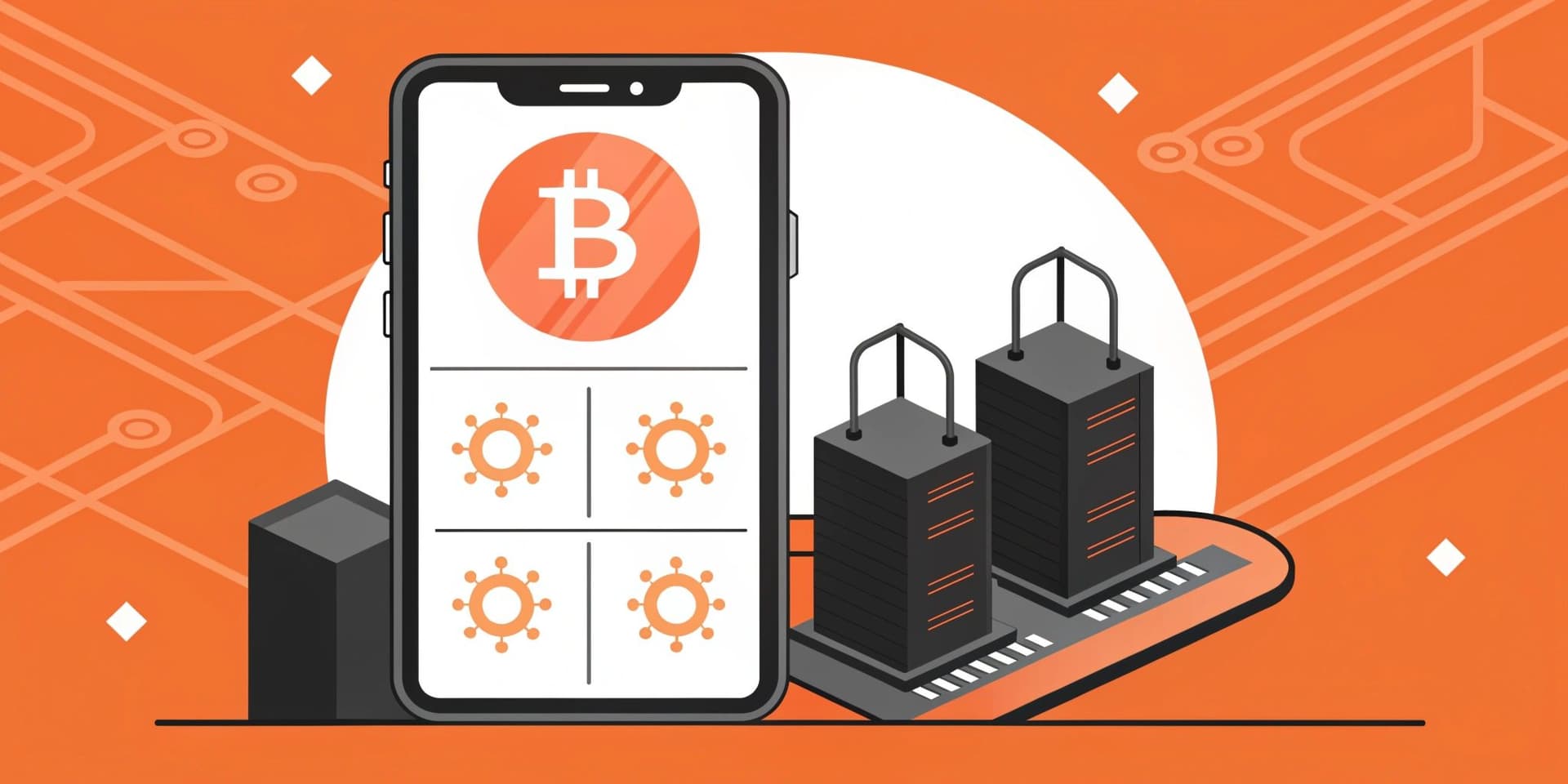
If you want the easiest crypto to mine on a phone, the honest answer is that the handset usually cannot mine Bitcoin in any meaningful way. Phones typically work better as a dashboard to monitor and manage mining activity happening elsewhere, such as in remote data centers or via cloud-managed contracts.
Mobile Crypto Mining Explained
Mobile crypto mining is often described as “mining,” but for most users it mainly involves access and control: checking performance, reviewing payouts, and managing contracts. The appeal comes from low barriers to entry and the ability to monitor from anywhere, especially when the heavy computing is handled off-device. The trade-offs are important: many options produce low net returns after fees, on-device approaches can harm battery and hardware through heat, and “free mining” apps can be packed with withdrawal limits, referral pressure, or unclear terms. App store restrictions also matter, because they limit what phones can run, particularly for any software that performs real hashing on-device.
Can a Phone Really Mine Bitcoin?
In theory, any device can attempt the computations involved in mining, but in practice a smartphone is not competitive. Bitcoin mining relies on purpose-built ASIC hardware designed to maximize hashing efficiency, while a phone’s CPU/GPU power, cooling capacity, and battery limitations make sustained hashing impractical. Trying it on-device can lead to overheating and rapid battery wear, while returns are generally negligible compared with the power and cost required.
The Three Types of Mobile Mining Apps
When people talk about mobile mining apps in 2026, they usually mean one of three categories:
- Simulated mining apps: Game-like experiences that reward taps, checking, or ad views, without performing real blockchain hashing.
- Cloud mining applications: Mobile interfaces that let you manage mining work running on external infrastructure.
- Direct device mining tools: Software that uses your phone to mine coins with low difficulty, typically yielding very small amounts.
Simulated Mining: Tap-to-Earn, Not Real Hashing
Apps marketed as “free mining” typically do not solve cryptographic puzzles. Instead, they often distribute rewards based on engagement—like tapping through sessions—or on ad-related activity. The practical outcome is usually limited to education and low-value participation, while any meaningful earnings depend entirely on how the token or reward can be used and whether the app’s terms are fair and transparent.
Cloud Mining: The Practical Route
If your goal is to earn via phone-based access in 2026, cloud mining is the approach that most closely matches how mining actually works:
- Your phone is used as a controller and monitor, reducing heat and battery strain.
- The hashing process occurs on remote hardware built for continuous computation.
- Some providers offer dashboards and scheduled payouts, but you still need to verify what fees and schedules apply.
- You may be able to adjust exposure through contracts without purchasing hardware yourself.
Know the Risks Before You Start
Before installing any mobile mining app, evaluate common failure points and safety risks:
- Scam alert: Promises of guaranteed windfalls with “no investment” are a frequent red flag.
- Thin margins: Even legitimate cloud mining can produce modest results once difficulty, coin price changes, and fees are considered.
- Store policies: iOS and Android have rules that often discourage or prohibit on-device mining.
- Safe downloads: Use reputable distribution channels to reduce malware and fraud risk.
Many “free mining” schemes rely on locked withdrawals or additional charges. Other tactics include referral-driven funnels, earnings that cannot be withdrawn to a user-controlled wallet, contract terms concealed until after payment, and requests to install files outside official app stores. As a baseline, prioritize apps that clearly disclose fees and payout calculations, allow at least small test withdrawals, and provide verifiable information about ownership and operations rather than anonymous accounts.
In 2026, mobile mining is mostly a monitoring job, not a computing job: small contracts can produce small, steady payouts, but unrealistic return promises are a reliable sign something is off.
Top Mobile Crypto Mining Apps for iPhone and Android in 2026
There is no universal “best” option for mobile mining, because outcomes depend on contracts, fees, and how a platform manages operational risk. If you use mobile interfaces to access off-site mining, you should treat each platform as a financial counterparty and review its fee structure and terms.
- Binance Pool: A pool service connected to a larger exchange ecosystem, with fees and payout flows tied to that platform’s structure.
- Ecos: A cloud-mining offering presented through a mobile interface, typically described through contract terms and reporting.
- Bitdeer: A cloud mining provider that publishes operational and plan-related information, with outcomes influenced by contract conditions.
- StormGain: An app that combines exchange access with mining-related features, with results depending on balance requirements and contract details.
- NiceHash: A marketplace model where hash power is bought or sold across algorithms, alongside mobile monitoring.
Profitability Rankings: Which Apps Pay the Most?
Trying to maximize returns requires checking the details, not the marketing: contract terms, platform or pool fees, and how payouts change with network difficulty. Some users also use trading rules alongside mining exposure, but that introduces additional market risk beyond mining itself.
For many mobile cloud mining setups, realistic net earnings are often modest unless capital is meaningful. A rough illustration is that small contracts may yield only cents to a couple of dollars per day after fees, while larger contracts can move the outcome higher. The main variables include investment size (which affects hash rate), contract length, maintenance and withdrawal fees, and whether the provider adjusts payouts as difficulty or market conditions change.
Example ranges that users often describe in practice: a small trial deposit (about $50–$200) may result in minimal “test” earnings at best; a mid-range budget (around $500–$1,500) can sometimes produce a few dollars per week to a few dollars per day when conditions are favorable; and higher allocations may scale payouts, though risk still increases with exposure to price movements, difficulty changes, and provider reliability.
- FioBit: Multi-coin allocation is presented as algorithm-assisted; you should independently verify any performance claims.
- Binance Pool: Payouts are tied to pool and platform parameters and closely follow broader Bitcoin market conditions.
- Bitdeer: Fees and distributions depend on chosen plans; review reporting and cost breakdowns.
- StormGain: Uses balance requirements and includes a minimum deposit for mining features, with results affected by its model.
- Ecos: Provides contract durations and daily payout options, typically described within its plan terms.
Cloud Mining vs. Direct Device Mining: The Hard Truth
| Aspect | Cloud Mining | Direct Device Mining |
|---|---|---|
| Phone Resource Usage | Minimal, dashboard only | Heavy processor use with severe battery drain |
| Supported Cryptocurrencies | Bitcoin, Ethereum, Solana, and more | Commonly Monero or Dogecoin |
| App Store Availability | Generally allowed | Widely prohibited in 2026 |
| Profit Potential | Contract-based and scalable | Almost zero for Bitcoin |
| Setup Complexity | Buy a contract and monitor | Technical setup with notable security risks |
For Android users evaluating phone-based mining, cloud solutions are typically the practical option because on-device approaches are limited by hardware constraints and often by platform policies.
Free Mining Apps That Aren’t Scams
If you want to start without committing significant funds, the realistic expectation is modest rewards, typically through engagement mechanics or cloud-backed micro-contracts. A few examples sometimes described this way include:
- Hexminer: Presented as automated cloud payouts without maintenance fees, with earnings typically expected to be small.
- CryptoTab Browser: A browser-based reward model that attributes value to browsing/referrals rather than device hashing.
- Pi Network: A check-in-driven simulation model with speculative value and limited tradability at the time of writing.
A safe default is to treat “free mining” like any other high-risk app category: if withdrawals require extra payments, permissions feel excessive, or the company cannot explain payouts clearly, walk away.
When you decide to allocate capital for higher exposure, it generally means moving to a paid contract on a platform with transparent terms and verifiable operational details.
Multi-Coin Support: Diversify Your Mining
Some services advertise multi-asset support to redirect mining output toward coins that are more favorable at a given time. In practice, you still have to examine how switching works and how fees affect net results. Some providers also offer strategies intended to respond to changing market or difficulty conditions.
- FioBit: Uses algorithmic allocation to split exposure across multiple coins for targeted daily outcomes.
- Bay Miner: Auto-switches among several networks based on profitability analysis, as described by the service.
- Cudo Miner: Markets controls and coin-switching features with an interface designed for mobile monitoring.
- Bitdeer: Provides contract options across several cryptocurrencies, with fee terms that vary by plan.
- NiceHash: Supports renting or selling hashing power across different algorithms, depending on demand.
In principle, multi-coin support can help a phone user follow market shifts without manually changing every contract, but the real impact depends on implementation, timing, and platform fees.
Cloud Mining vs. Traditional Rigs: Pros and Cons
Choosing between remote cloud operations and running your own hardware is mainly a trade-off between upfront cost, ongoing responsibilities, and risk distribution.
| Aspect | Cloud Mining | Traditional Rigs |
|---|---|---|
| Initial Investment | Contract fees only, no hardware purchases | Significant outlay for specialized miners plus setup |
| Ongoing Maintenance | Provider handles operations | You manage power, cooling, repairs, and upgrades |
| User Experience | Simple mobile experience for beginners | Requires technical expertise and space |
| Scaling Up | Add contracts with a few taps | Buy, configure, and house more equipment |
| Earnings Potential | Moderate, reduced by platform fees | Higher when electricity is cheap and setup is optimized |
| Risk Factors | Provider default or shifting terms | Hardware failures, rising power costs, noise, and heat |
For many phone users, cloud mining is an accessible entry point because it avoids the practical complexities of owning and operating hardware.
NiceHash vs. StormGain vs. Binance Pool: Head-to-Head
| Feature | NiceHash | StormGain | Binance Pool |
|---|---|---|---|
| Payment Structure | Marketplace with variable rates | Daily payouts after a $50 minimum | Low fees and direct exchange integration |
| Security Features | Regular audits and two-factor authentication support | Standard exchange-grade protections | Industry-leading security infrastructure |
| Mobile Experience | Detailed controls for power users | Simplified interface for beginners | Comprehensive dashboard plus exchange access |
| Additional Features | Flexible hash power marketplace | Built-in trading platform | Access to the broader Binance ecosystem |
These platforms can be used alongside disciplined risk management, but mining returns still depend on contract terms and market conditions.
Risks of Mobile Mining and How to Stay Safe
As you explore phone-based mining or passive-earn apps, keep these risks in view:
- Device damage: On-device mining can overheat hardware, degrade batteries, and shorten lifespan.
- Fraudulent operations: Check company history, look for independent feedback, and test withdrawals with small amounts before scaling.
- Diminishing returns: Difficulty and price changes can quickly alter profitability.
- App store removals: Policy changes may delist apps without notice.
- Suspicious activity: If you see red flags or malicious behavior, document it and report through the appropriate channel.
App Store Policies for Mining Apps in 2026
Major app stores enforce rules for iOS and Android mining-related software. In 2026, apps that perform direct mining on the device are generally restricted or prohibited, while remote dashboards and wallet-related tools may be permitted under certain conditions.
Apple’s rules commonly reject apps that excessively strain devices or create undue resource usage, which aligns with the behavior of on-device miners. Google’s policies similarly limit on-device mining while allowing management interfaces for remote operations.
Passive Earning: Browser Mining vs. Cloud Contracts
| Method | Expected Earnings | User Involvement | Payment Reliability |
|---|---|---|---|
| CryptoTab Browser | Very small BTC amounts | Browse and refer | Consistent micro-payouts |
| Pi Network | Unknown future value | Daily check-ins and network growth | No current exchange value |
| Cloud Mining Contracts | Scales with investment | Initial setup plus occasional monitoring | Structured payouts in established cryptocurrencies |
If you are aiming for meaningful passive returns, many users combine paid cloud contracts with limited use of engagement-based apps to manage effort versus potential upside.
Getting Started With Mobile Cloud Mining
If you plan to manage mining activity via your iPhone or Android through remote contracts, focus on these steps:
- Review providers carefully, including published terms, history, and how payouts are calculated.
- Begin with a small allocation to validate reliability, onboarding, and payout timing.
- Read all fees up front, including maintenance, withdrawal, and any additional charges mentioned in the contract.
- Use strong account security, including unique passwords and two-factor authentication.
- Track performance against expectations and contract conditions, and stop if terms appear inconsistent.
Treat cloud mining as a financial relationship: emphasize transparency, security practices, and realistic expectations for net profit after fees.
Alternative Mining Coins for Mobile Users
Bitcoin may be the most discussed, but some providers also support other networks and coin exposure through cloud-based arrangements in 2026:
- Ethereum: Although Ethereum uses proof-of-stake, some providers may still market ETH exposure through arrangements they define in their terms.
- Litecoin: Often discussed as a Bitcoin alternative, with mining characteristics distinct from Bitcoin.
- Dogecoin: A widely recognized coin with ongoing interest and mining-related activity.
- Solana: A high-throughput network; opportunities offered via “mining-style” services depend on how a provider structures plans.
- Monero: A privacy-focused cryptocurrency that some cloud services still market through specialized operations.
If your real goal is home mining with your own equipment (not rented hash power), feasibility depends on the hardware you have and the coin you choose. Monero is often considered one of the more practical options for general-purpose computers, while Litecoin and Dogecoin are frequently mined at home with dedicated setups rather than via a phone. Mining directly on a phone at home is generally constrained by thermal limits and battery impact, making it a poor trade-off for most users.
Diversifying across multiple cryptocurrencies can spread risk and align exposure with changing market cycles, but it does not remove provider or market risk.
Wrapping Up: The Reality of Mobile Crypto Mining in 2026
Direct Bitcoin mining on a phone is still not realistic for most users. A more practical approach is using your phone to monitor and manage off-device mining activity through professional infrastructure.
When evaluating a mobile mining app, prioritize cloud-first options and review contracts, fees, and reputation carefully. With due diligence and strong security, you can use a phone to manage exposure, even though mining is only one part of a broader risk-managed strategy that may also include trading, staking, and other yield methods.