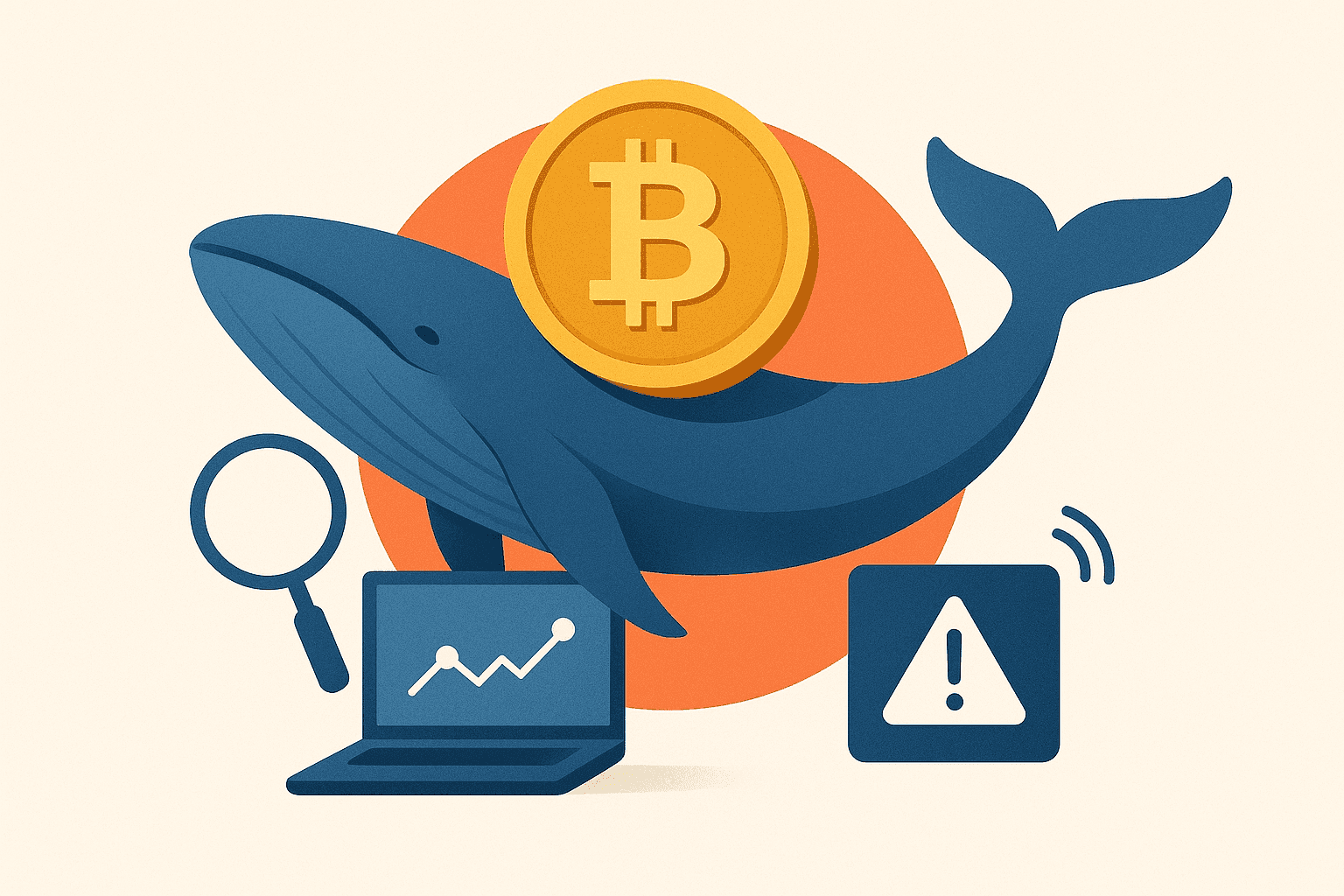
A crypto “whale” is any individual, fund, company, or state holding a large enough position to affect market prices—especially when liquidity is thin. The label is often borrowed from gambling culture, where “whales” are high-rollers placing large bets. In practice, the size that qualifies as a whale is context-dependent: for Bitcoin, whale ranges are commonly discussed around 500–1,000+ BTC, while Ethereum is often framed around 10,000–50,000+ ETH. For major large-cap altcoins, the relevant factor is less about an absolute number and more about whether holdings can meaningfully influence day-to-day liquidity. “Whale activity” is also broader than a single transfer. It may include multi-address accumulation or distribution patterns, repeated exchange inflows/outflows, spot execution that moves order books, DeFi liquidity shifts, and hedging signals visible in derivatives positioning.
Whales can transact through centralized or decentralized venues, where deep liquidity reduces slippage. Still, the market impact of a large wallet is not just the raw transfer size—it is also the timing, venue, and how quickly the market absorbs the inventory being moved.
For example, transfers by U.S. authorities from seized-asset wallets toward exchanges in 2023–2024 contributed to price volatility; during that period, Bitcoin experienced declines on the order of a few percent as markets debated potential selling pressure and the possibility of front-running.
What Does Whale Activity Mean?
Whale behavior can reflect routine custody and reorganization, or it can signal clearer buy/sell intent.
Crypto Whale Wallet-to-Wallet Transfers
Large wallet-to-wallet moves are often “housekeeping.” Funds may be redistributed across addresses for security, operational structure, or risk management. Because a large actor can control many addresses, many transfers that look unusual in isolation have limited market impact.
That said, address-to-address movements can also correspond to private arrangements, treasury rebalancing, custody vault changes, or investment rounds. At the very largest scales (for instance, tens of thousands of BTC), activity is commonly associated with institutions, miners, early adopters, or authorities managing seized coins.
Accumulation (Buy Signal)
Large holders typically need exchange order depth—or efficient execution routes elsewhere—to transact at scale.
When assets move out of exchanges, it is often consistent with longer-term positioning. If multiple large addresses show sustained outflows rather than one-off movements, it can indicate conviction and can reduce immediate circulating supply available for trading.
Distribution (Sell Signal)
When funds flow back to exchanges, owners may be preparing to sell or to access liquidity quickly.
On exchanges, capital can be swapped into stablecoins, converted to fiat, or routed through OTC processes without continuously visible open-book selling. Persistent inflows from large wallets across multiple days can therefore reflect deliberate preparation rather than an immediate panic liquidation.
In some cases, market tops coincide with more controlled distribution, where price action continues to look orderly while large holders reduce exposure.
Why Tracking Whale Activity in Crypto Matters?
You may have seen a high-urgency post: an “ominous alert” about a large whale transfer. The immediate question many traders ask is practical—what does this mean for my position and timing?
For context, during the 2025 holiday period, large BTC movements attracted attention partly because holiday liquidity can be thinner. In low-liquidity conditions, repositioning by large holders can have an outsized effect relative to the same action executed during busier market hours.
The useful distinction is between reacting to an alert and interpreting what the flow most likely implies. Monitoring whale-linked activity can help identify whether supply appears to be tightening, whether distribution is forming, and which assets are being rotated into or out of ahead of broader narratives.
In practice, consistent observation can improve your ability to connect on-chain behavior to liquidity and positioning—especially when you combine whale signals with other market indicators.
To observe whale-related moves effectively, it helps to use multiple tools rather than relying on a single data feed.
Top Tools to Track Crypto Whale Activity
No single tracker is perfect. The most practical approach is to understand what each tool does well and how the outputs complement each other.
| Tool Name | Key Features | Supported Chains | Alert Options | Unique Selling Point |
|---|---|---|---|---|
| Whale Alert | Real-time large-transfer monitoring; labeled entity tags; configurable thresholds | Bitcoin, Ethereum, Ripple, and other major networks | Social feeds; mobile notifications; chat integrations; API | Fast, simple “what moved and where” radar |
| Arkham Intelligence | Entity-level wallet identification; flow visualizations; tracing across time and chains | Bitcoin, Ethereum, Solana, Avalanche, Tron, and more | Wallet/entity notifications | Deep labeling and deanonymization of onchain activity |
| Nansen | Smart-money classification; portfolio tracking; performance analytics | Dozens of networks, including Ethereum, Solana, Arbitrum, and Polygon | Custom alerts; signals for unusual activity | Tracks profitable wallets and sector rotation behavior |
| Glassnode | Cohort metrics; exchange balance trends; cycle indicators | Bitcoin, Ethereum, and expanding multi-chain support | Dashboards; threshold alerts | Institutional-grade cycle and cohort analytics |
| Dune Analytics | Community-built dashboards; custom queries; interactive visualizations | 100+ networks | Embeds; API; dashboard-driven monitoring | Build-your-own analytics from public onchain datasets |
Many people start with a combination of public or lower-cost resources: a feed for raw large transfers, a public analytics workspace for exchange and token-level context, and any additional free metrics available without subscription. The main trade-offs usually involve reduced historical lookback, fewer advanced labels, fewer high-frequency alerts, or less cohort-level depth compared with paid tiers.
Whale Alert: Real-Time Transfer Alerts
Whale Alert is a real-time transaction monitor that focuses on large-value transfers across major networks such as Bitcoin, Ethereum, and Ripple.
It functions like a high-speed early-warning system, notifying you when sizeable amounts move between wallets and exchanges and sometimes tagging known addresses.
Its strength is speed and straightforward interpretation: you can quickly decide which transfers deserve deeper investigation.
Top Features:
- Real-time tracking across 10+ major blockchains.
- Labeled addresses for exchanges, custodians, and recognized entities.
- Multi-channel alerts via social feeds, mobile apps, or chat platforms.
- Custom thresholds to filter by transaction size.
- Public API access for bots and integrations.
Arkham Intelligence: Entity-Level Wallet Identification
Arkham Intelligence focuses on mapping activity to entity-level profiles, using labeling to convert raw transfers into more interpretable ownership and behavior.
Its Ultra system links large numbers of labels across many entity pages, connecting addresses to exchanges, custody services, traders, and other notable categories.
This can change the meaning of an alert from “funds moved from an unknown wallet” to a more specific description based on mapped labels.
The platform also provides dashboards, flow visualization, and tools to follow funds over time and across chains, along with wallet-level alerting.
In 2026, it continues to broaden classification and labeling coverage as new public data and heuristics become available, which can improve how often on-chain events are correctly attributed.
Top Features:
- Ultra labeling engine for extensive entity identification.
- Multi-chain monitoring across BTC, ETH, Solana, Avalanche, Tron, and more.
- Tracer for chronological fund flows across chains.
- Entity pages with holdings, history, and balance changes.
- Custom alerts for wallet or entity activity.
- Key opinion leader tracking for prominent crypto figures (where labeling is available).
Nansen: Smart-Money Wallet Analytics
Nansen is an onchain analytics platform built to track “smart money”—wallets that show verifiable realized performance over time.
Rather than only watching raw addresses, it groups entities by behavior and tracks their portfolio changes, win-rate metrics, and realized profit and loss based on available on-chain data.
You can follow clusters of outperforming entities to see which assets they accumulate, which DeFi protocols they interact with, and when they rotate across sectors.
Top Features:
- Smart Money tracking across hundreds of millions of labeled wallets with performance stats.
- Coverage across 30+ chains, including ETH, Solana, Arbitrum, and Polygon.
- Custom alerts and signals for unusual onchain activity.
- Token-focused analytics and holder distribution views.
- NFT and DeFi dashboards for collections, liquidity, and protocol flows.
- Exchange Flow insights showing capital entering or leaving centralized exchanges.
Glassnode: Cycle and Cohort Analytics
Glassnode provides cycle analytics with an emphasis on Bitcoin and Ethereum, while expanding multi-chain coverage. It aggregates cohorts such as long-term holders, short-term traders, exchange balances, and miners to evaluate accumulation versus distribution.
Top Features:
- 3,500+ onchain metrics, including indicators such as spent output profit ratio, market value to realized value, and network value to transactions.
- Cohort analysis by holder age, wallet size, and behavior.
- Exchange flow analytics for net inflows, outflows, and balance trends.
- Higher-frequency updates, with some datasets refreshed as often as every 10 minutes.
- Custom dashboards and alerts for targeted thresholds.
- Weekly research from onchain analysts.
Dune Analytics: Custom Onchain Dashboards
Dune Analytics is a community platform for querying and visualizing onchain data using a query language across 100+ networks. Instead of relying only on prebuilt metrics, it supports user-created dashboards from public datasets.
Over one hundred thousand public dashboards cover topics such as whale tracking, DEX volumes, NFTs, and protocol health. You can fork existing work or adapt queries for narrower research goals.
Top Features:
- Support for 100+ chains via a unified query interface.
- Custom queries without managing blockchain APIs directly.
- Interactive visualizations through charts and dashboards.
- Collaboration tools and API access for embedding and automated alerts.
How to Track Crypto Whales?
There is no single correct approach. Decide whether you want to react to events in real time or detect positioning changes earlier using broader context.
Even across different methods, a key interpretive pattern often applies: exchange outflows to wallets can align with buying or holding, while exchange inflows can align with preparation to sell. The important caveat is that these flows can also be operational, so confirmation matters.
If your goal is to identify whale-related wallets rather than only whale-sized transactions, start from labels and clusters. Use tools like Arkham Intelligence or Nansen to pull up labeled entities (exchanges, funds, market makers), then look for large withdrawal destinations that repeatedly receive funds and do not immediately recycle them back to deposit addresses. Because platforms use labeling and clustering heuristics—such as repeated interaction patterns, shared funding sources, and linked flow behavior—you can build a watchlist around entities instead of isolated addresses.
To infer what large holders may be buying, focus on net accumulation across the relevant entities, not a single headline transfer. Large-wallet clusters often rotate in phases, with activity sometimes starting in Bitcoin and Ethereum, then extending into other liquid large caps, and later moving toward higher-beta assets or major DeFi tokens depending on risk appetite. Stablecoins can also be used as temporary parking when participants de-risk.
Use entity-level portfolio views and balance trends to validate the “being bought” side—for example, by checking whether exchange balances decline for a given asset while large holders’ balances increase over the same window.
Here are three monitoring playbooks you can adapt.
Method 1: Use Whale Alert Notifications
Capture breaking moves and the immediate market context around them with a straightforward workflow:
- Start with Whale Alert notifications for large transactions.
- When an alert fires, pivot to Arkham or another labeling tool to identify the relevant wallet or entity.
- Check Glassnode for exchange balance and cohort context; rising exchange balances can correspond to changing sell pressure.
- Cross-check with Nansen to see whether other labeled “smart money” entities appear to be acting similarly.
Formula: Alert fires → identify entity → confirm trend → decide how to respond.
Weakness: Verification can take time, and price may move before you finish a full assessment.
Method 2: Follow a Few Proven Traders
Focus on a limited set of consistently active, high-conviction wallets to detect changes earlier:
- Identify high-conviction entities in Nansen or Arkham (for example, funds or long-term large operators).
- Set targeted alerts for those entities specifically.
- When these entities accumulate, you may receive signals before broader social attention.
- Use Dune to validate whether their behavior is repeatable (such as regular dip buys) rather than one-off timing.
Formula: Identify winners → monitor wallets → respond when behavior changes → ignore unrelated noise.
Weakness: Past performance does not guarantee future outcomes, and even sophisticated players may be providing exit liquidity for larger participants.
Method 3: Filter for Insider Information
Instead of reacting to every transaction, anchor interpretation in broader market structure:
- Use Glassnode to position the market within a cycle regime such as accumulation, distribution, or capitulation.
- Filter Whale Alert events through that lens; for example, routine selling during accumulation may be less informative than unusual activity during distribution.
- Use Arkham or Nansen to investigate anomalies only when on-chain behavior appears to contradict the macro context.
Formula: Know the cycle → filter noise → investigate outliers → act on confirmed divergence.
Weakness: Macro regime shifts can be slow, so rapid reversals driven by a small number of large actors may be missed by cycle-based frameworks.
How to Interpret Whale Activity: Crypto Transactions That Matter Most?
Suppose an alert highlights a major flow—for example:
In late November and early December 2025, crypto Twitter pointed to about $7.5 billion in whale inflows to Binance over 30 days, described as the highest since March, when Bitcoin declined roughly 30%.
Many retail traders reacted by selling. A more analytical approach would test what the flow implies in combination with broader positioning and exchange balance context.
Reactive Tracking: How to Read This Signal?
Step 1: Do Not Panic at Headlines
When exchange inflow statistics look alarming, avoid immediate reflex trades. Check Glassnode or Santiment and compare how whale wallet balances and accumulation metrics are moving.
Source: Glassnode Studio
In this example, exchange inflows increased, but Glassnode’s Accumulation Trend Score was reported at 0.99 out of 1.0—one of the highest readings since 2024. That profile is more consistent with aggressive buying than broad distribution, and clustering near about $92,132 was interpreted as smart money adding after a pullback from around $108K.
You can also corroborate the direction using dashboards that summarize accumulation patterns rather than focusing only on the flow label.
Source: Perplexity Finance
Takeaway: exchange inflows alone do not always imply sell pressure. The flow can reflect repositioning rather than liquidation.
Step 2: Compare Exchange Inflows to History
Once you confirm whales appear to be building positions, consider why the inflow to exchanges happened.
Source: Perplexity Finance
Two similar inflow periods can point to different outcomes:
- March 2025: inflows preceded a decline from roughly $102,000 to $70,000 (about 30%).
- November–December 2025: inflows coincided with stabilization near about $89,000–$94,000.
Same nominal size can still produce different intent and different market structure effects.
March activity may reflect exit behavior. December activity could align with OTC settlement, treasury rebalancing, or temporary liquidity placement rather than a public “panic sell.”
Step 3: Validate With Market Cycle Position
Final check: identify where the market sat within the cycle.
- Bitcoin was down roughly 15% from a December 2024 peak near $108,000.
- The Fear & Greed Index was in extreme fear (11–30 out of 100).
- Mid-tier whale cohorts (100–1,000 BTC) reportedly increased holdings by about 0.47% over two weeks, with new whale entities appearing.
- Retail wallets below 0.1 BTC were capitulating, based on the cited framing.
Final result: whales buying during retail selling can align with a contrarian signal—but it is not guaranteed.
Can whale orders predict price? Sometimes, but the more defensible claim is probabilistic: market-moving size interacts with liquidity and execution conditions. Large spot orders—or large flows into venues where selling can happen quickly—can precede volatility because they change how much inventory the market must absorb. However, whale-sized activity is not a reliable standalone directional predictor. A visible buy wall can be removed, sell pressure can be offset through hedging, and “big” flows may be operational (custody transfers, settlement, internal exchange reshuffles) rather than a deliberate trade. Treat whale-sized orders and transfers as a shift in probability, then verify with follow-through in price response, liquidity conditions, and whether the entity’s balances actually change after the move.
Whale alerts are observations; the edge comes from testing what the flow implies before treating it as a trade.
Best Practice Checklist: What to Know When Tracking Crypto Whales
- Seek confirmation from more than one large-holder cluster before treating a move as meaningful.
- Interpret large sell behavior differently depending on whether the broader market is risk-off or risk-on.
- When on-chain balance changes conflict with social narratives, give more weight to the balance data.
- Track net positioning changes rather than isolated transfers that may be operational noise.
- Use social media for context about crowding and sentiment, not as a primary timing signal.
What Are the Risks and Limitations of Whale Tracking?
Whale tracking is not foolproof.
Large actors can also create misleading impressions—for example, through spoof-like behavior where large orders are posted to provoke reactions and then withdrawn. Another limitation is timing: by the time a transaction is visible and interpreted, the market may have already adjusted.
Following whales blindly is risky because different participants have different strategies, time horizons, and risk tolerance. Even when on-chain data is accurate, some large transfers may represent exchanges or fund movements, and misinterpretation can lead to poor decisions.
There are also visibility and privacy constraints. Large actors may route activity through custodians, split flows across many addresses, or use privacy-focused methods to obscure origin and destination. In addition, labeling and deanonymization are not always complete; labels can be incomplete or outdated, and tagging errors can occur.
Finally, whale-based approaches tend to perform better when markets trend and positioning changes are clearer. In choppy ranges, even large holders may struggle to establish a consistent direction. Treat whale data as one input among many, not a complete trading system.
Conclusion
Tracking whales can help you see where capital is moving before retail attention fully catches up. By the time alerts become mainstream on social feeds, the move may already be underway. Used carefully, whale data can sharpen your view of liquidity, positioning, and rotation when combined with additional signals.
Large participants—including corporate treasuries, stablecoin issuers, governments, and major funds—may move assets in ways that are not captured by simple “exchange sell/buy” interpretations alone. The operational details matter.
When assets are held on exchanges, you do not control the corresponding private keys. Risks such as hacks, freezes, insider abuse, or insolvency can affect access and outcomes regardless of how correct your on-chain read seemed at the time.
If you want to reduce counterparty risk, consider self-custody. Keeping private keys offline and managing custody yourself can help avoid sudden platform restrictions and keep assets under your control.
Frequently Asked Questions
1) How Much BTC Makes You a Whale?
A: There is no single hard line, but roughly 500–1,000+ BTC is commonly used as a whale benchmark. The practical threshold depends on liquidity, market cap, and how concentrated supply is.
2) When Are Crypto Whales More Active?
A: Activity can be uneven. Weekends and late hours may show less reliable patterns because of thinner liquidity and bot-driven noise. Attention often increases around the start of the work week when institutional flows resume.
The London–New York overlap (13:00–16:00 Coordinated Universal Time) is typically a period of higher market participation, with banks, OTC desks, and market makers active. Major macro events—such as inflation releases or central bank communications—can also increase the likelihood of size being executed in covered conditions.
3) What Is the Best Whale Tracking App?
A: There is no universally best tool. Combining tools—such as a transfer feed for event detection and an analytics platform for context—can help you build a workflow aligned with your goals.
4) How Much Crypto Do Whales Own?
Whale status varies by token due to differences in market cap, liquidity, and holder concentration.
Also, thresholds are situational. In thinner markets, far smaller BTC balances may have whale-like influence depending on the asset and execution environment.