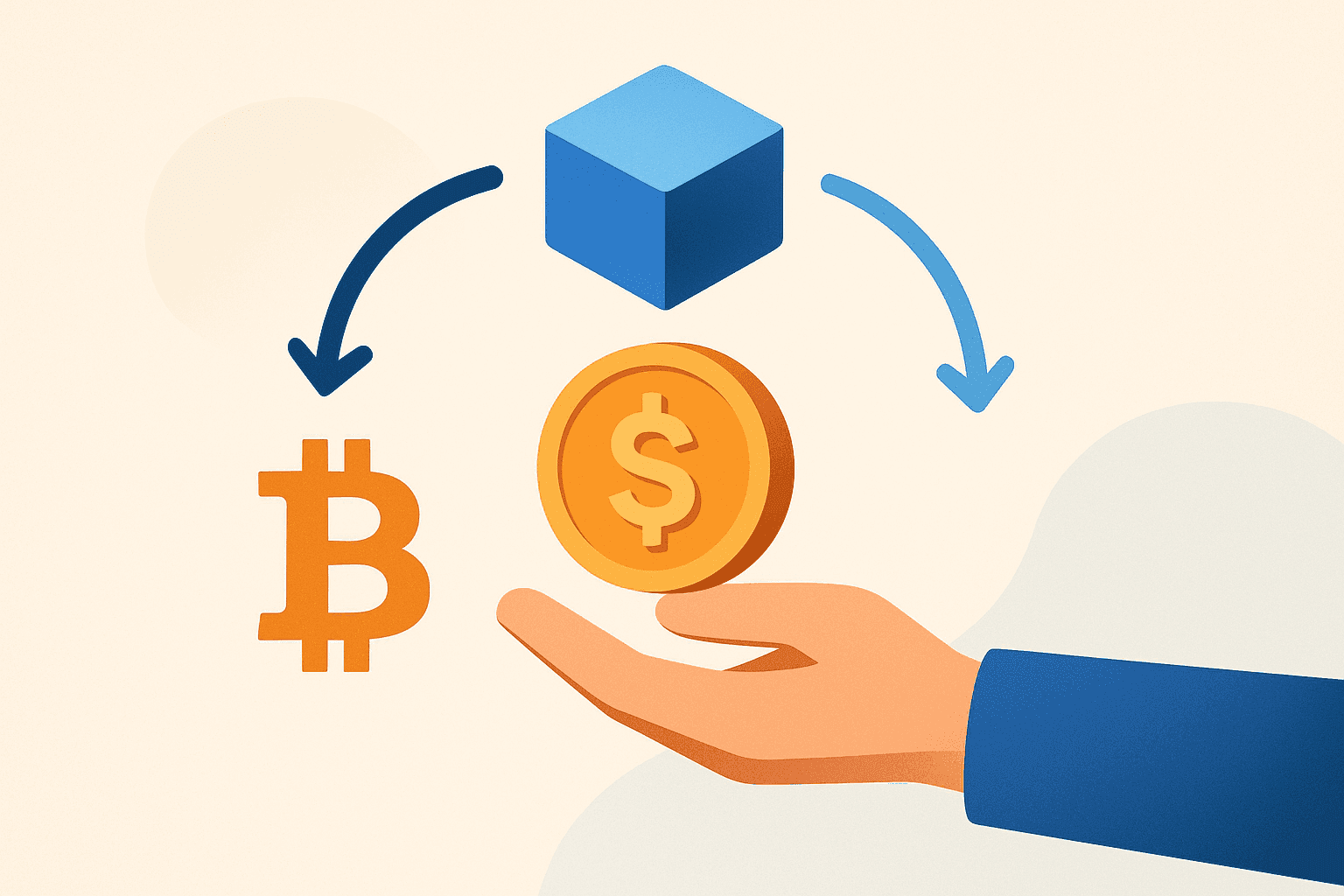
Decentralized finance (DeFi) delivers blockchain-native financial services without intermediaries, making crypto trading simpler through liquidity pool-based swaps for a growing global audience. Between 2017 and 2023, average annual DeFi user accounts expanded from just 189 to over 6.6 million, and on-chain DeFi trading activity surpassed $1 trillion in 2021.
Analyses show decentralized exchanges such as Uniswap at times exceed the trading volume of established centralized exchanges like Coinbase. A major driver of this shift is the automated market maker framework, which powers many leading decentralized exchanges and enables streamlined peer-to-peer trading.
Because liquidity pool-based exchanges are so prevalent, learning their fundamentals before swapping crypto assets helps you weigh both advantages and possible downsides of this model.
Crypto Market Making: How It Works
Automated market makers reimagine the long-standing practice of market making. Understanding how market making operates on centralized exchanges, and contrasting it with decentralized trading, clarifies the role automated market makers play. In practice, they simplify trading by removing the need for order books and counterparties: instead of waiting for a matching buyer or seller, traders can typically swap instantly against a smart contract-managed pool with permissionless access from a self-custodial wallet.
| Exchange Type | Liquidity Mechanism | Order Matching | Who Provides Liquidity | Fee Structure |
|---|---|---|---|---|
| Centralized exchange | Central limit order book | Matching engine pairs bids and asks | Professional market makers and other traders | Bid-ask spread (for example, BTC bid $24,997 vs. ask $25,000 = $3) plus exchange fees |
| Decentralized liquidity pool exchange | Smart contract liquidity pools | Swap executes against the pool’s pricing formula | Liquidity providers depositing assets into pools | Protocol trading fee plus price impact from pool rebalancing |
Automated Market Makers: What They Are
Automated market makers are algorithmic protocols that remove intermediaries from the market-making process. Instead of an order book, decentralized exchanges rely on smart contracts to execute peer-to-peer swaps. For instance, a contract can be coded to send five Ethereum (ETH) to a wallet after a trader deposits 10,000 units of a dollar-pegged stablecoin, automatically validating the transfer on-chain. These mechanisms run on blockchains that support smart contracts, including Ethereum, Cardano, and Solana.
Automated market makers come in multiple designs. Constant product models maintain a reserve balance with a formula like x × y = k; constant sum models keep a simple additive balance and tend to work best for assets that stay near the same price; stableswap or hybrid approaches aim to reduce price impact for tightly pegged assets; and weighted or dynamic pool designs allow multi-asset pools and custom allocations that can change how prices move as trades flow through the pool.
Automated market makers matter because they turn liquidity into a public utility: anyone can trade or provide liquidity without needing approvals, accounts, or a matching counterparty.
When traders ask which automated market maker ecosystems are “best” or most popular to trade, they often gravitate to the largest and most battle-tested platforms and their associated tokens. Uniswap is widely used for its deep liquidity on Ethereum and broad token coverage; Curve Finance is known for stablecoin-focused pools and efficient pricing for correlated assets; PancakeSwap is popular for its integration with BNB Chain and a low-fee retail user base; Balancer differentiates with multi-asset, weighted pools; and SushiSwap is known for its multichain footprint and community-driven feature set.
Automated market makers also do not natively support fiat-to-crypto trading in the same way a bank-connected venue does, because smart contracts settle on-chain with crypto assets. A common workaround is to use a fiat on-ramp (often integrated into wallets or third-party services) to purchase a base crypto asset first, then swap into the desired token through a decentralized exchange.
Security and trust in automated market makers are established through a mix of code transparency and operational safeguards. Well-known protocols often rely on smart contract audits, bug bounty programs, open-source code that can be inspected, timelocks or multisignature controls for upgrades, and (in some ecosystems) optional insurance-style coverage or risk backstops that can help users manage smart contract and exploit risk.
Looking ahead, automated market makers continue to evolve through innovations like concentrated liquidity, hybrid designs that blend order book-style execution with pool liquidity, and cross-chain approaches that aim to route swaps across multiple networks more efficiently. If these designs continue to mature, they can improve pricing, reduce capital inefficiency, and expand the kinds of assets and strategies that can be traded in DeFi.
Liquidity Providers: Who They Are
While smart contracts automate settlement, they do not create capital. Liquidity pool exchanges encourage participants to provide liquidity so trades can occur. Rather than limiting this role to institutions, any trader can become a liquidity provider by depositing crypto assets into liquidity pools. In return for liquidity provision, liquidity providers typically earn a share of trading fees or token incentives.
How an Automated Market Maker Works: The Constant Product Model
Different automated market maker designs exist, but a widely used approach is the constant product market maker introduced by Uniswap. It maintains pool balance with the formula x × y = k, where x and y are the reserves of the two assets in a trading pair and k is a constant. Liquidity providers generally contribute assets in a 50/50 ratio by value to keep the pool balanced.
Consider ETH priced at $2,000. A liquidity provider adding funds to an ETH/stablecoin pool could deposit two ETH and 4,000 units of a dollar-pegged stablecoin, a combined $8,000, to match the 1:1 dollar value on both sides of the pair.
Now assume the ETH/stablecoin pool holds 50 ETH and 100,000 units of a dollar-pegged stablecoin. Here, k equals 5,000,000 (50 × 100,000). If a trader buys 1 ETH by adding 2,000 units of a dollar-pegged stablecoin, the new pool state is determined by solving for x in the constant product formula:
- (50 − 1) × (100,000 + x) = 5,000,000.
- 49 × (100,000 + x) = 5,000,000.
- 100,000 + x = 5,000,000 ÷ 49.
- 100,000 + x ≈ 102,040.816.
- x ≈ 102,040.816 − 100,000.
- x ≈ 2,040.816.
This outcome shows the purchase removes one ETH and pushes the market price from $2,000 to about $2,040.816 per ETH. The stablecoin side increases to roughly 102,040.816. Multiplying 49 by 102,040.816 returns the constant 5,000,000, confirming the formula. As traders buy and sell, the automated market maker continuously updates pool ratios and market prices using this mathematical mechanism.
Benefits of the Automated Market Maker Model
Automated market makers empower self-custody and open new ways for participants to earn by supporting liquidity pools.
- Traders retain full control of their crypto assets. Swaps settle via algorithms and smart contracts directly from self-custodial wallets, minimizing counterparty exposure.
- Token launches are accessible for new blockchain teams. Projects can list pairs on a decentralized exchange without relying on centralized exchange approval or venture funding, enabling experimentation and community-driven distribution.
- Anyone can act as a market maker and earn trading fees. By depositing assets into liquidity pools, participants may earn a portion of trading fees, provided they accept DeFi risks such as exploits and lack of insurance.
Risks With First-Generation Automated Market Makers
Despite their prominence across platforms like Uniswap, Curve Finance, and PancakeSwap, early automated market maker designs come with trade-offs and potential inefficiencies.
- Heavy reliance on arbitrage. When pool prices drift from broader market rates, arbitrageurs buy and sell across venues to realign values. Because these decentralized exchanges lack traditional order books, they depend on external traders to correct these gaps.
- Challenges with large orders and price targeting. Without native limit orders, sizable trades can move the pool significantly, creating slippage, the gap between the expected price and the executed price as the pool ratio shifts during the swap.
- Impermanent loss for liquidity providers. As the relative price of the two pooled assets changes, the pool’s automatic rebalancing can leave the liquidity provider holding more of the underperforming asset and less of the outperforming one, which can cause them to underperform a simple hold unless trading fees offset the difference.
- Exposure to scams and malicious token listings. The ease of listing also lowers barriers for malicious actors to launch pump-and-dump tokens, a problem associated with losses measured in billions of dollars across DeFi.
In liquidity pools, pricing is mechanical, so risks tend to be mechanical too: slippage increases when liquidity is thin, and liquidity providers can trade away upside when markets trend hard in one direction.