If you are new to crypto trading, how these visuals work—and how they differ from technical analysis in other markets—may not be obvious. This guide introduces cryptocurrency candlesticks and how to interpret them. It covers:
- What a candlestick chart shows in crypto markets.
- How to recognize a candlestick pattern on a crypto chart.
- How to interpret candles using repeatable chart-reading steps.
- The most common candlestick formations seen in crypto charts.
Candlestick Charts in Crypto: What They Show and Why They Matter
Candlestick charts trace their roots to 17th-century Japanese rice markets, where traders used stacked candle-like representations to track price movement. Over time, the approach was refined and became a widely used way to visualize whether price is likely to advance or retreat.
Reading candles is part of technical analysis, which contrasts with fundamental analysis. In traditional equities, fundamentals commonly focus on revenue, balance sheets, customers, and outlook. For cryptocurrency, fundamentals may include the underlying technology, tokenomics, community traction, wallet growth, smart contract usage, active users, and broader macroeconomic conditions. Candlesticks, by comparison, focus on what price is doing across a chosen timeframe.
Candlestick trading uses prior price behavior to infer how market participants may react next. A candlestick chart compresses trading history into a visual timeline, helping you assess context such as trend, range, and potential turning points.
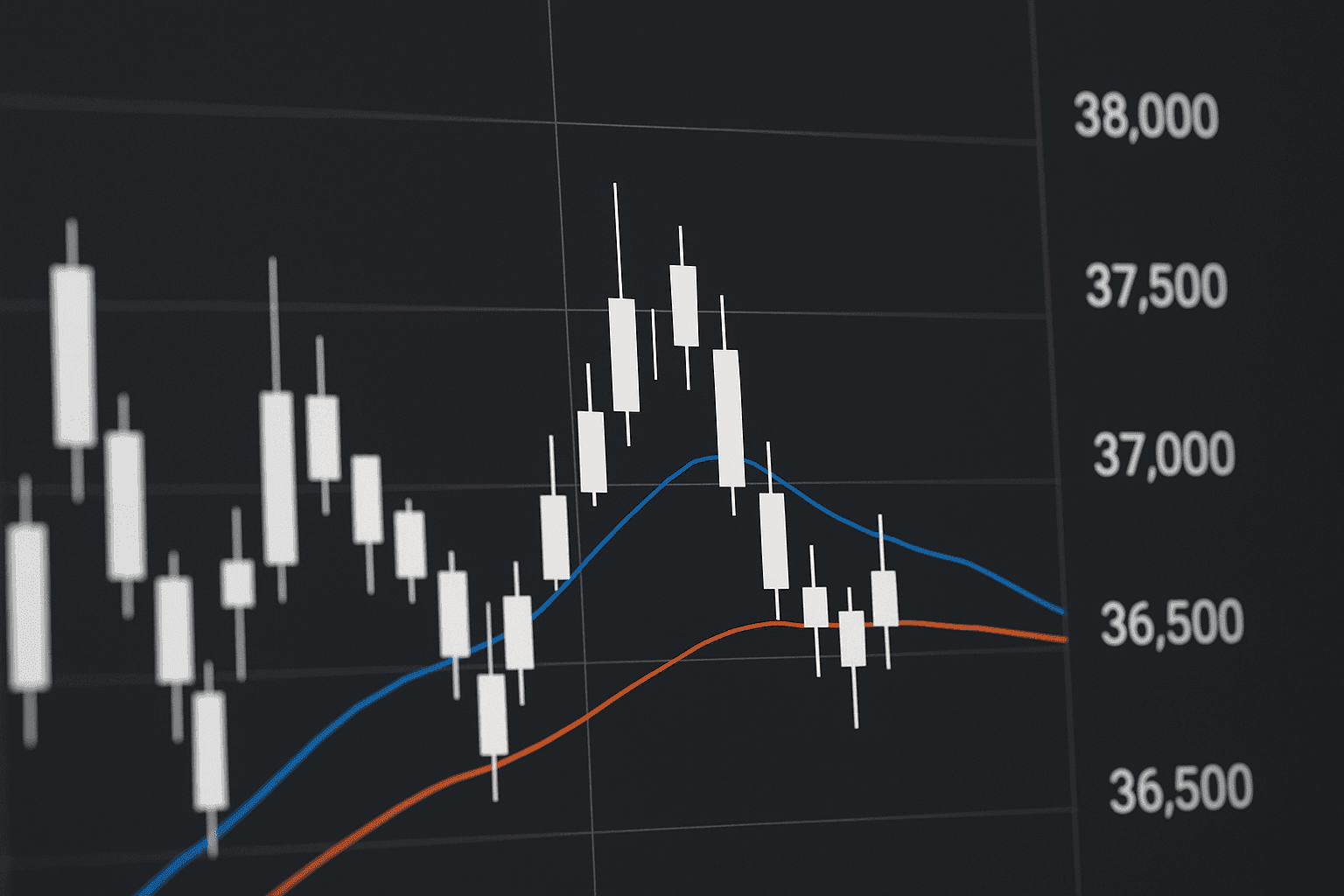
The candle’s body—the visible rectangle, typically green or red—shows the distance between the opening and closing prices for a selected timeframe. Each candlestick summarizes four core price points: the open, high, low, and close.
Thin lines extending above and below the body are wicks (or shadows). The upper wick marks the session’s high; the lower wick records the low.
When a candle closes above its open, price advanced during that period. Many platforms color these bullish candles green for quick identification, while some setups invert colors or allow customization, so it’s important to follow your platform’s convention.
“Bullish” generally refers to higher prices being favored over the interval; “bearish” refers to lower prices being favored. Red candles are often labeled bearish because they reflect a price decline across the timeframe.
A single candle can provide information, but sequences of candles are usually more useful because they reveal whether buyers or sellers are gaining control.
How to Identify Candlestick Patterns on a Crypto Chart?
Sometimes a lone candle is a meaningful signal. Doji candles are one example: they feature a very small body alongside longer wicks, suggesting that open and close were close together. Common variations include:
- Long-Legged Doji: Upper and lower shadows are similarly long, highlighting indecision and uncertainty in the market.
- Gravestone Doji: A long upper wick with little to no lower shadow, suggesting higher prices were rejected and sellers pushed back.
- Dragonfly Doji: A long lower shadow with minimal upper wick, showing heavy early selling that reversed back to the open by session end.
Beyond single candles, patterns range from basic to advanced. Many formations rely on multiple candles, where the sequence matters as much as the shape.
Calling something a pattern usually requires at least two candles; seasoned traders often look beyond that to reduce noise. More context can help distinguish genuine shifts from isolated fluctuations.
How to Read One Candlestick (Step-by-Step)
- Choose the timeframe (for example, 15m, 1h, or 1D). The meaning of the candle depends on the timeframe you’re analyzing.
- Identify the direction of the candle by comparing open vs close (close above open typically indicates a bullish interval; close below open indicates bearish).
- Check the candle’s extremes using the wick highs and wick lows (high and low tell you how far price traveled during the interval).
- Measure the body relative to the wicks: a large body suggests stronger control by buyers or sellers; long wicks suggest rejection and indecision.
- Map the candle onto your key levels by marking nearby support and resistance. Candle signals matter more when they occur at meaningful areas, not at random prices.
- Record the “story”: for example, “buyers pushed up but sellers defended the high” (upper wick rejection) or “price sold off then recovered by the close” (long lower wick with bullish close).
- Plan confirmation and invalidation: decide what would confirm the idea and what would invalidate it (for instance, a break beyond a recent swing high/low or a close outside a level).
How to Spot Patterns in Crypto Charts?
Crypto trades 24/7, so your chart will generate a continuous stream of candles. A disciplined approach helps you avoid overreacting to brief moves:
Support and resistance are key zones:
- Support: A level where price declines tend to stall or bounce.
- Resistance: A level that tends to cap upward movement.
One widely cited example is Bitcoin’s 20,000 level during September, which later failed. For broader context, focus on current market structure rather than copying a past level blindly.
Price often reacts at these zones. When a level breaks, it’s prudent to wait for confirmation before entering a trade. These areas are also practical places to scan for candlestick patterns, because they influence the likelihood of rejection or follow-through.
How to Read These Types of Cryptocurrency Charts
Upward Trend
An uptrend features a general climb in price over time—even if red candles appear intermittently. The market is typically considered bullish as long as the broader path points higher (for example, higher highs and higher lows).
Downward Trend
A downtrend shows persistent weakness, often marked by lower highs and lower lows across candles. That structure signals bearish control.
Consolidation Trends
During consolidation, price oscillates in a range without a clear break in either direction. This sideways action can occur within larger uptrends or downtrends.
Calling the end of a trend usually benefits from confirmation from additional context such as moving averages and level behavior.
When a candlestick setup aligns with momentum and participation (for example, an oscillator turning and volume expanding), it tends to be more dependable than the candle pattern alone. In practice, you would look for volume expansion during the rejection or breakout, then verify that the next candles continue in the expected direction rather than immediately reversing.
Important Factors to Consider
Use a timeframe that matches your strategy. Minutes or hourly candles may suit intraday trading, while longer horizons are better aligned with investing decisions. Higher timeframes can help filter noise and improve signal quality in technical analysis.
Tie confirmations to what you’re deciding. Some traders use a “3-candle rule” as a simple confirmation filter: instead of acting on the first candle that suggests a reversal, breakout, or breakdown, they wait for three subsequent candles (or three closes) to support the same direction. For example, if a pattern appears at resistance and you expect a bearish rejection, you might wait for three consecutive candles that close below that resistance area before treating the move as more than a temporary dip.
Patterns that appear in the middle of nowhere may offer limited value. Anchor your reading to support and resistance, then assess how the candle sequence behaves around those levels.
Candlestick patterns have limitations. They can generate false signals, they depend heavily on trend and level context, and the same “shape” can imply different outcomes on different timeframes. In crypto specifically, volatility, continuous trading, and sudden news-driven moves can invalidate a clean-looking setup quickly—especially if you treat patterns as predictive rather than as prompts for confirmation and risk management.
Crypto markets can move sharply on headlines or rumors. Consider basic risk controls or hedges to reduce exposure to sudden swings.
The Most Common Types of Candlestick Patterns in Crypto Charts
Once you’ve mapped the broader trend, scan for formations that occur at meaningful areas. The patterns below are frequently referenced because they describe common shifts between buyers and sellers.
Engulfing patterns are commonly watched because they can show a decisive change in control within a short window. In an engulfing setup, the second candle’s body fully overtakes the prior candle’s body, which may suggest stronger follow-through—especially when it appears at a well-watched support or resistance zone.
Common bullish candlestick patterns include:
- Morning Star: A three-candle reversal structure that can suggest selling pressure is fading and buyers are taking control, especially after a decline into support.
- Piercing Line: A two-candle reversal formation where the second candle pushes meaningfully back into the prior candle’s body after a decline; it’s most convincing when it reacts near support and closes strongly.
- Three White Soldiers: A sequence of strong bullish candles that can indicate sustained buying momentum, often after a pullback ends.
Common bearish candlestick patterns include:
- Evening Star: A three-candle reversal structure that can signal buyer exhaustion after an advance, particularly near resistance.
- Dark Cloud Cover: A two-candle reversal formation where the second candle drops deeply into the prior candle’s body after an up move; stronger signals typically show clear rejection of higher prices.
- Three Black Crows: A sequence of strong bearish candles that can indicate sustained selling momentum, often after a rally fails near a ceiling.
| Pattern | Bullish/Bearish bias | Candle count | Where it often appears | Confirmation clues |
|---|---|---|---|---|
| Morning Star | Bullish reversal | 3 | After a decline near support | Follow-through candles that hold above the reversal zone; improved closes relative to the prior bearish move. |
| Piercing Line | Bullish reversal | 2 | After a drop near support | Second candle closes well into the prior body; subsequent candles reduce lower-wick rejection and push price upward. |
| Three White Soldiers | Bullish continuation/reversal (context-dependent) | 3 | After a sell-off or pullback | Successive candles with higher closes; limited long upper wicks if you expect buying control. |
| Evening Star | Bearish reversal | 3 | After an advance near resistance | Subsequent candles confirm by closing lower; rejection behavior becomes clearer than in the prior up move. |
| Dark Cloud Cover | Bearish reversal | 2 | After a rally near resistance | Second candle closes into the prior bullish body; later candles fail to reclaim the level. |
| Three Black Crows | Bearish continuation/reversal (context-dependent) | 3 | After a bounce that stalls | Successive closes move downward; rallies struggle to extend above the previous candle bodies. |
Bullish and Bearish Engulfing
This is a two-candle setup. In a bullish engulfing pattern, a red first candle is fully covered by a larger green second candle, signaling a shift in market sentiment and a potential move higher. In a bearish engulfing, a strong red second candle engulfs the previous candle, hinting at downside. For both, ideal context is nearby support (bullish) or resistance (bearish), followed by candles that do not immediately negate the engulfing move.
Hammer Candlestick
A hammer displays a small body atop a long lower shadow—often about twice the body length—with little to no upper shadow. It may be red or green, but the key point is the long lower wick showing rejection of lower prices. Confirmation typically comes when the next candle closes at or above the hammer’s neckline (the top of the hammer’s body). Hammers can mark a reversal after intense selling pressure; an inverted hammer, which sports a long upper shadow, can also be relevant when interpreted within the surrounding trend and level behavior.
Shooting Star
Often seen near the peak of an uptrend, a shooting star features a small real body, minimal lower shadow, and a long upper shadow. The long upper wick reflects rejection of higher prices and can precede a bearish reversal, especially if it forms under resistance and is followed by lower closes.
Hanging Man
Appearing after a recognizable advance, the hanging man can warn of a reversal. It has a small real body and a pronounced lower shadow. Traders sometimes refer to similar small-bodied candles as spinning tops; as always, confirmation matters. In practice, you would look for a follow-up candle that fails to sustain higher prices and closes nearer the lower end of the range.
Triangle Patterns
Many traders draw triangle shapes to illustrate horizontal consolidation structures that can affect how candles behave around boundaries.
There are three main variants: ascending, descending, and symmetrical.
| Pattern Name | Description | Typical Signal |
|---|---|---|
| Ascending Triangle | A breakout-style formation where a flat resistance is tested repeatedly while higher lows compress price from below. | Upside breakout bias |
| Descending Triangle | A bearish-leaning setup formed by a flat support level with lower highs pressing down from above. | Downside breakdown bias |
| Symmetrical Triangle | Converging trendlines built from lower highs and higher lows, showing balance between buyers and sellers before a move in either direction. | Neutral until breakout |
Concrete Example Scenarios (Beginner-Friendly)
Example 1: Bullish setup near support. Suppose price has been declining and then stalls at a support area. You see a hammer candle with a long lower wick and a small body near the upper half of the candle range. Instead of buying immediately based only on the shape, you wait for the next candle to close at or above the hammer’s neckline. If the following candles keep closing higher (and ideally volume is stronger during the move), that gives you confirmation. An invalidation approach is to consider the setup questionable if price breaks back below the support area or below the recent swing low that the hammer reacted to.
Example 2: Bearish setup near resistance. Suppose price is rising and repeatedly rejects a resistance level. A bearish engulfing pattern forms: a small green candle is followed by a larger red candle that fully covers the prior body. You then look for confirmation such as closes staying below resistance and follow-through candles that do not quickly reclaim the engulfed body. For invalidation, you can treat the bearish idea as weaker if price breaks back above the resistance zone or above the prior swing high that framed the rejection.
Conclusion
Learning to recognize candlestick patterns and read charts can improve the quality of trading decisions.
Chart skills are a core pillar of market success. This overview is a starting point, not a complete catalog. Traders monitor many formations, and consistent execution takes experience and practice.
Candlesticks can be useful, especially in crypto, but they work best alongside other tools and with clear risk rules. Traders often use patterns to time entries and exits, look for confirmation of a broader trend before committing capital, and place stop-loss levels around obvious invalidation points (for example, beyond a recent swing high or low suggested by the pattern).