Years of working around digital coins point to one practical requirement: you need to understand how to read and preserve the records that document network activity. In systems designed to reduce reliance on trust and third parties, what counts as “evidence” in Bitcoin? For that purpose, the formal on-chain record plays the central role. In the sections below, we break down what it contains, how transaction details are formed, and why anyone moving crypto value should be able to interpret and keep those details.
Bitcoin Payment Receipts: The Essentials
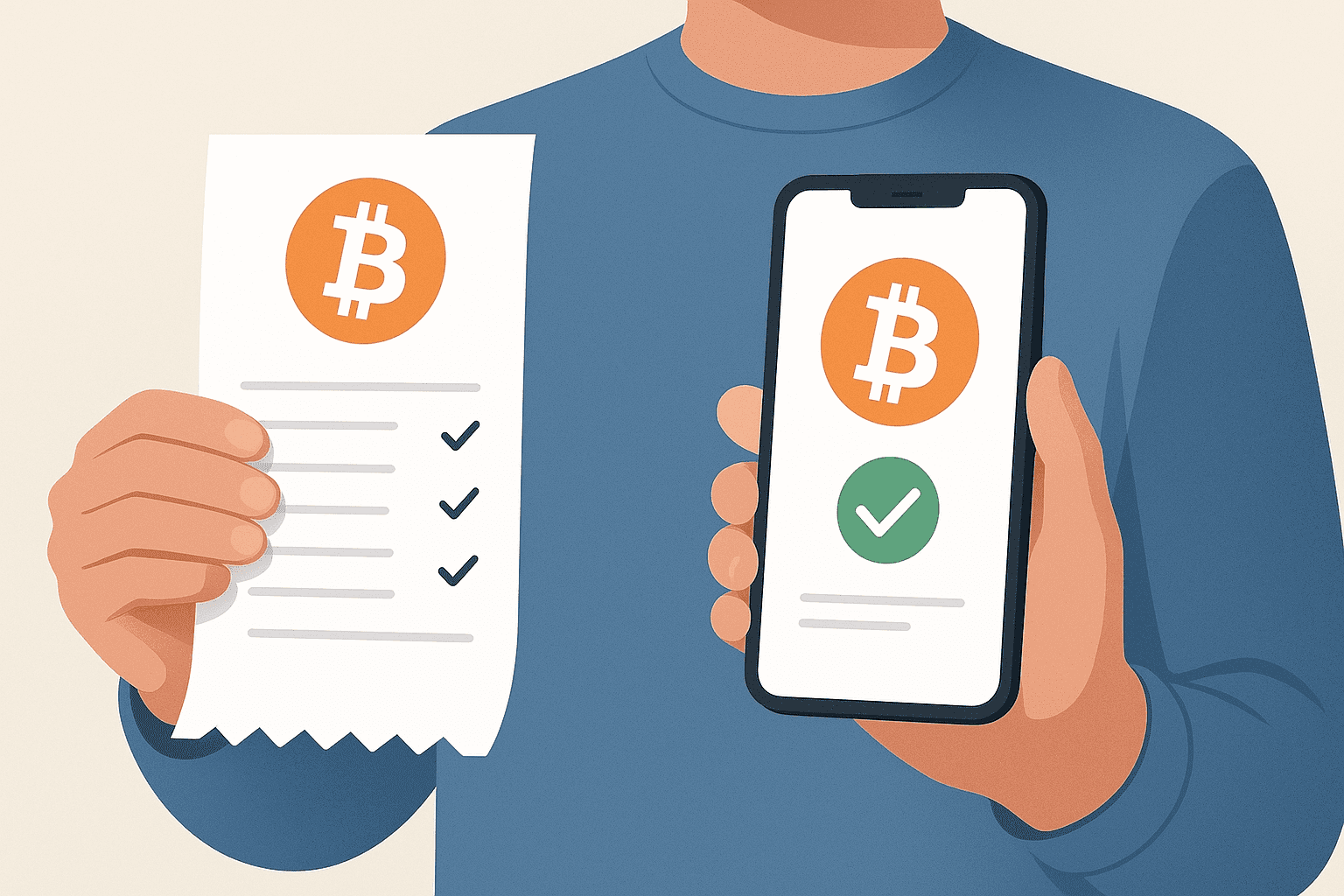
A payment confirmation on Bitcoin is a record that identifies the amount, the relevant time window, and the wallet addresses involved as sender and recipient.
After a payment moves from one party to another, the corresponding entry becomes visible to both sides, and the open blockchain keeps it as part of the public history for anyone to verify.
Why These Records Matter for Crypto Payments
Before going deeper, it helps to clarify why these records deserve attention in crypto payments.
- Proof that a transfer occurred—useful for reconciliation and record-keeping.
- Assurance without a single central referee—participants can validate the same underlying data.
- More resistance to certain failures such as double-spends, because attempts are constrained by network rules.
Without this kind of shared proof, resolving disputes becomes difficult, and there is no support channel that can simply reverse a transaction as if it were a normal bank transfer.
How to Create Your Own Invoice-Style Record in a Wallet
Although it can sound technical, producing a wallet-based confirmation is usually simple if you follow a few steps in the wallet app you use.
- Choose a wallet you control—use an application from a legitimate, official source.
- Get a fresh receiving address—generate a new address inside the wallet for each invoice or payment request.
- Share carefully—send the address to the payer, and avoid sharing anything unnecessary.
- Confirm after network processing—once confirmations complete, the transaction appears with the details you can save as your receipt.
Inside a Cryptocurrency Transfer: Key Pieces
When value moves on the network, several fields work together to describe what happened.
- Sources—earlier UTXOs that fund the spend and supply the coin inputs.
- Destinations—new UTXOs created for recipients, which can be spent in the future.
- TXID—a unique identifier for the specific transaction record.
- Miner transaction fees—the amount paid for processing and inclusion.
Once you recognize these elements, you can interpret the record more quickly and set expectations for timing and cost.
Security and Verification for App and Wallet Users
Under the surface, the system’s design offers practical assurances even for everyday app and wallet users.
- A shared ledger visible to anyone—transactions are published to the blockchain history.
- History that becomes hard to change—after sufficient confirmations, the record is effectively final for normal use.
- Independent cross-checking by many nodes—a single compromised device cannot rewrite the ledger.
When You Need Help: Limits of Decentralization
Alongside the benefits, there are trade-offs newcomers and business teams should account for.
- Pseudonyms and cross-border activity can complicate tracing in practice.
- No built-in arbitrator for reversals—if an error occurs, there is no standardized “undo” mechanism or direct customer support number to call.
Compliance, Billing Rules, and Fiat Reporting
Looking at the 2026 horizon, regulatory concerns continue to expand as cryptocurrency rules develop alongside traditional fiat payment and reporting requirements.
- The core technology remains decentralized, but oversight approaches and reporting obligations can change quickly across jurisdictions.
For example, tax authorities in the United States have implemented digital-asset reporting requirements in recent years; staying informed can help you keep records more consistently and reduce avoidable issues later.
Beware of Scam Generators and Fake Apps
As a practical safeguard, avoid “generator” tools and look-alike applications. For wallet or address-related tasks, use software that you can verify as legitimate before entering any information.
Summary: Get Paid and Stay Safe
In the end, these records may seem like small details, but they make network activity easier to verify and reconcile. Learn how to capture the relevant information correctly, and you can send and receive with greater clarity in both personal and business contexts.