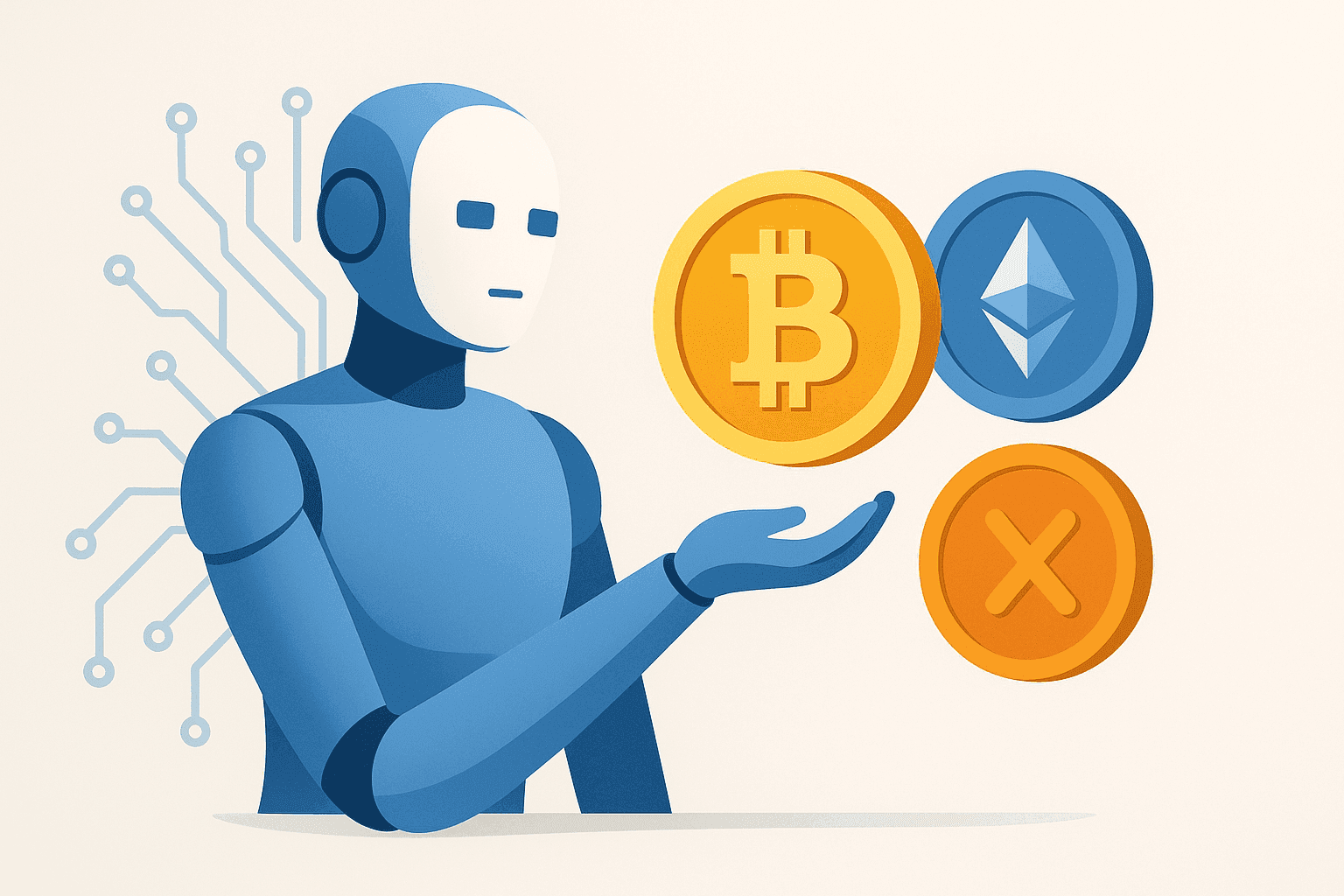
Envision software that observes, learns, and acts on its own. That is the promise behind autonomous systems—particularly AI agents in crypto—where programs read incoming signals, evaluate options, and execute actions without continuous human supervision.
When this autonomy is applied to blockchains, it can form a broader financial stack: agents may automate trading, manage hedging logic, support on-chain operations, and coordinate services. The potential is significant, but real-world constraints and failure modes still matter.
So what are these agents, and why do they matter for digital assets? Let’s break it down.
What Are AI Agents?
AI agents are better understood as digital operators rather than simple scripts. They interpret inputs, identify patterns, and act based on strategies that improve over time. Instead of sending reminders, they can rebalance a portfolio, flag suspicious activity, or run multi-step execution logic—end to end.
In most implementations, performance improves via machine learning and feedback loops: models adapt as new data arrives and market or user conditions change.
Within crypto, that capability enables behaviors such as trading workflows that run faster than manual execution, portfolio logic that reacts to on-chain signals, and automated assistance that understands context across DeFi applications.
In practice, they analyze market and operational inputs and take actions in real time, changing how users and apps interact with blockchain ecosystems.
Use Cases for AI Agents
People often picture AI assistants that answer questions. Agents are different: they can work behind the scenes to orchestrate tasks, optimize workflows, and make decisions that reduce the need for constant human involvement.
Their applications span many areas. Below are some of the more recognizable categories.
Media, Content Creation, and Entertainment
Agents can draft articles, generate images, edit video, and assist with music composition. In games, they can support adaptive NPC behavior and storylines that respond to player actions, helping create more responsive experiences.
Customer Service and Virtual Assistants
Conversational systems can resolve tickets, guide users through processes, and provide always-on support using natural language understanding.
IT Support and Help Desk Automation
They can install patches, monitor infrastructure, and help remediate common issues before they escalate—reducing outages and routine workload for engineering teams.
Human Resources and Recruitment
Agents may scan resumes, schedule interviews, run preliminary assessments, and guide new hires through onboarding. This can improve consistency and support data-driven screening, although human review is still important for high-stakes decisions.
Travel
Trip planning can be largely hands-off. Agents can assemble itineraries, compare options, manage bookings, and provide local recommendations as plans change.
Environmental Monitoring
By combining sensor streams, agents can help forecast conditions, track emissions, and monitor resource usage to support disaster readiness and conservation planning.
Across sectors such as healthcare, cybersecurity, and software engineering, agents can automate parts of workflows, analyze operational signals, and assist decision-making—aiming to improve efficiency and resilience.
Now combine that intelligence with decentralized rails, and you get crypto AI agents coordinating directly on-chain.
AI agents in crypto are still early-stage, but they are already proving useful for always-on execution and coordination; the next wave will be defined by safer permissions, better transparency, and tighter integration with on-chain workflows.
How Do Crypto AI Agents Work?
Many blockchain-based agent systems follow a basic loop:
- Data Collection: They gather on-chain records, social chatter, and market feeds to understand activity patterns, price movement, and sentiment signals.
- Data Processing: Models evaluate inputs, recognize structures, estimate likely outcomes, and incorporate risk constraints using machine learning.
- Action: They trigger trades, adjust allocations, or call smart contracts—without manual clicks required for each step.
What Are AI Agents in Crypto?
In digital asset markets, agents can cover execution, portfolio strategy, and interaction with dApps. Because their actions occur on public ledgers, many moves are auditable and timestamped.
This traceability can improve accountability across the ecosystem.
Common capabilities include:
- Placing orders programmatically from live market inputs.
- Parsing large data sets across blockchains and social platforms.
- Rebalancing holdings as volatility and market conditions change.
- Interfacing with DeFi protocols, NFT markets, and other on-chain services.
Use Cases for AI Agents in Crypto
On-chain agents often take roles where automation and transparency can help. The most visible areas of impact include the following.
Automated Trading and Portfolio Management
Agents can monitor order books and signals continuously, executing when predefined conditions or predictions are met. They may tune exposure to match risk preferences and respond quickly—24/7—often faster than manual trading.
DeFi and Market Analysis
Agents can help manage liquidity, set strategy parameters, and pursue yield opportunities automatically. This emerging “DefAI” approach combines AI with DeFi to reduce complexity in interactions and broaden access for users who may not want to manage every step manually. The segment was projected to grow from $1 billion to about $10 billion by the end of 2025.
DefAI automates workflows by evaluating on- and off-chain data, then tailoring how services are used for trading, lending, and other tokenized activities.
Instead of tracking every wallet and narrative manually, specialized bots can summarize relevant signals, score opportunities, and act across strategies.
Reported outcomes can include improved optimization in DeFi protocols and clearer insight into market structure to support more informed decisions.
Other finance-focused patterns include:
- Liquidity Management: Agents rebalance liquidity pools by routing capital where utilization and fees justify it, which is relevant for decentralized exchanges.
- Yield Farming Optimization: They rotate positions toward higher risk-adjusted returns and can automate compounding when rewards are available.
- Lending and Borrowing: They manage collateral, adjust health parameters, and borrow when terms are favorable.
Web3 Gaming, NFTs, and Social Interaction
In blockchain games, agents can support responsive NPCs, adapt difficulty to player skill, and enable emergent behaviors that change over time. The goal is to make game worlds feel more dynamic.
They can also assist with NFT workflows such as pricing, listing, and trading, especially as marketplaces become more active.
On social platforms like X, agent accounts may schedule updates, amplify campaigns, and help moderate community spaces. Gamified designs can add missions, rewards, and dynamic interaction loops.
One example mentioned in this space is G-Agents AI by Enjinstarter, where its Gamety app rewards tasks via agentic gameplay. Other major communities have also been exploring similar agent-native experiences.
Decentralized Governance
Agents can assist DAOs by handling parts of proposal workflows, engagement, and monitoring with less day-to-day manual coordination. APEAI DAO is one example on Solana, coordinating meme coin-related activities, tweeting autonomously, and supporting membership screening via verification prompts.
They can also monitor ecosystems for anomalies, vote manipulation, or access abuse, and then flag or respond when threats are detected. Automating ballots, policy enforcement, and ongoing checks can make DAO operations more consistent.
Agents may further adjust token-related incentives in real time by tuning parameters to support growth, sustainability, and participation.
Cross-Chain Payment Solutions
Agentic wallets can reduce complexity so non-technical users can describe an outcome while the system handles route selection, approvals, and execution:
- Cross-Chain Interoperability: Agents can select routes, bridges, and conversions automatically. For example, a user might move value from an Ethereum account to a Bitcoin ecosystem without manually coordinating every step, with the agent choosing based on speed or cost.
- Making Peer-to-Peer Payments: Users can send assets to a name or via a voice prompt. The agent can check wallet status, help confirm security details, and submit the transaction—similar to a familiar mobile payments flow.
Top 8 AI Agent Token Projects by Market Capitalization
The following list highlights agent-focused networks and tokens that have attracted attention in the crypto market.
| Project Name | Token Symbol | Description | Key Use Case |
|---|---|---|---|
| Artificial Superintelligence Alliance | FET | Formerly known as , a decentralized machine learning platform for building and deploying agents. | Automated trading and smart contract orchestration |
| Virtual Protocol | VIRTUAL | Introduced in 2024, enables launching agents without coding; token supports payments and revenue sharing. | No-code agent creation and monetization |
| ai16z | AI16Z | A DAO on Solana applying AI to investment decisions to modernize portfolio management. | AI-driven investment and portfolio decisions |
| aixbt by Virtuals | AIXBT | An agent from Virtual Protocol focused on market intelligence using real-time social signals. | Market intelligence for trading judgments |
| Griffain | GRIFFAIN | Built to streamline agent efficiency inside decentralized applications, emphasizing reliability and throughput. | Agent execution within dApps |
| Freysa | FAI | A natural language and decisioning tool used for customer support automation and conversational experiences. | Support automation and conversational workflows |
| AI Rig Complex | ARC | Geared toward high-speed execution and complex decision flows for traders, emphasizing rapid analysis. | High-speed trading execution and decisioning |
| Zerebro | ZEREBRO | Designed to simplify user-to-dApp interactions, from placing trades to managing decentralized identity. | dApp interaction and identity workflows |
How to Buy AI Agent Tokens
Many agent tokens can be acquired through decentralized exchanges on networks such as Solana or Base. The exact steps depend on the token and the chain it trades on, but the general flow is similar.
Buy AI Agent Tokens on Solana
To buy on Solana, you typically use a Ledger device with Ledger Live. Set up your wallet, create a Solana account in Ledger Live, fund it with SOL for fees, and then connect to a supported DEX such as Serum or Raydium.
After that, swap SOL for the agent token you want directly through Ledger Live. The goal is to streamline signing while keeping the private key operations associated with the Ledger hardware.
Buy Agent Coins on Solana (with SPL tokens now supported in Ledger Live):
- Set Up Your Ledger: Choose a Ledger hardware wallet such as Ledger Flex or Ledger Stax, then download and install Ledger Live to manage assets securely.
- Create a Solana Account: Follow the Ledger Live setup to add a Solana account and deposit SOL for fees and swaps.
- Purchase Your Agent Coin: With SPL tokens available in Ledger Live, you can buy directly in the app or use a Solana DEX like Serum or Raydium to swap SOL for your preferred token.
Buy AI Agent Tokens on Base Blockchain
Here is a typical way to acquire Base-network agent tokens:
- Get a Ledger Crypto Wallet: Start with a Ledger hardware wallet to safeguard keys and funds.
- Download the Ledger Live Crypto Wallet App: Use Ledger Live to view balances, manage tokens, and track activity.
- Set Up Your Ledger Crypto Wallet: Complete onboarding to enable secure transactions.
- Create and Fund Your Ethereum Account With ETH: Base swaps usually require ETH for gas. Add an Ethereum account in Ledger Live and transfer ETH to it.
- Swap Your ETH for the Agent Token: Swap via Ledger Live’s Uniswap Trading API for a DEX-like experience with signing and hardware-level confirmation. You can also review transactions on compatible touchscreens such as Ledger Stax or Flex. Note: At present, swaps in Ledger Live are powered only by the Uniswap Trading API on Ethereum, with no other integrated swap providers in the app.
What Is the Difference Between Crypto AI Agents and AI Tokens in Crypto?
Crypto AI agents are autonomous programs that run on-chain or interact with on-chain systems. They analyze market data, execute strategies, tune portfolios, interact with DeFi protocols, and call smart contracts while adjusting behavior based on outcomes.
AI tokens usually function as part of the ecosystem around those agents. They can gate access to services, fund compute or transaction activity, and support governance or reward systems. Tokens themselves do not act independently; they provide the economic mechanism that enables platforms and agents to operate.
TLDR — Agents handle strategy and execution. Tokens typically supply access, incentives, and fees.
Benefits and Risks of Using AI Agents in Crypto
Potential benefits include efficiency (less manual monitoring), speed (rapid reaction to market changes), automation (hands-off execution across trades and dApps), transparency (auditable on-chain actions), and scalability (running multiple strategies concurrently).
Key risks include security vulnerabilities (key handling, permission design, and smart contract exposure), regulatory uncertainty (rules that may affect automated financial activity), model bias and data quality problems (leading to misleading signals), operational errors (bad prompts, brittle logic, or edge cases), and ethical concerns (fairness, market impact, and accountability).
The Challenges Faced by AI Agents in Crypto
Agentic infrastructure is still developing, and several hurdles need to be addressed before broad adoption.
Security
Because agents may hold permissions and interact with sensitive data, they can become targets for attackers. Defense-in-depth, secure coding practices, and recurring audits are important to reduce exploit risk.
Regulation
Policy is evolving, and automating financial actions adds complexity. Unclear requirements may slow adoption, and future rules could limit certain agent-led strategies.
Bias and Errors
Model behavior reflects the data it is trained on. Skewed or low-quality inputs can result in poor decisions or losses. Hallucinations and overfitting are also realistic risks, especially in volatile environments.
Ethical Concerns
Heavy algorithmic activity can shift markets away from purely human interpretation, potentially amplifying swings. That raises questions about transparency, fairness, and accountability.
Integration
Different blockchains use different standards and constraints, which makes truly universal agents difficult to build. More interoperable, chain-agnostic approaches can help agents operate across environments.
Ledger Helps You Navigate the AI Agent Ecosystem Securely
If you plan to hold agent-related tokens, managing keys and permissions is critical. Hardware wallets such as Ledger Stax and Ledger Flex combine secure elements with Ledger OS to help protect assets.
Using a Ledger crypto wallet with Ledger Live can also support safer day-to-day management and clearer transaction review when connecting to integrations.
For users who want agent-driven workflows over time, these devices and Ledger Live aim to balance convenience with a security-first approach.
FAQs About Crypto AI Agents
What Is the Best Crypto AI Agent?
There is no single “best” agent for everyone. The right choice depends on your goals—execution, market analysis, portfolio oversight, support workflows, and more. If you explore tools, consider how they handle data sources, execution controls, permissions, and risk management.
Which Is the Most Powerful AI Agent?
“Most powerful” typically depends on what you measure: speed of execution, quality of insights, coverage of data streams, or robustness of permissions. One example discussed here is AIXBT by Virtuals, which focuses on real-time streams from multiple social accounts and thought leaders.
Are Crypto AI Agents Legit and Safe?
They can be, but it depends on implementation and oversight. Evaluate platforms carefully, use best practices such as hardware wallet storage, and stay aware of regulatory and operational changes.
A practical safety and legitimacy checklist includes: evidence of third-party security reviews or audits, clear information about the team or entity behind the product, documented permissions and key management (what an agent can sign or spend), understandable token economics and fees, open-source code or verifiable technical documentation, and a track record of incident response and updates.
Watch for red flags such as anonymous teams without accountability, unverifiable performance claims or guarantees, unclear custody of funds or requests to hand over private keys, missing audit history, overly broad approvals that can drain wallets, opaque pricing or “hidden” revenue extraction, and aggressive marketing that does not match technical substance.
With appropriate security controls and due diligence, agent-driven systems may be a meaningful innovation in blockchain finance.