In a government building in Conakry, a wall clock bearing the likeness of Guinea’s president shows a time that never changes. Its hands are frozen just before midnight. For a country that has spent decades circling one of the world’s richest iron ore deposits without ever fully unlocking it, the symbolism feels uncomfortably accurate. Yet for the first time in a generation, Guinea’s most ambitious industrial project appears to be moving from promise to reality.
Simandou, a vast iron ore formation discovered in the 1990s, has long been described as transformational. Instead, it became a case study in how resource wealth can be trapped by lawsuits, political upheaval, and global power struggles. What is different now is not the scale of the deposit, but the alignment of forces pushing it forward.
From Legal Quagmire to Construction Zone
For years, Simandou existed more in courtrooms than on construction sites. Exploration rights initially granted to Rio Tinto were partially reassigned in 2008 under controversial circumstances, triggering a cascade of disputes that spanned continents and legal systems. Those battles dragged on well into the 2010s, freezing progress while ownership claims were contested and overturned.
The final legal chapter only closed recently, clearing the way for physical development to resume. By then, Guinea had lost decades — but not the deposit itself. With competing claims resolved and political priorities reshuffled, the project was reactivated at a moment heavy with symbolism: just weeks before national elections and early in the tenure of Guinea’s current leadership.
Iron Ore on the Move
In mid-November, iron ore finally began flowing from Simandou’s remote southeastern highlands toward the coast. The journey — nearly 600 kilometres — follows a newly built railway linking dense forest terrain to a purpose-built Atlantic port near Conakry.
What unfolds along this route resembles a carefully choreographed industrial relay. Signalling systems sourced from Europe coordinate locomotives built in the United States, pulling wagons manufactured in China. At the port, those wagons rotate and unload their cargo onto conveyors that lift and funnel the ore onto barges bound for Asia.
The scene underscores the project’s complexity. This is not simply a mine. It is a stitched-together global system designed to test whether a low-income country can manage infrastructure of continental scale without surrendering control.
Rewriting the Landscape
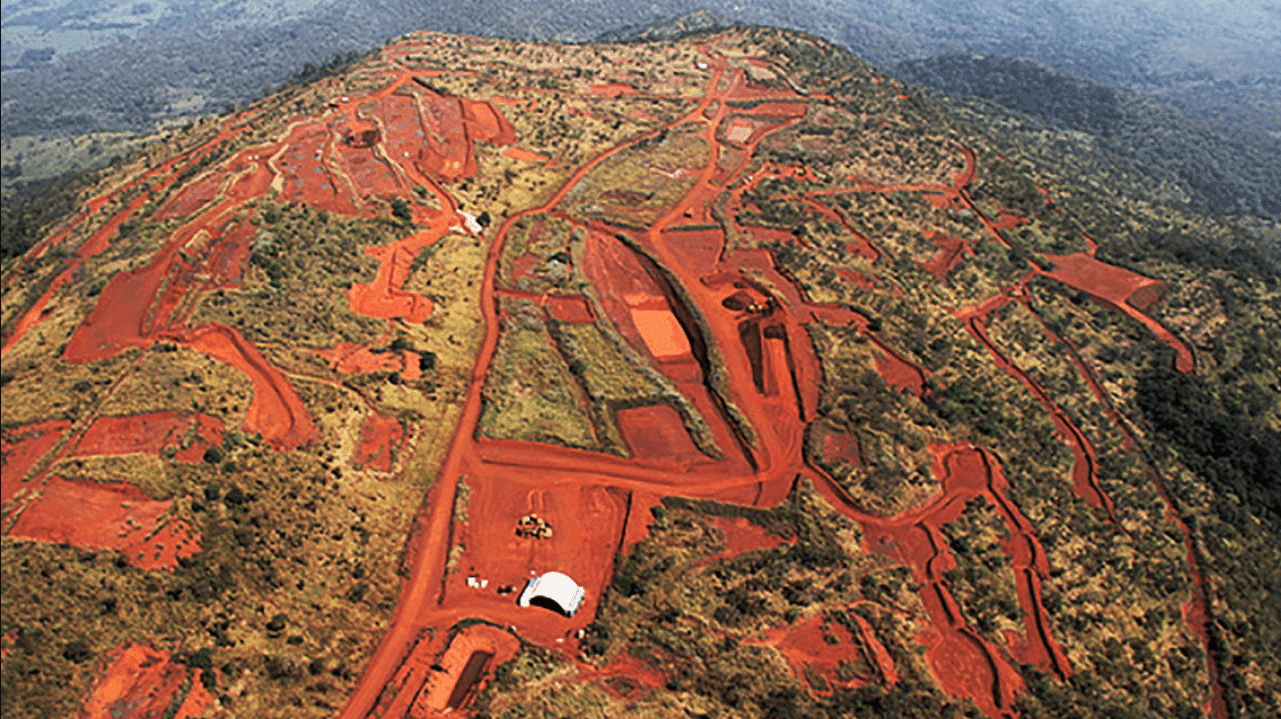
From the air, the contrast is stark. Forest canopy gives way to terraced slopes carved deep into the mountains. Entire sections of terrain have been lowered, reshaped, and stabilised to create workable platforms. Heavy machinery — some of the largest mining vehicles in use anywhere — had to be shipped in pieces and reassembled on site. Roads and bridges across Guinea were reinforced just to allow them to pass.
Veteran geologists recall drilling hundreds of metres without ever leaving iron-rich rock. The depth and quality of the ore shocked early analysts, confirming Simandou’s status as one of the most valuable undeveloped iron deposits on the planet.
Once extracted and processed, the ore moves along conveyors stretching kilometres down the mountainside before reaching rail stockyards. At full capacity, trains nearly a kilometre long will depart around the clock, feeding a port that, only a few years ago, was little more than marshland.
A Political Reset
Engineering alone did not revive Simandou. Politics did. After years of instability and stalled negotiations, Guinea’s post-2021 leadership opted for a technocratic approach to mining governance. The appointment of experienced administrators signalled a break from improvisation and confrontation.
Negotiations with international partners were anything but smooth. Investors hesitated, pushed back, and tested the government’s resolve. Eventually, Guinea drew a firm line: access to Simandou would require shared infrastructure. No parallel railways. No fragmented ports. One integrated system.
That decision reshaped the project. Instead of competing private corridors slicing through the country, all operators were forced into a single logistical framework. The result is an uneasy but functional coalition of global firms — none fully in control, all dependent on the others.
Managing China’s Gravity
China’s presence looms large over Simandou, as it does over much of the global iron ore trade. At peak output, the mine could account for roughly five percent of worldwide supply, a volume significant enough to influence prices.
For Beijing, the appeal is clear: secure supply for steel production and leverage over global pricing. For Guinea, the challenge is ensuring that volume does not translate into vulnerability. Officials speak openly about the need to avoid flooding the market and to diversify export destinations beyond China.
Infrastructure sharing, while born of political necessity, also serves that goal. It limits monopolisation and gives Guinea leverage through its ownership stake and veto rights embedded in the project’s governance structure.
From Foreign Project to National Workforce
Despite its international footprint, Simandou’s labour force is overwhelmingly local. Tens of thousands of workers are spread across the mine, railway, and port, the majority of them Guinean. Training programs have been adapted to local conditions, relying heavily on practical instruction rather than written manuals.
At vocational centres near the site, apprentices learn trades ranging from welding to heavy equipment operation. A dedicated academy is being developed to turn short-term construction employment into longer-term industrial skills.
This focus reflects a looming risk: once construction peaks pass, jobs will decline sharply. Authorities are acutely aware that unmanaged demobilisation could destabilise surrounding communities. Plans are already being drawn up to channel labour into agriculture, energy, and logistics projects along the railway corridor.
Mining Around Nature, Not Through It
Simandou is also an environmental fault line. The region is home to endangered species and rare ecosystems, forcing developers into costly compromises. In one area, a tunnel was bored not for ore extraction, but to allow chimpanzees to move safely through their habitat. Power lines were raised to accommodate elephant migration routes.
Entire forests have been designated off-limits, protected despite sitting atop mineral wealth. Seed banks preserve millions of plant specimens for future restoration. These measures have delayed construction and driven costs higher, but they reflect a broader effort to avoid repeating the ecological damage seen in other mining regions.
Waiting for the Clock to Move
Back in Conakry, the unmoving clock still hangs on the wall. Whether Simandou finally pushes Guinea past its long pause remains an open question. The mine is running, trains are moving, and ships are loading. Yet the real test lies ahead: translating iron ore into lasting institutions, diversified growth, and social stability.
Guinea’s leaders insist the country will not sacrifice everything for extraction alone. Development, they argue, must come with limits.
The clock may still read midnight. But for the first time in decades, it feels as though someone has reached for the hands.