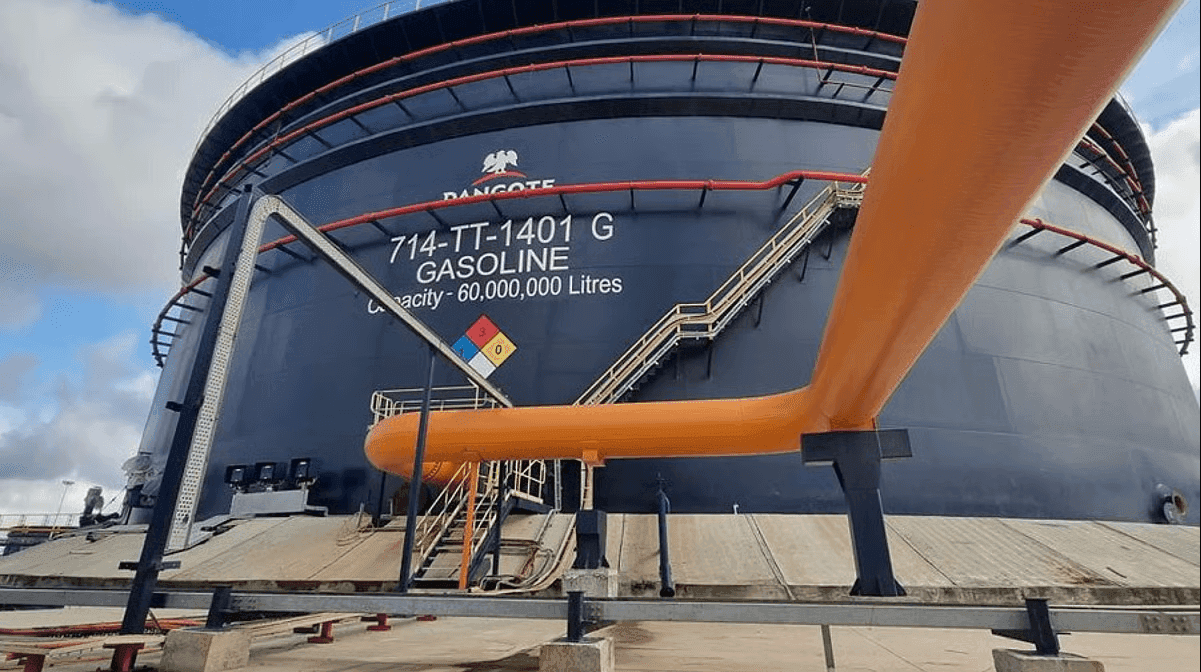
Nigeria has entered a new phase in global fuel commerce as the Dangote Refinery completed its first gasoline export to the United States. The delivery represents a symbolic and commercial breakthrough for Africa’s largest refining project, positioning the country as a supplier to one of the world’s most competitive fuel markets.
The tanker Gemini Pearl discharged roughly 320,000 barrels of gasoline at a terminal in Linden, New Jersey. The cargo was handled by major trading houses before reaching North American distribution channels.
International traders drive early momentum
The shipment was acquired by Vitol, the world’s leading independent oil trader, which subsequently sold most of the volume to Sunoco. The transaction demonstrates that fuel refined in Nigeria meets U.S. regulatory and quality requirements—an essential benchmark for long-term export growth.
Additional consignments are already in transit. One cargo arranged by Glencore is headed to Shell, while another shipment facilitated by Vitol is expected shortly thereafter. Although precise quantities have not been disclosed, the sequence of deals underscores strong market appetite for output from the new facility.
Transforming Nigeria’s energy balance
Built at a reported cost of $19 billion, the refinery has a processing capacity of 650,000 barrels per day, making it one of the largest single-train plants globally. For years, Nigeria relied heavily on imported refined products despite being a major crude producer. The facility is designed to reverse that imbalance by satisfying domestic demand and generating export revenue.
By reducing reliance on imported gasoline, the project could ease pressure on foreign currency reserves while creating a new revenue stream through transatlantic trade. Analysts view the development as a structural shift in Atlantic Basin fuel flows, with West Africa emerging as a refining hub rather than merely a crude exporter.
Short-term maintenance pause
Industry monitoring firm IIR Energy has indicated that the refinery’s gasoline unit may enter a maintenance phase lasting several months. If confirmed, this could temporarily slow export activity before full production resumes.
Even with a potential operational pause, the successful arrival of Nigerian-refined gasoline in the United States signals a reconfiguration of global supply chains. As new refining centers rise outside traditional markets, trade routes and competitive dynamics are evolving, placing facilities like Dangote’s at the center of shifting energy geopolitics.