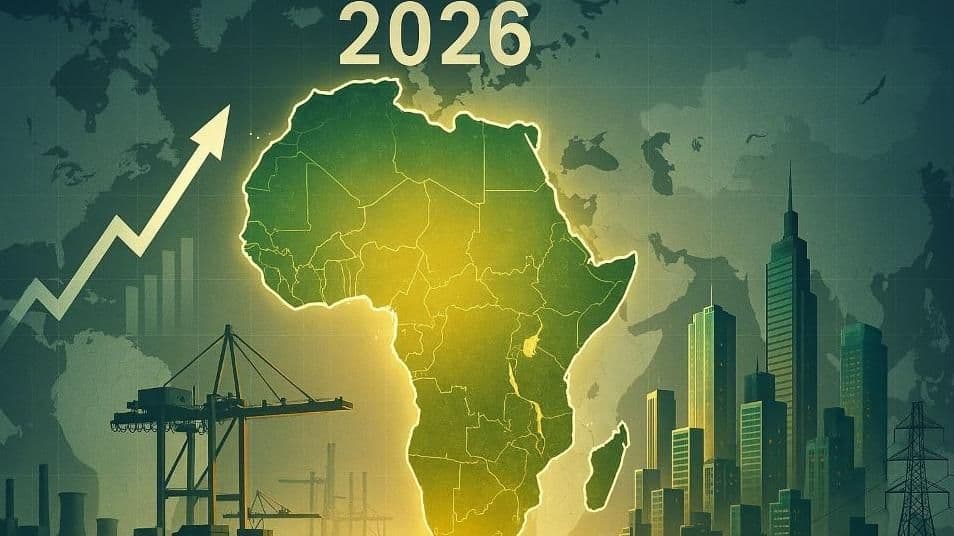
Projections for 2026 place Africa in an unusual position within the global economy. While many regions continue to struggle with sluggish demand and post-crisis adjustment, a growing number of African states are expected to record growth rates that would be considered exceptional elsewhere. This divergence is not accidental; it reflects a mix of sector-specific rebounds, reform-driven catch-up, and demographic pressure translating into economic activity.
Growth, however, is uneven by design. Some countries are advancing because long-delayed production cycles are restarting. In others, structural reforms are only now producing measurable results. The continent’s outlook for 2026 is therefore less about a single “African story” and more about a collection of national trajectories moving at very different speeds.
Resources, Reforms and the Shape of Expansion
The fastest growth rates are concentrated in economies where extractive industries dominate fiscal and export revenues. Oil production recovery and expanded mining capacity are expected to push certain states into double-digit territory. These surges tend to inflate headline GDP figures quickly, even though their broader impact on employment and income distribution remains limited.
In contrast, parts of East Africa are following a different path. Countries such as Uganda, Rwanda, and Ethiopia are benefiting from policy continuity, infrastructure spending, and gradual diversification away from raw commodities. Their expected growth, while slightly lower than resource-driven spikes, is more closely tied to domestic demand, services, and light manufacturing. This makes their expansion structurally more stable, but also more sensitive to financing conditions and external shocks.
Debt Pressure as the Hidden Constraint
Behind the optimistic growth numbers sits a less comfortable reality: public debt servicing. By 2026, African governments are projected to transfer close to 95 billion dollars to creditors, a scale that directly competes with spending on health, education, and infrastructure. In some countries, debt repayments already absorb around one-fifth of total government expenditure, narrowing policy choices even during periods of economic expansion.
Many finance ministries are therefore watching global monetary trends closely. A gradual easing of interest rates in advanced economies could reduce refinancing costs and offer temporary breathing room. Without such relief, faster growth alone may not translate into stronger public finances, especially where revenues remain volatile.
Electricity and the Limits of Industrial Ambition
Economic expansion also runs into physical constraints. Electricity supply remains one of the most binding obstacles to industrial development, particularly in Central Africa. Even where investment projects exist on paper, unreliable power continues to disrupt production, inflate costs, and deter private capital. Countries with low electrification rates struggle to convert growth into industrial depth, reinforcing dependence on imports and raw material exports.
Africa’s outlook for 2026 is therefore best described as promising but fragile. Rapid growth is achievable and, in some cases, likely. Whether that growth reshapes economies in a lasting way will depend less on headline percentages and more on how governments manage debt, energy access, and climate exposure during this narrow window of opportunity.