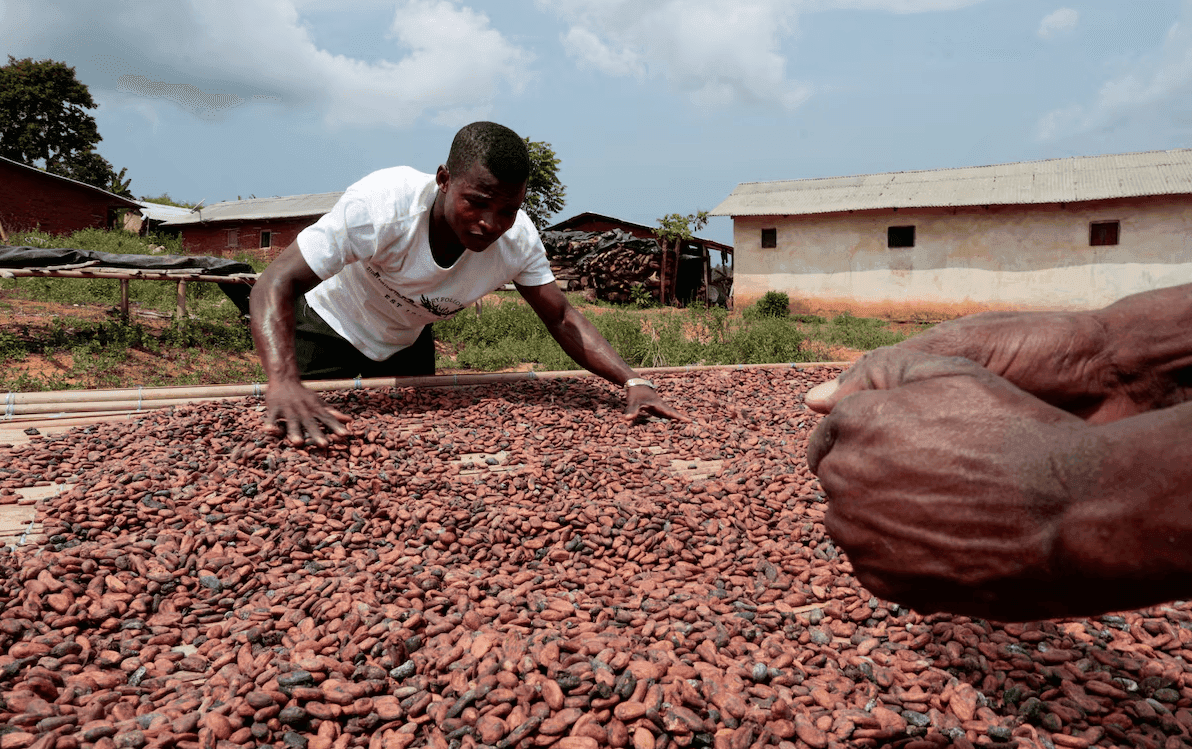
The government of Ivory Coast has dramatically reduced the official rate paid to cocoa producers following a steep fall in global market values. Agriculture Minister Bruno Kone confirmed that the guaranteed purchase price has been lowered to 1,200 CFA francs per kilogram.
This revision comes earlier than the usual seasonal price announcement. Officials explained that the adjustment was necessary because the international cocoa market shifted quickly, leaving domestic prices far above what exporters could obtain abroad.
Global Cocoa Market Reversal
Cocoa prices on international exchanges experienced extreme volatility in recent years. Supply shortages previously drove values to record highs, but the situation changed rapidly as production levels improved and inventories increased.
After reaching roughly $12,000 per tonne in late 2024, cocoa prices dropped sharply. Current global prices are now close to $2,900 per tonne, creating a mismatch between domestic purchase guarantees and global trading conditions.
Given that Ivory Coast produces more cocoa than any other country, these market changes have a major effect on the national economy. The crop represents a key source of income for millions of rural households and remains one of the country’s most important export commodities.
Farmers and Exporters Under Pressure
Producers have voiced frustration over the reduction, arguing that such a large adjustment will significantly reduce household earnings. Many growers rely heavily on cocoa revenues to support families and cover farming costs.
Exporters had already begun slowing purchases when the domestic price remained much higher than international values. In some areas, unsold cocoa stocks accumulated as traders hesitated to buy at the official rate.
Earlier this year, the Coffee Cocoa Council attempted to ease pressure by purchasing significant volumes of cocoa at the previously higher price.
A similar step was taken by neighboring Ghana, which also reduced payments to farmers after the global downturn in cocoa markets. The adjustments across the region highlight how fluctuations in commodity prices can quickly reshape incomes for millions of West African producers.