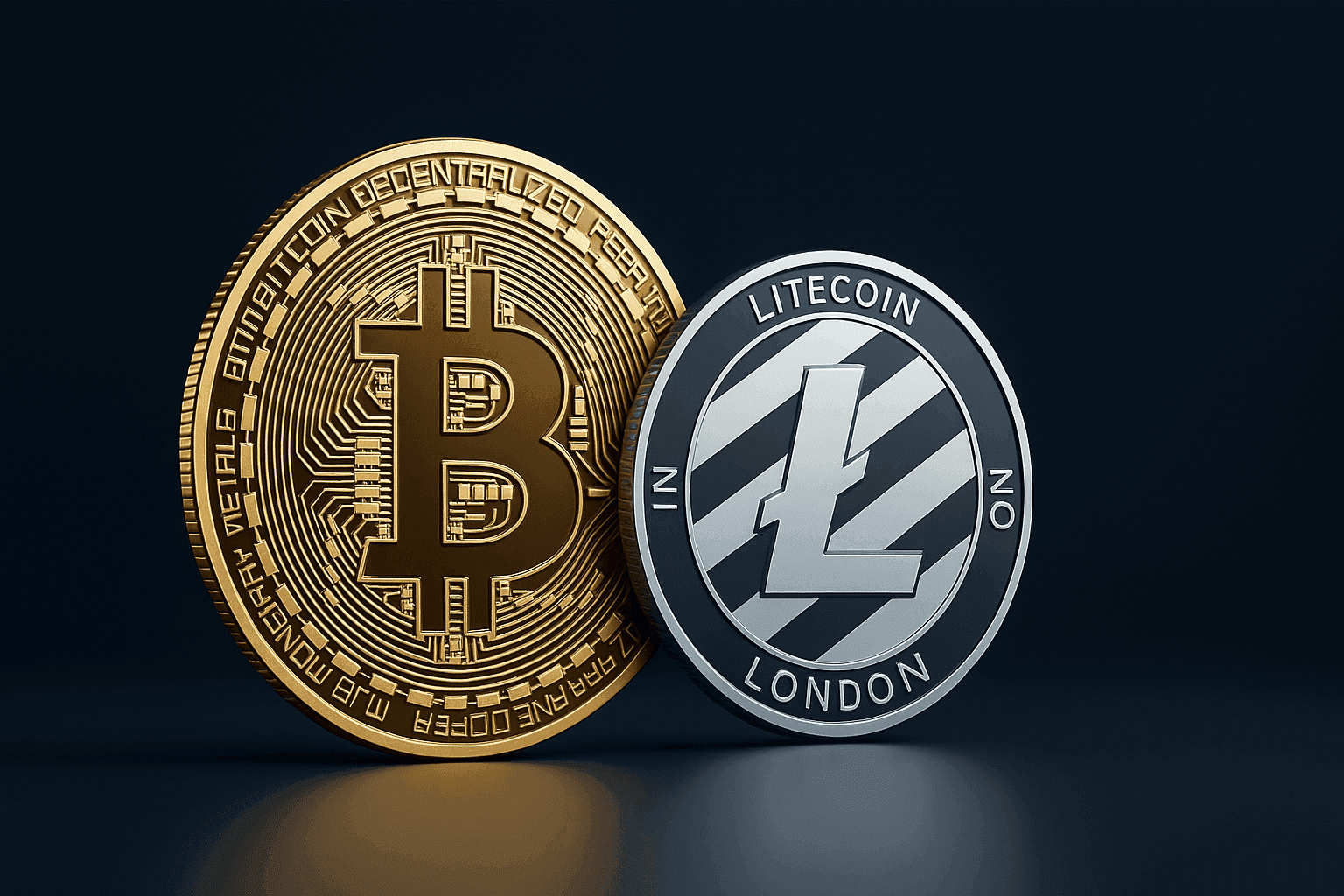
If you’re wondering which cryptocurrency carries the “digital silver” nickname, the answer is Litecoin (Ltc). Litecoin is commonly referred to as digital silver across the crypto community, while Bitcoin is widely regarded as digital gold—a pairing that mirrors how precious metals have long balanced store-of-value and day-to-day exchange in the broader crypto market.
The nickname is grounded in intent, not hype. Created by Charlie Lee in 2011, Litecoin was engineered to sit alongside Bitcoin rather than replace it. Framing Ltc as “silver to Bitcoin’s gold” draws on a familiar split: gold protects wealth as a store of value, and silver circulates in routine payments.
Litecoin is often called “digital silver” because it was designed as a faster, lower-fee companion to Bitcoin, and the label stuck as users began treating Bitcoin as long-term savings while using Litecoin for smaller, everyday transfers.
Lee’s goal was a lighter, cost-efficient peer-to-peer network that preserved decentralization and security but delivered faster, cheaper transfers. That complementary design has held up across years of volatility, giving Litecoin a clear and durable value proposition.
Technical Underpinnings of the Digital Silver Role
Litecoin’s blockchain emphasizes practical throughput and accessibility, reinforcing its positioning as digital silver through choices that prioritize efficient settlement and ease of participation.
Key Technical Features of Litecoin as Digital Silver:
- Scrypt Mining Algorithm. Emphasizes memory over raw compute, making participation more accessible to a broader set of miners.
- 2.5-Minute Block Interval. Roughly four times quicker than Bitcoin’s 10-minute cadence, enabling faster confirmations.
- 84 Million Maximum Supply. Four times Bitcoin’s 21 million cap, echoing a silver-to-gold style ratio while preserving scarcity.
- Higher Transaction Throughput. Around 56 transactions per second compared with roughly 7 on Bitcoin.
- Lower Transaction Fees. Suited for smaller transactions and everyday payments.
Scrypt’s Practical Edge
Litecoin diverges from Bitcoin by using Scrypt rather than Sha-256. By being memory-intensive, Scrypt initially slowed the rise of specialized hardware and let users mine with consumer Cpu and Gpu.
This aligns with the silver ethos: inclusive participation without prohibitive capital costs. While Scrypt-focused ASICs later arrived, memory demands still keep the entry threshold lower than typical Bitcoin mining.
Bitcoin vs. Litecoin: The Gold–Silver Contrast
| Feature | Bitcoin | Litecoin |
|---|---|---|
| Hashing Algorithm | Sha-256 | Scrypt |
| Block Time | Targets about 10 minutes | Targets roughly 2.5 minutes |
| Maximum Supply | Capped at 21 million | Capped at 84 million |
| Transactions Per Second | Around 7 | Around 56 |
| Primary Role | Store of value | Medium of exchange |
Faster Confirmations for Daily Spend
Litecoin’s quicker block cadence shortens confirmation times versus Bitcoin, making point-of-sale and small-value transfers more workable while preserving security and decentralization.
Higher practical throughput—around 56 tps compared with Bitcoin’s single-digit range—supports frequent, smaller payments, while Bitcoin continues to excel as deliberate, long-term savings.
Supply Economics: Litecoin’s 4:1 Ratio
An 84 million coin cap—four times Bitcoin’s 21 million—expands distribution and unit affordability without abandoning scarcity.
Issuance follows a similar four-year halving rhythm, but Litecoin’s occurs every 840,000 blocks versus Bitcoin’s 210,000, maintaining the 4:1 relationship over time.
Litecoin as a Testing Ground for Innovation
Litecoin has repeatedly functioned as a proving arena for upgrades that later benefit Bitcoin and other cryptocurrencies, reflecting its role as an accessible platform for real-world experimentation.
Notable Innovations Piloted on Litecoin
- Segregated Witness (SegWit) — May 2017: Activated on Litecoin before Bitcoin, expanding block capacity and enabling second-layer solutions.
- Lightning Network Testing — 2017: Offered an early, lower-risk network for Lightning experimentation ahead of broader Bitcoin mainnet adoption.
- MimbleWimble Extension Block (Mweb) — May 2022: Introduced an optional confidentiality layer unique to Litecoin.
SegWit Went Live on Litecoin First
When Litecoin activated SegWit in May 2017, it showcased the upgrade’s safety and utility, smoothing the path for Bitcoin to follow while boosting capacity and unlocking second-layer innovation.
Early Lightning Experiments on Litecoin
Developers used Litecoin for Lightning Network trials as early as 2017, gathering insights that informed broader rollouts across the crypto ecosystem when mainnet testing on Bitcoin felt riskier.
Mweb: Litecoin’s Optional Privacy Layer
MimbleWimble Extension Block, activated in May 2022, adds confidentiality without sacrificing speed. It blends multiple privacy techniques to protect amounts, sources, and recipient details.
- Confidential Transactions. Obscures on-chain amounts to enhance privacy.
- Native CoinJoin-Style Aggregation. Blurs transaction origins and paths.
- Stealth Addressing. Conceals recipient identity on the public ledger.
Market Position and Real-World Adoption
Litecoin’s performance and usage patterns reflect its complementary role in crypto, highlighting both the opportunities and constraints of being the medium-of-exchange counterpart to Bitcoin.
Market Capitalization and Stability
With a multibillion-dollar market cap and a persistent top-tier ranking among cryptocurrencies, Litecoin remains far smaller than Bitcoin yet proportionally aligned with a silver-to-gold relationship.
Ltc’s longevity—consistently within the upper ranks for more than a decade—speaks to enduring utility and community support, outlasting many short-lived altcoin cycles.
Adoption Milestones for Litecoin
- Payment Processors. Supported by major gateways, enabling merchant acceptance.
- Large Consumer Platforms. Available for millions of users on mainstream apps.
- Transaction Throughput at Scale. Hundreds of millions of transfers processed over time.
- Social Integrations. Presence expanding on chat and wallet tools.
- Mining Security. Rising hashrate reflects miner confidence in the network.
- Merchant Usage. Frequently ranks as a leading non-stablecoin for payments.
Charlie Lee’s 2017 Exit From Litecoin Holdings
In December 2017, Charlie Lee sold his Litecoin to avoid conflicts of interest, noting that public statements could be misread as self-serving if he held a large personal stake.
The move, while debated, removed founder-centric concerns. Lee continues to contribute to Litecoin’s development and advocacy without a significant personal position.
How the Gold–Silver Analogy Plays Out?
The Bitcoin–Litecoin relationship resembles gold and silver but adapts the metaphor to digital constraints and advantages, producing distinct, complementary roles across the two networks.
Traditional Metals vs. Digital Assets: A Comparison
Primary Value Proposition: Gold is chiefly a store of value, while silver balances industrial demand and payments; Bitcoin serves as digital gold, whereas Litecoin targets faster transactions.
Supply Ratio: Physical gold-to-silver ratios vary over time; Bitcoin-to-Litecoin is fixed at 4:1 by protocol design.
Price Volatility: Precious metals tend to be steadier; cryptocurrencies are more volatile, with Bitcoin typically less volatile than Ltc.
Market Dynamics: Metals matured over millennia; Bitcoin and Litecoin have evolved rapidly within just over a decade.
Complementary Use Cases Across the Two Networks
Institutions and individuals often hold Bitcoin as a long-horizon store of value. Litecoin’s speed and lower fees make it practical for commerce and routine transfers.
As adoption deepened, specialization emerged organically: Bitcoin’s slower blocks and higher fees suit large-value storage, while Litecoin’s quicker, cheaper settlements fit everyday usage.
How Prices Relate Over Time?
Historically, the Ltc/BTC price ratio has trended down, echoing silver’s underperformance versus gold, as Bitcoin consolidates the store-of-value narrative.
Unlike metals, the crypto ratio reflects an early, evolving market in which Bitcoin dominates the savings role while Litecoin focuses on utility-driven payments.
Outlook for Litecoin’s Digital Silver Role
Litecoin’s path forward includes both tailwinds and headwinds as the cryptocurrency landscape grows more competitive and feature-rich.
Opportunities and Challenges for Litecoin
- Opportunities: Advance privacy capabilities like MimbleWimble Extension Block and expand layer-2 solutions. Potential path toward institutional products that validate Litecoin’s role. Wider payments adoption as crypto gains mainstream traction. Strong brand recognition and network effects built over years. Ongoing utility as a live testing venue for Bitcoin-aligned upgrades.
- Challenges: Stablecoins competing directly in point-of-sale and remittances. New protocols offering richer smart features or alternative designs. Need to maintain relevance amid rapid technical change and volatility. Regulatory attention on privacy tooling such as MimbleWimble Extension Block. Relative price underperformance compared with Bitcoin during some cycles.
Technology Roadmap and Priorities
Focus areas include strengthening MimbleWimble Extension Block, building out layer-2 approaches, and improving cross-chain compatibility, all aimed at reinforcing Litecoin’s payments-first identity.
Its role as a proving ground keeps Litecoin technically relevant, as successful experiments often inform Bitcoin’s own upgrade trajectory.
Conclusion: Why Digital Silver Still Matters
The Litecoin-as-digital-silver concept has endured, backed by design choices that favor speed, accessibility, and security while complementing Bitcoin’s store-of-value focus.
Beyond faster confirmations, a larger supply, and approachable mining, the analogy captures the economic pairing of a reserve asset with a medium of exchange across cryptocurrencies.
As the ecosystem matures, Bitcoin and Litecoin illustrate how complementary networks can coexist, with Litecoin enhancing real-world utility rather than competing head-on with Bitcoin’s digital gold role.
Frequently Asked Questions
Why Is Litecoin Called Digital Silver?
Litecoin fills the payments-focused role next to Bitcoin’s digital gold narrative. It targets quicker confirmations and lower transaction fees, making it practical for everyday cryptocurrency transfers while Bitcoin emphasizes being a store of value.
Historically, the “silver” label grew out of Litecoin’s early positioning as a complementary network—faster to move, easier to use for smaller amounts, and meant to circulate while Bitcoin was increasingly treated as long-term savings. Over time, the phrasing became a common community shorthand for how the two assets are used, even as market conditions and narratives evolved.
How Does Litecoin Differ From Bitcoin Technically?
Litecoin uses the Scrypt algorithm rather than Bitcoin’s Sha-256, targets roughly 2.5-minute blocks instead of about 10 minutes, caps supply at 84 million versus 21 million, and enables higher throughput—around 56 transactions per second compared with Bitcoin’s ~7.
What Is the MimbleWimble Extension Block Feature in Litecoin?
MimbleWimble Extension Block, activated in May 2022, is an optional privacy layer that adds confidential transactions, mixing-style aggregation, and stealth addressing to hide amounts, origins, and recipients while keeping performance intact.
Why Did Charlie Lee Sell His Litecoin?
In December 2017, Charlie Lee exited his Litecoin position to avoid conflicts of interest, ensuring public communications were not seen as price-motivated. He remains involved in development and advocacy without a major personal stake.
What Role Does Litecoin Play in Cryptocurrency Innovation?
Litecoin often serves as a live test network for features later adopted elsewhere. Examples include early SegWit activation, Lightning Network experimentation, and the rollout of MimbleWimble Extension Block for enhanced privacy.
Are There Any Cryptocurrencies Specifically Backed by or Representing Silver?
Yes. Separate from Litecoin’s “digital silver” nickname, some projects issue tokens intended to represent ownership of physical silver held by a custodian or vault provider. These are often described as tokenized silver or silver-backed tokens, and they aim to track silver’s market price by linking each token to a defined amount of metal.
What Are Some Silver-Backed Crypto Tokens Available?
Examples that have been offered as silver-backed tokens include Kinesis Silver (Kag) and Aurus Silver (Aws). In general, these projects present silver exposure via on-chain tokens that are meant to be backed by physical bullion, with the issuer describing how reserves are stored and audited.
Can Silver-Backed Cryptocurrencies Be Redeemed for Physical Silver?
It depends on the issuer’s policy. Some silver-backed token projects offer redemption for physical metal (often with minimum redemption sizes, identity checks, fees, and delivery or pickup logistics), while others are designed mainly for price exposure and trading without retail physical redemption.
As an example, projects like Kinesis market redemption pathways for their silver-linked token, while other tokenized-silver offerings may restrict redemption to certain users, jurisdictions, or institutional channels—or not offer physical redemption at all.
What Are the Benefits and Risks of Investing in Silver-Backed Cryptocurrencies?
Potential benefits include gaining silver price exposure in a token format, easier transferability than traditional bullion ownership, and the ability to custody and move positions using crypto-style wallets and settlement.
Key risks include issuer and custodian risk (you rely on a third party to hold the metal), redemption and jurisdiction limits, liquidity constraints on smaller markets, fees for minting/redemption or storage, and the fact that silver itself can be volatile—so a silver-backed token is not designed to hold a stable fiat value.
How Do Silver-Backed Tokens Differ From Stablecoins or Gold-Backed Tokens?
Stablecoins are typically collateralized (or managed) to target a stable value against a fiat currency, so their primary goal is price stability rather than commodity exposure. Silver-backed tokens are collateralized by silver, so their value generally fluctuates with silver’s market price.
Gold-backed tokens work similarly to silver-backed tokens in structure (metal in custody, tokens representing claims), but the underlying asset differs: gold is commonly treated as a monetary reserve asset, while silver often has a stronger mix of industrial and monetary demand, which can shape liquidity and volatility profiles.
Is Silver Listed on Binance or Other Major Crypto Exchanges?
Physical silver itself is a commodity, not a cryptocurrency, so it is not typically “listed” as native silver on crypto exchanges the way Bitcoin or Litecoin are. Some major exchanges and trading platforms may offer silver exposure through tokenized commodities, derivatives, or related instruments, but availability depends on the venue, the user’s region, and current listing decisions.
If you’re looking for silver in a crypto format, the practical route is usually to search for tokenized-silver tickers (or issuer names) on a given exchange and confirm whether the product is spot tokenized silver, a derivative, or a different kind of synthetic exposure.