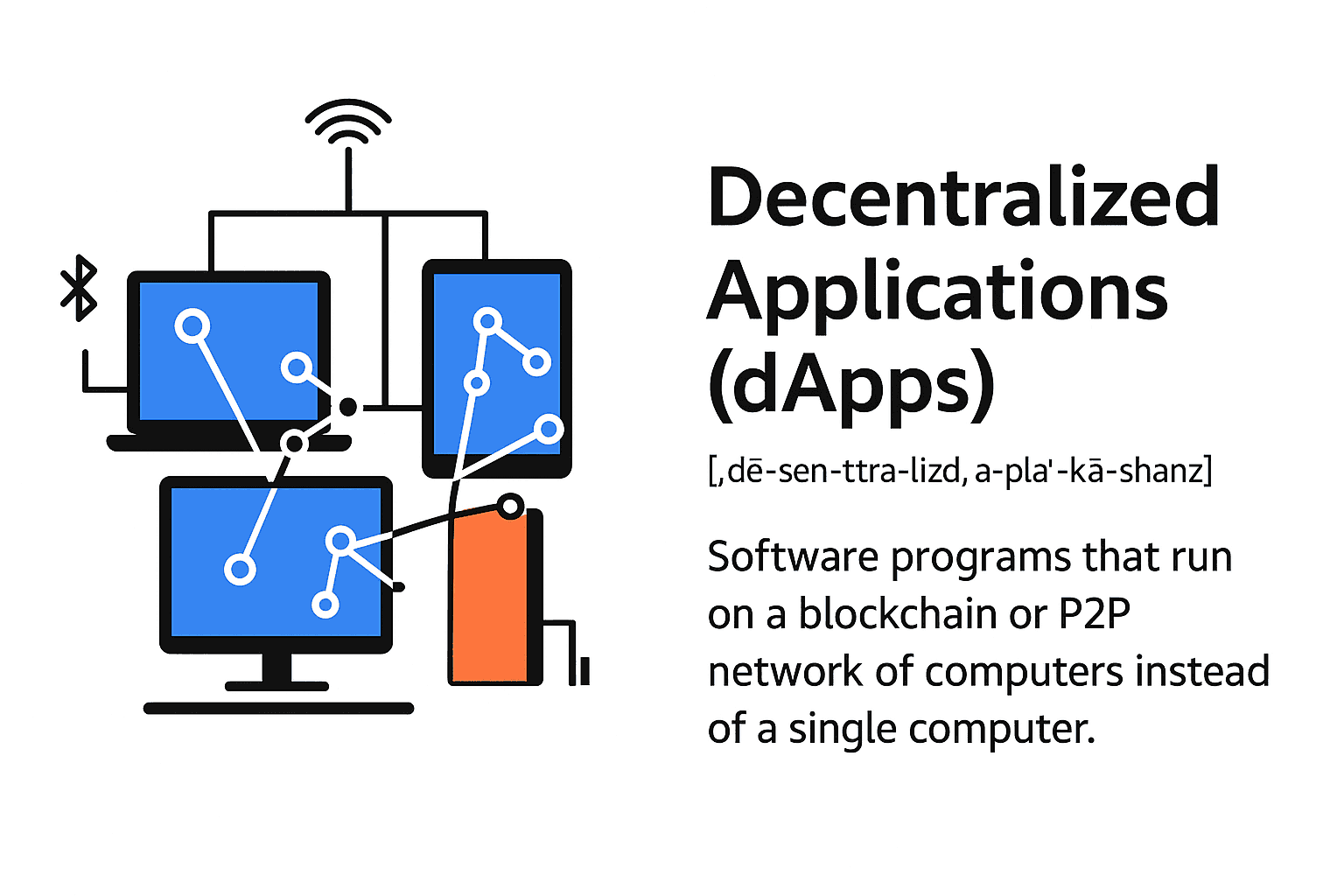
If you are asking what is dApps in crypto, it refers to software that runs on a blockchain or peer-to-peer network instead of a company’s servers. Often built on Ethereum, these tools power finance, games, and social platforms while emphasizing privacy and censorship resistance.
Decentralized Applications (dApps) Explained
Decentralized apps are programs that execute on distributed systems rather than centralized infrastructure. By coordinating activity across a blockchain or other peer-to-peer rails, they remove single points of failure and reduce reliance on intermediaries.
Key characteristics typically include:
- Decentralized operation: Core logic or data is coordinated across many participants rather than a single company-controlled backend.
- Blockchain integration: The app reads from and writes to a shared ledger so activity can be verified without relying on one operator.
- Smart contracts: On-chain code can automate rules and transactions so the app can function without manual approval from a central party.
- Open-source or verifiable code: Many projects publish code or make it auditable so users can inspect how it works.
- Incentives and token economics: Networks often use tokens, rewards, or fee mechanisms to motivate participation and secure the system.
How These Apps Operate on Blockchains and Peer-to-Peer Networks
Traditional web apps such as Uber or X (formerly Twitter) run on infrastructure owned and controlled by one company. No matter how many users participate, the backend remains under that operator’s authority.
In contrast, some software coordinates activity across a peer-to-peer network. Examples like BitTorrent, Tor, and Popcorn Time let many participants seed, share, and consume content directly with one another. These tools are decentralized applications, but they are not blockchain-based dApps because they do not use a blockchain ledger or smart contracts to execute and record activity.
Blockchain-based dApps take this further by executing code in an open-source, decentralized environment. A developer could publish a social feed to a chain where anyone can post, and only the original author can remove their own messages—no single entity can censor the ledger.
Popular blockchains used to build dApps include Ethereum, Binance Smart Chain, Solana, Polygon, and Avalanche. Developers often choose these networks because they have large user ecosystems, mature tooling, and active communities, while some also emphasize lower fees or higher throughput for app-like experiences.
Centralized Versus Decentralized Apps: Core Differences
Centralized apps are owned by a single party that maintains servers and software. Users install the client and send data to and from the company’s backend, which governs access and behavior.
Why Decentralized Applications Matter
Several traits of dApps can reshape how information, value, and services are exchanged online.
Cost and Efficiency: Cutting out the intermediary can reduce fees and latency while broadening access. Imagine managing your finances with near-total control through DeFi tools rather than relying on a bank.
Security: Blockchains employ cryptography and distributed consensus to make records tamper-evident. Because the ledger is validated across many nodes, altering data is exceedingly difficult.
Accessibility: Anyone with an internet connection can participate. This global reach opens the door to new services, digital assets, and information, regardless of location.
Transparency: On-chain activity is auditable. Users can verify transactions without appealing to central authorities, building trust in anonymous or distributed environments.
Practical Uses for dApps
The aim of a dApp is to decentralize specific functions—removing middlemen for finance, gaming, social feeds, and beyond.
They also support secure governance, including voting systems, and can integrate with browsers as plugins for advertising, analytics, or crypto-native tipping.
Common real-world scenarios include:
| Use Case | Description |
|---|---|
| Financial Services | Enabling peer-to-peer exchanges, remittances, or asset transfers without banks. |
| Supply Chain Management | Recording movements of goods for transparency and accountability. |
| Identity Verification | Storing and validating credentials, such as voter rolls or travel documents. |
| Real Estate | Supporting direct property sales and tracking ownership records and deeds. |
| Healthcare | Managing medical records and facilitating secure communication among providers. |
| Education | Powering decentralized learning platforms where students and teachers interact directly. |
| Social Media | Hosting user-generated content with stronger resistance to centralized moderation. |
| Predictive Markets | Letting users create markets and place outcome-based wagers. |
Scams and Risks to Watch For
Fraud has occurred in this space, including Ponzi schemes that pay earlier participants with funds from newer users.
Some bad actors promote fake initial coin offerings to raise money for projects they never intend to build.
Phishing sites, malicious emails, and malware-laced dApps have been used to steal keys, drain wallets, or compromise devices.
Before connecting a wallet, verify the permissions you are granting and the exact transaction you are approving; a single mistaken authorization can be enough to move assets.
Beyond outright fraud, smart contract bugs and vulnerabilities can be exploited to drain pooled funds or manipulate protocol rules. DeFi-style projects can also suffer rug pulls or exit scams, where insiders remove liquidity or abandon a protocol after attracting deposits.
User error is another common source of loss, such as sending funds to the wrong address or approving a malicious prompt that grants broader access than intended. Because there is no central operator, tracing culprits and recovering funds can be difficult.
Pros and Cons of Decentralized Apps
Advantages:
- Privacy and autonomy: Many benefits center on user control and reduced dependence on centralized accounts.
- Trust-minimized exchange via smart contracts: On-chain agreements can execute automatically between pseudonymous users.
- Censorship resistance for social platforms: Community-run infrastructure can make it harder for any single participant to suppress content.
- Developer innovation and flexibility (e.g., on Ethereum): Programmable networks can accelerate experimentation across finance, gaming, social tools, and e-commerce.
Disadvantages:
- Scalability and network congestion: Heavy demand for computation or storage can congest a blockchain network.
- User experience challenges: To compete with mainstream apps, dApps must deliver intuitive interfaces and responsive performance.
- Security risks from unaudited code: Sloppy or unreviewed deployments can invite exploits and loss of funds.
- Difficulty upgrading deployed smart contracts: Once code and data are on-chain, patching bugs or improving features can be complex.
Regulatory Hurdles and Compliance
Location-based rules are difficult to apply when activity spans many jurisdictions and no single entity controls the system. This complicates supervision of markets and services built on decentralized rails.
The Emerging Centralization of dApps: Consider data protection rules in the European Union. If a provider serves users in the European Union, it must comply regardless of where the team is based.
In December 2023, a European subnet of the Internet Computer Protocol launched to help teams build compliant applications. If such infrastructure becomes the default path to compliance, reliance on a permissioned set of nodes could undermine decentralization.
Some projects raise funds through token sales, which may be treated as unregistered securities offerings. Financial dApps like exchanges or lending protocols often must adhere to know-your-client and similar rules.
Consumer Protection: Even without a purchase, users may grant access that can place assets at risk. Wallets like MetaMask display prompts and warnings to help users slow down and confirm details before proceeding.
Examples of dApps
CryptoKitties is a well-known blockchain game where players collect, breed, and trade unique digital cats.
Each CryptoKitty is a one-of-a-kind asset recorded on-chain. Like other collectibles, prices can move with market demand and rarity, similar to NFTs.
Uniswap is a decentralized exchange protocol on Ethereum. Automated on-chain code creates liquidity pools, allowing users to swap tokens directly from a wallet without intermediaries.
Aave is a DeFi lending protocol where users supply assets to earn yield and borrowers can take overcollateralized loans from shared liquidity pools.
OpenSea is an NFT marketplace where users can list, buy, and sell collectibles and other tokenized items across supported networks.
Lens Protocol is a social media-focused network that lets users publish profiles and posts on-chain, enabling apps to build on the same social graph.
Augur is a prediction market platform that lets users create markets and trade outcomes based on real-world events.
What Does Decentralized Application Mean?
A decentralized application is generally open source and interacts with a blockchain to read or write data, often using cryptocurrency to pay for network usage or to move value between users.
How Do dApps Make Money?
dApps can generate revenue through a mix of on-chain and off-chain models. Some charge transaction or protocol fees (for example, a small fee on swaps, borrows, or trades) that are routed to liquidity providers, token holders, or a community treasury. Others issue tokens and rely on token demand to fund development, sometimes pairing this with staking or rewards programs that bootstrap usage.
Some dApps also offer premium features, paid interfaces, or analytics tools while keeping the underlying protocol open. In other cases, advertising, sponsorships, or marketplace listing fees provide income, especially for consumer-facing apps that attract steady traffic.
What Blockchain Platforms Are Used to Build dApps?
Many dApps are built on Ethereum because of its large developer community, mature smart contract tooling, and deep liquidity across DeFi. Binance Smart Chain is also popular for lower fees and easy deployment for teams targeting high transaction volume.
Solana is often chosen for speed and throughput, while Polygon is commonly used to reduce costs for Ethereum-compatible apps. Avalanche is used by teams that want flexible network design and fast finality for financial and gaming use cases.
Is Trust Wallet a dApp?
No. Trust Wallet is primarily a non-custodial crypto wallet, not a decentralized application on its own.
That said, it can act as a gateway to dApps by connecting to them and, in some versions, offering a built-in dApp browser. In practice, the wallet manages keys and approvals, while the dApp logic runs on the blockchain.
What Is the Most Popular Decentralized Application?
Crypto wallets such as MetaMask lead in usage, followed by marketplaces and exchanges like Uniswap and OpenSea. Gambling-focused apps such as MetaWin also attract large audiences.
Is Bitcoin a Decentralized Application?
Bitcoin is decentralized, but it is not an application. It is a blockchain network and native cryptocurrency used for payments and as a speculative asset.
The Bottom Line
dApps shift software from centralized servers to blockchain networks, enabling peer-to-peer interactions, open-source development, and greater censorship resistance. They promise new models in finance, gaming, and social media, but users should proceed carefully given ongoing risk and evolving regulation.