With President Trump signaling support for Bitcoin and other digital assets, momentum around U.S.-focused cryptocurrency policy is building. New initiatives aimed at clearer legislation and supervision — including the Securities and Exchange Commission’s Crypto Task Force and a dedicated interagency Working Group — point to a landscape primed for broader adoption. Add Eric Trump’s statement about exempting certain U.S.-based crypto projects from capital gains, and the stage is set for faster innovation and a more crypto-friendly environment. As this policy shift takes hold, keep these nine crypto coins on your watchlist.
In this guide, “U.S.-based” generally means a project with a meaningful U.S. nexus — such as a founding team or core company headquartered in the United States, U.S. incorporation, substantial U.S. operations, and/or a compliance posture designed around U.S. rules. That said, most networks and tokens are global by nature. Also, a U.S. nexus does not mean a coin is issued, endorsed, or backed by the U.S. government. There is no official U.S. government-backed crypto coin, even though government agencies may at times hold various cryptocurrencies as a result of seizures or enforcement actions.
| Coin Name | Ticker | Launch Year | Founders/Organization | Market Cap | Key Features |
|---|---|---|---|---|---|
| XRP (Ripple) | XRP | 2012 | Jed McCaleb, Arthur Britto, and David Schwartz | Exceeding $148 billion | Rapid, low-cost remittances and cross-border transfers; settlement layer in Ripple’s enterprise solutions |
| Solana | SOL | 2020 | Solana Labs | Above $81 billion | High-throughput blockchain with low fees; popular for decentralized applications and NFT activity |
| USD Coin | USDC | 2018 | Center Consortium | Topping $56 billion | Dollar-tracking stablecoin on Ethereum and other chains; widely used as a medium of exchange |
| Avalanche | AVAX | 2020 | Emin Gün Sirer and Ava Labs | North of $9.8 billion | Platform for launching DeFi protocols and NFT applications; speed, scalability, and flexibility |
| Sui | SUI | 2023 | Mysten Labs | Above $9 billion | Move-based network targeting high performance and low fees; claims of roughly 300,000 transactions per second |
| Stellar | XLM | 2014 | Stellar Development Foundation | Near $10 billion | Crypto-to-fiat conversion and cross-border payments; facilitates on-chain transactions |
| Hedera | HBAR | 2018 | Hedera Hashgraph LLC | Above $8 billion | Hashgraph-based network with a governing council; designed without mining |
| Litecoin | LTC | 2011 | Charlie Lee | Exceeding $9 billion | Fast, low-cost peer-to-peer transactions; maximum supply of 84 million coins |
| NEAR Protocol | NEAR | 2020 | Erik Trautman, Alex Skidanov, and Illia Polosukhin | Over $3.5 billion | Layer 1 focused on usability and scalability for dApps and Web3; supports staking |
1. XRP (Ripple)
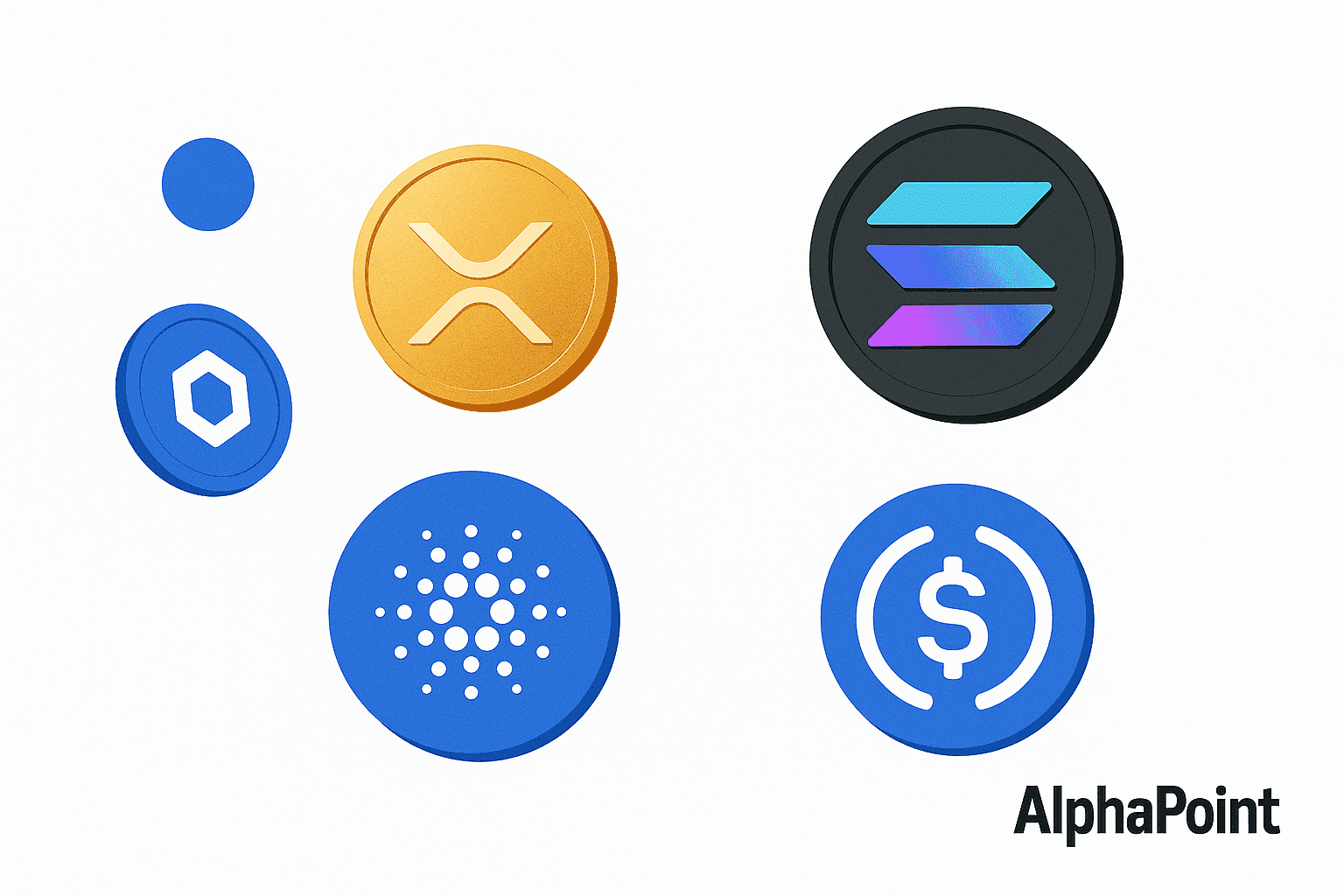
XRP powers the XRP Ledger, introduced in 2012 by Jed McCaleb, Arthur Britto, and David Schwartz. Unlike many cryptocurrencies, it was pre-mined with a hard cap of 100 billion tokens.
Engineered for rapid, low-cost remittances and cross-border transfers, it functions as a settlement layer in Ripple’s enterprise solutions.
Known for efficiency relative to BTC, XRP ranks among the largest digital assets with a market capitalization exceeding $148 billion.
2. Solana (SOL)
Solana, launched by Solana Labs in 2020, has grown into a leading high-throughput blockchain with a market cap above $81 billion and is often viewed as a top challenger to Ethereum.
Its speed and low fees make it a preferred network for decentralized applications and NFT activity in the broader crypto market.
3. USD Coin (USDC)
USD Coin is a stablecoin designed to track the U.S. dollar on Ethereum and other chains, offering a digital currency that aims to hold a steady value.
Introduced by Center Consortium in 2018, USDC has a market cap topping $56 billion and is widely used as a reliable medium of exchange within cryptocurrency markets.
4. Avalanche (AVAX)
Avalanche, created in 2020 by Emin Gün Sirer and Ava Labs, is a decentralized platform built for launching DeFi protocols and NFT applications, prized for speed, scalability, and flexibility.
Its native token, AVAX, holds a market capitalization north of $9.8 billion, making it a strong choice for enterprise-grade deployments.
5. Sui (SUI)
Sui, introduced by Mysten Labs in 2023, is a newer blockchain that has gained traction quickly, with a market cap above $9 billion despite its recent debut.
Using the Move programming language, the network targets high performance and low fees, with claims of processing roughly 300,000 transactions per second.
6. Stellar (XLM)
Stellar, developed in 2014 by the Stellar Development Foundation, is built for seamless crypto-to-fiat conversion and efficient cross-border payments.
XLM maintains a market cap near $10 billion and primarily facilitates on-chain transactions, while also being available on exchanges as an investable asset.
7. Hedera (HBAR)
Hedera, initiated in 2018 by Hedera Hashgraph LLC, operates under a governing council that includes prominent organizations in technology and academia.
It uses Hashgraph rather than a traditional blockchain, removing mining from the equation and appealing to sustainability-focused users and enterprises.
Its utility token, HBAR, carries a market capitalization above $8 billion, used for network fees and held by investors as a digital asset.
8. Litecoin (LTC)
Litecoin, launched in 2011 by Charlie Lee using Bitcoin’s open-source code, is often called “silver” to Bitcoin’s “gold,” with a maximum supply of 84 million coins.
Despite waves of newer tokens, LTC remains relevant, supporting swift, low-cost, peer-to-peer transactions and holding a market cap exceeding $9 billion.
Its speed and affordability make it attractive for both individuals and businesses handling cross-border payments.
9. NEAR Protocol (NEAR)
NEAR Protocol is a Layer 1 network launched in 2020 by Erik Trautman, Alex Skidanov, and Illia Polosukhin to simplify building dApps and Web3 experiences.
With usability and scalability at its core, NEAR has a market cap over $3.5 billion. The NEAR token is also widely used for staking within the network.
How Are U.S.-Based Crypto Coins Regulated?
Oversight of cryptocurrencies in the United States occurs at both federal and state levels. Here’s how that typically plays out, including why requirements can look different depending on where a business operates and which activities it offers (such as custody, brokerage, or payments).
Federal and State Regulation
Multiple federal agencies share responsibility for supervising digital assets and related activities:
- Securities and Exchange Commission: Regulates tokens deemed securities. The agency has brought actions against several firms and exchanges, including claims related to XRP sales.
- Commodity Futures Trading Commission: Oversees derivatives markets, including futures, swaps, and options tied to crypto assets.
- Financial Crimes Enforcement Network (FinCEN): Enforces anti-money laundering and counter-terrorist financing requirements across U.S. digital currency activity.
- Internal Revenue Service: Treats cryptocurrency as property for tax purposes. Taxes can apply to ordinary income, business income, and capital gains from disposals.
In addition to federal rules, issuers and exchanges must follow state-specific requirements. New York, for example, requires a BitLicense for virtual currency businesses. Licenses are also required in the District of Columbia, Delaware, Colorado, and Alaska. In practice, state differences often show up in how licensing is structured (such as money-transmitter-style registration versus a dedicated virtual-currency framework), what activities trigger approval (custody, lending, or exchange services), and how examinations, disclosures, and consumer-complaint processes are handled.
As rulemaking evolves, U.S.-linked crypto projects should plan for tighter operational expectations even when the policy tone is supportive.
Many states are still drafting clearer policies, and federal guidance continues to evolve. Staying current with both levels of regulation is essential, especially as new proposals and enforcement priorities can change what “compliance-ready” looks like for tokens, exchanges, and stablecoin issuers.
Ongoing Developments
Several policy moves are poised to reshape the crypto landscape in the near term:
- Trump’s Executive Order: The “Strengthening American Leadership in Digital Financial Technology” directive has already altered the policy posture. For existing and future U.S.-linked projects, the practical impact is often felt through changes in agency coordination and priorities, which can influence how quickly new products get built, banked, and brought to market.
- Order rescinding U.S. central bank digital currency development: It rescinds efforts to develop and issue a U.S. central bank digital currency, shifting attention away from a government-issued digital dollar and toward private-sector innovation.
- Order supporting access for crypto businesses: It directs open and equitable access to financial services for cryptocurrency businesses, which may improve on-ramps and off-ramps for compliant firms and reduce operational friction for developers building in the United States.
- Order supporting dollar-backed stablecoins: It supports the evolution of dollar-backed stablecoins, which could benefit projects that prioritize reserves, transparency, and regulated distribution.
- Creation of a national digital asset reserve Working Group: It created a Working Group charged with clarifying rules and evaluating the concept of a national digital asset reserve, a step that could shape future frameworks that investors and builders must plan around.
- Bitcoin Act of 2024 (federal Bitcoin reserve): The Bitcoin Act of 2024 proposes a federal reserve of over one million Bitcoin. Similar measures have been floated in several states, potentially accelerating adoption and innovation.
- Securities and Exchange Commission’s Crypto Task Force: Under Commissioner Hester Peirce, the task force aims to bring clearer guardrails, which could reduce uncertainty, attract institutional participation, and spur new projects.
When people ask which crypto is “best” in the United States, the answer usually depends on the use case and risk tolerance: Bitcoin is often viewed as the benchmark due to adoption and liquidity, USD Coin is commonly used for dollar stability and settlement, and networks like Solana, Avalanche, and NEAR may stand out for builders focused on applications. For U.S.-linked projects specifically, many investors also weigh how a token is distributed, whether the team operates through a U.S. entity, and how realistically the project can meet compliance and reporting expectations over time.
U.S.-based crypto can come with real advantages, including access to deep capital markets, stronger institutional participation, and the possibility of clearer operating standards over time. It also comes with challenges, such as higher compliance costs, faster-moving enforcement risk when rules are unclear, and the need to navigate a patchwork of state-by-state requirements.
Tax policy can also influence popularity. If certain U.S.-linked crypto projects were to receive preferential tax treatment (such as exemptions from capital gains), it could increase retail interest and encourage builders to base operations domestically. But adoption would still hinge on how narrowly any policy is written, how it is implemented, and whether exchanges and wallets can support the needed reporting.
If you want to invest in or gain exposure to U.S.-based crypto, common routes include buying tokens directly through exchanges or broker platforms where they are listed, holding assets in a self-custody wallet, or using regulated investment products that provide crypto exposure where available. Some investors also choose diversified exposure through funds or portfolios that include U.S.-linked networks and stablecoins, depending on their objectives and risk profile.