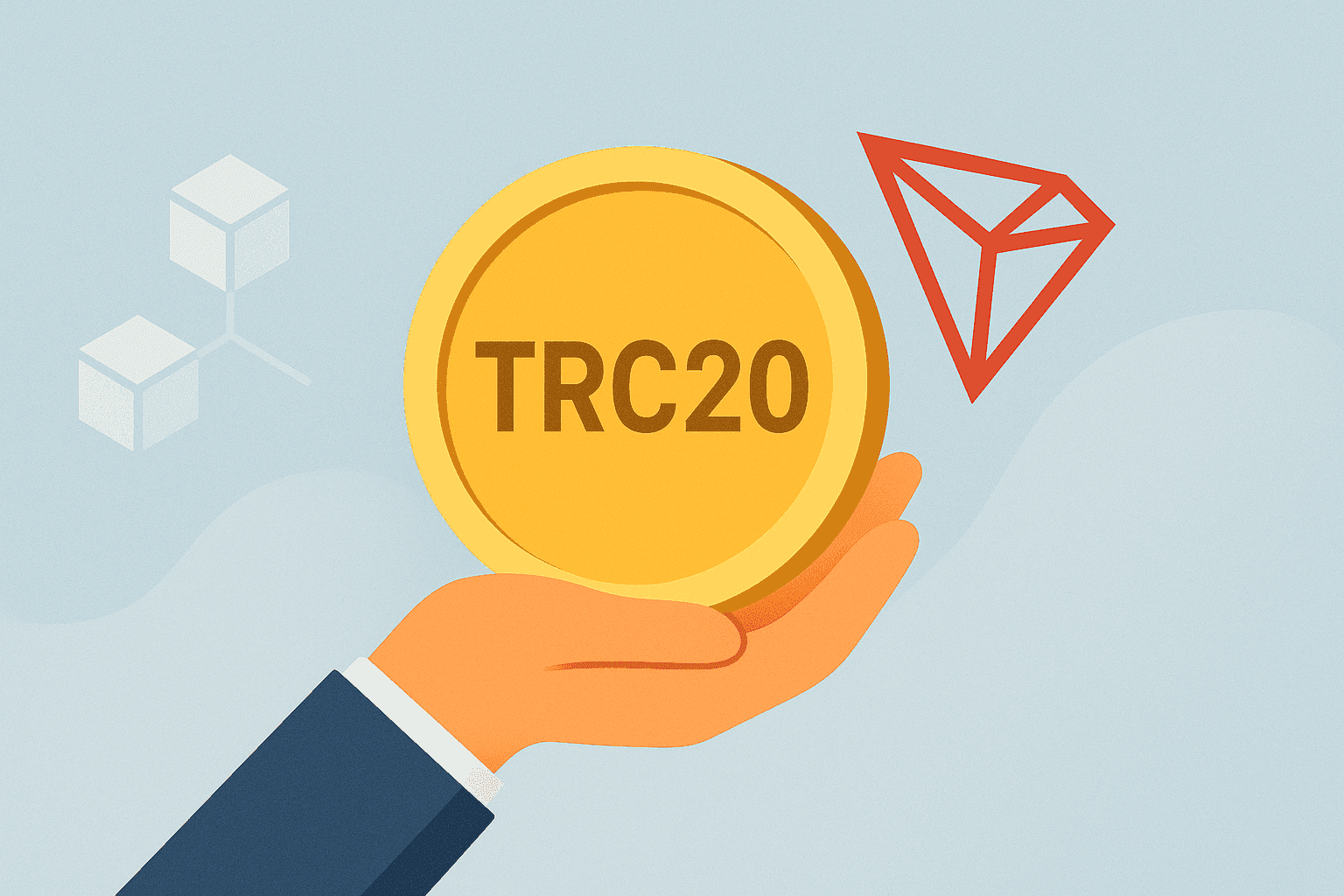
If you are looking for what TRC20 means in crypto, it refers to a token standard on the Tron blockchain that defines how tokens behave so wallets, exchanges, smart contracts, and dApps can interact consistently and at low cost. TRC20 itself is not a coin with a single price; the dollar value depends on the specific TRC20 token you hold (for example, USDT issued as TRC20 is designed to track $1, while other TRC20 tokens can fluctuate).
What Is TRC20?
TRC20 is a formal token standard issued on the Tron network. Think of it as a rulebook every Tron-based token must follow. Because of this shared specification, a wallet or exchange understands how to read balances, process a transaction, and call a smart contract. It mirrors the idea of ERC-20 on Ethereum but is tailored for Tron’s fast and inexpensive infrastructure.
TRC20 is not the same thing as USDT. TRC20 is the standard, while USDT (Tether) is a stablecoin that can be issued on multiple networks and standards—including TRC20 on Tron, ERC-20 on Ethereum, and BEP20 on Binance Smart Chain.
Key Takeaways
- TRC20 is Tron’s token standard, similar in interface to ERC20 (Ethereum) and BEP20 (Binance Smart Chain), but it typically differs in fees, settlement speed, and the surrounding ecosystem depending on the underlying chain.
- TRC20 assets are smart contracts exposing fixed functions such as transfer, balanceOf, and totalSupply, executed by the Tron Virtual Machine (TVM) at low cost.
- The model is popular due to minimal fees, quick confirmations, and broad exchange support, with USDT issued as TRC20 representing a large share of stablecoin activity on Tron.
- Pros include cheap transactions, speed, EVM familiarity, major stablecoin liquidity, and energy efficiency; cons include reduced decentralization, heavy reliance on USDT, and contract-level risks.
- TRC20 is widely used across everyday transfers and app activity, which is why it remains one of crypto’s most utilized token standards.
Why Does TRC20 Exist?
Blockchains need predictable token behavior. Without shared rules, every token would act differently and break compatibility. TRC20 solves this by offering:
- Uniformity. Core functions and data formats are consistent across the Tron blockchain.
- Compatibility. Wallets and dApps can support new tokens without redesigning their logic each time.
- Reliability. Smart contracts know which interfaces exist and how to handle inputs and outputs.
The purpose is straightforward: a dependable, repeatable way to launch tokens on Tron.
How Does a TRC20 Token Work Technically?
TRC20 operates like a template for smart contracts. Each token is a contract that implements a known interface. That interface governs:
- How many units can exist (tokenomics and supply control).
- How balances are tracked per wallet address.
- Who can transfer tokens and under what rules.
- How approvals let third parties spend on a holder’s behalf.
Step 1: Create a Contract That Follows TRC20 Rules
A token issuer writes a contract in a Solidity-style language because the TVM is closely aligned with the EVM on Ethereum.
The contract specifies items such as:
- totalSupply: the maximum number of tokens in circulation.
- name and symbol: for example, USDT or TRX.
- balanceOf: the function that returns a holder’s balance.
- transfer: the method that moves tokens between addresses.
Once the implementation adheres to the TRC20 interface, the network can validate and accept it.
Step 2: Deploy the Contract to the Blockchain
After deployment on the Tron network, the token becomes active and available to wallets and dApps. The code is immutable on-chain, so the rules cannot be altered post-launch, which adds predictability for DeFi use cases.
Step 3: Wallets and Apps Recognize It Automatically
Because the interface is standardized, Tron-compatible services already know how to:
- Read balances from the contract.
- Send and receive token transactions.
- Invoke contract functions safely.
This is why USDT on Tron behaves as smoothly in your wallet as TRX.
To get a TRC20 wallet address, create an account in a Tron-compatible wallet and then copy the receive address for Tron/TRC20. Tron addresses typically start with “T,” and common wallet options that support TRC20 include TronLink, Trust Wallet, and Ledger (used with a Tron-compatible interface).
If you are unsure whether your USDT is ERC20 or TRC20, check the network shown in your wallet or exchange (it is usually labeled during deposit/withdrawal). You can also look at the address format: TRC20 (Tron) addresses commonly start with “T,” while ERC20 (Ethereum) addresses start with “0x.” Transaction details in your wallet history typically show the network as well.
The Role of the Tron Virtual Machine (TVM)
TRC20 runs on the TVM, a runtime closely resembling Ethereum’s EVM. The result is a system that prioritizes performance and efficiency.
- It is extremely fast for regular transactions.
- It is resource-efficient for on-chain execution.
- It keeps costs inexpensive compared with many networks.
Transactions consume “bandwidth” or “energy,” but the resource cost is typically far lower than on Ethereum. This efficiency has helped Tron grow into a leading cryptocurrency ecosystem.
What Makes TRC20 Popular?
Many users choose Tron-based transfers for their balance of speed and low cost. That preference is driven by three standout benefits.
1. Transaction Fees Are Extremely Low
Most TRC20 transactions cost a few cents or less, and sometimes nearly zero if you have staked bandwidth. This makes it ideal for:
- Small-value transfers that need predictable costs.
- High-frequency strategies where fees erode margins.
- Routine account funding between services.
For many, it is simply the cheapest way to move value. Tron also connects well with bridges, so moving assets to or from the Tron blockchain is straightforward.
2. Confirmations Are Fast
While some blockchains may take around 30 seconds or more to confirm, Tron is optimized for high throughput and settles in seconds.
This speed benefits platforms that:
- Need near real-time responsiveness.
- Must keep operating costs low.
- Cannot tolerate settlement delays.
3. Broad Ecosystem and Exchange Support
Tron is integrated across most major exchanges. As a result, TRC20 tokens:
- Are simple to list and trade.
- Move quickly between platforms.
- Reach a very large user base.
Stablecoins like USDT are heavily issued on TRC20, which continually expands the ecosystem.
Advantages of TRC20
| Advantage/Disadvantage | Description |
|---|---|
| Advantage | Very low transaction costs. Fees are consistently minimal, whereas ERC-20 transfers on the Ethereum network can be more expensive. |
| Advantage | Speed and throughput. The Tron blockchain processes many transactions per second, reducing bottlenecks. |
| Advantage | EVM compatibility. Developers familiar with Ethereum tooling can onboard quickly to TVM-based development. |
| Advantage | Widespread stablecoin usage. USDT on TRC20 provides deep liquidity and practical, everyday utility. |
| Advantage | Energy-efficient consensus. Delegated Proof of Stake enables fast, low-energy block production. |
Disadvantages of TRC20
| Advantage/Disadvantage | Description |
|---|---|
| Disadvantage | Less decentralization. A limited set of super representatives create blocks, which some crypto purists view as a centralization risk. |
| Disadvantage | Reliance on USDT. TRC20’s success is closely tied to Tether’s footprint, introducing a potential single point of failure. |
| Disadvantage | Smart contract vulnerabilities. As with any token standard, bugs or exploits can occur at the contract level. |
| Disadvantage | Smaller DeFi footprint than Ethereum. Tron’s DeFi exists but remains less advanced, with TRC20 used more as a payment and transfer rail. |
What Can You Do With TRC20 Tokens?
- Cross-border transfers
- Payroll
- E-commerce payments
- B2B flows
- Stablecoin transfers (e.g., USDT)
- Lending
- Staking
- Providing liquidity
- Yield farming
- Deposits and withdrawals on exchanges
Why Is TRC20 So Cheap?
Costs stay low because of:
- DPoS consensus, which keeps block production inexpensive.
- A resource model where users can stake for energy and bandwidth.
- High efficiency in a network designed for scale.
As a result, transactions rarely face long queues.
TRC20 vs. ERC-20: The Comparison
| Feature | TRC20 (Tron) | ERC20 (Ethereum) | BEP20 (Binance Smart Chain) |
|---|---|---|---|
| Token standard style | EVM-like contract interface implemented on Tron via TVM | EVM contract interface on Ethereum | EVM contract interface on Binance Smart Chain |
| Typical user experience | Fast confirmations and low fees for many everyday transfers | Broadest DeFi and app ecosystem, but fees can be higher | Often low fees and fast blocks, with strong exchange-linked ecosystem |
| Ecosystem emphasis | High stablecoin usage and transfer-heavy activity | Largest developer and application footprint | Large retail and exchange-adjacent app activity |
| Network choice impact | Costs and speed are driven by Tron’s bandwidth/energy model | Costs and speed are driven by Ethereum gas dynamics | Costs and speed reflect BSC’s chain design and validator structure |
Final Thoughts
TRC20 has become one of the world’s most used token standards, propelled by USDT’s rapid growth on the Tron network. Built around speed, efficiency, and low cost, it aligns with what most people want when sending value or managing stablecoins.
The user experience is fast and inexpensive, though questions about decentralization and reliance on a few large players remain. Even so, TRC20 is now a key pillar of modern crypto infrastructure.
In short, TRC20 enables predictable, quick, low-cost tokens on Tron. It is a foundational standard for payments, stablecoins, dApps, and the large flows that traverse the Tron blockchain daily.