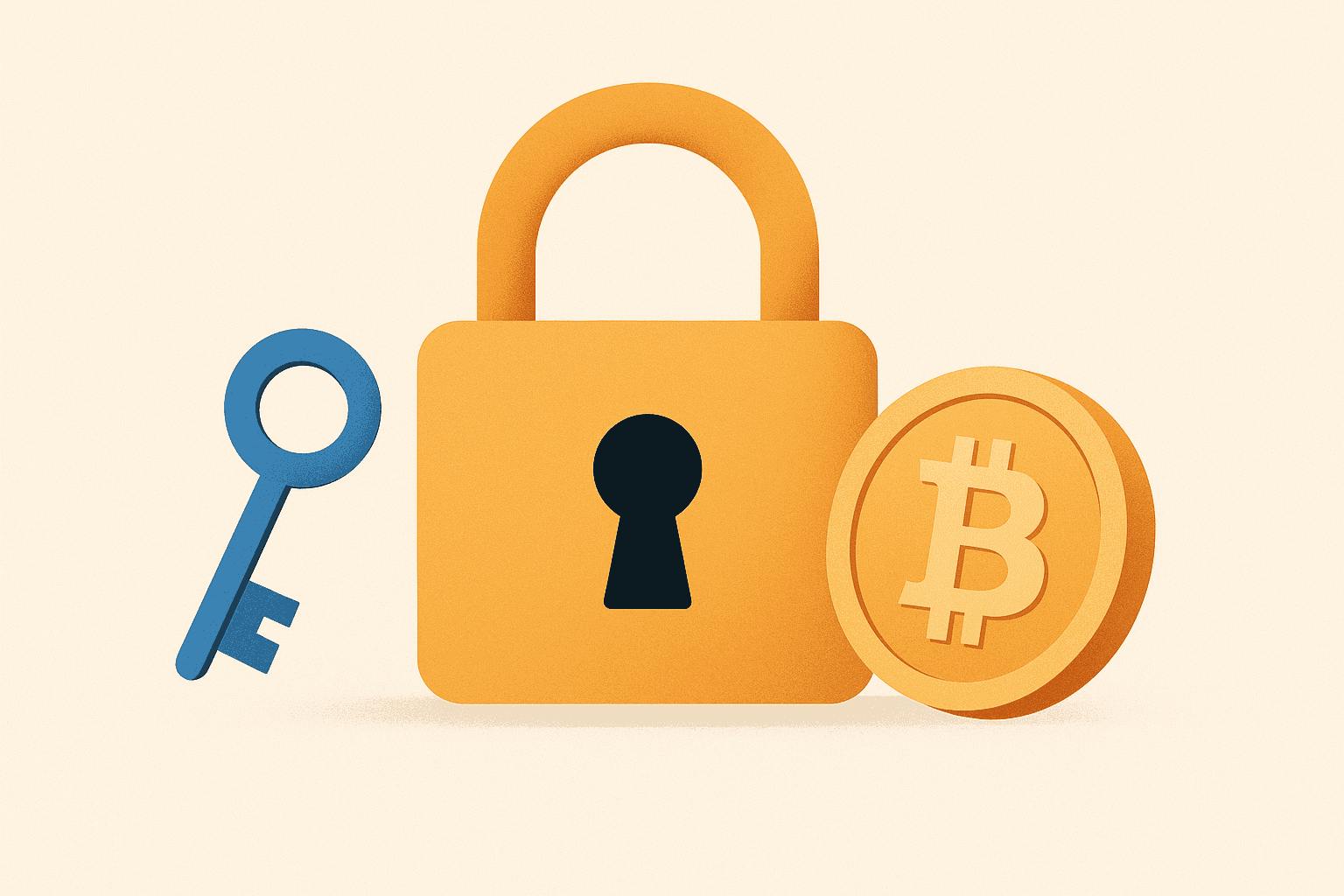
This mantra discourages complacency by reminding every crypto user that where private keys live—and who can touch them—defines your security and ownership.

To truly decode this mantra, begin with the basics: private keys power control on the blockchain.
What Are Private Keys and Why They Matter?
Many say a crypto wallet “stores coins,” but that’s a misconception. Your Bitcoin and other cryptocurrencies live on the blockchain, where balances at each address are recorded by the network’s nodes and cannot be altered by third parties.
The item your crypto wallet protects is the private key.
Each blockchain address is created from a key pair: the public key, which identifies your account and forms your address; and the private key, which authorizes transactions and lets you manage your crypto assets.
Possession equals permission. If someone obtains your private key, they can move the funds from that address. That’s the entire point behind the warning about keys and ownership.
Why This Saying Endures
Two big ideas keep this principle relevant for every crypto user.
Self-Custody
First, it cautions against custodial services. Centralized exchanges and similar platforms often operate custodial wallets. You might see a balance and initiate a withdrawal, but the custodian holds the private keys and can set policies over your funds—much like a traditional bank.
Technically, that’s because deposits are received into addresses controlled by the exchange’s wallet infrastructure (often pooled across many users). The platform records “who owns what” in its internal database, and when you request a withdrawal, you’re asking the exchange to sign and broadcast a transaction with its own private keys.
In practical terms, a custodial account is not a wallet you control on-chain. The platform owns the private keys for the omnibus addresses and you rely on the provider’s internal ledger to reflect your balance.
A non-custodial wallet is the opposite: you (and only you) control the private keys (typically via a recovery phrase), so transactions can only be authorized by you. Software can help you view balances and prepare transactions, but it can’t move funds without your cryptographic approval.
In crypto, ownership is ultimately the ability to sign with the private key; without that, you’re relying on someone else’s system to honor your balance.
Because of that setup, the operator can charge fees on transfers, restrict withdrawals, or even rehypothecate user deposits. Beyond those obvious downsides, custodial control can also expose you to legal seizure or account freezes, service outages and technical failures that block withdrawals, and internal fraud where privileged access is abused.
Even if you trust a centralized exchange such as Coinbase, things can still go sideways. If a custodian fails or declares bankruptcy—as the world saw with high-profile collapses like Ftx—your access to assets can be frozen. You’re also outsourcing security, hoping the custodian can withstand hacks and operational risks.
History also offers clear examples of exchanges losing user funds: Mt. Gox collapsed after massive customer Bitcoin losses tied to security failures and poor controls; Ftx imploded after allegations that customer deposits were misused; and QuadrigaCX users were left unable to withdraw when access to wallets was reportedly lost and records didn’t line up with liabilities.
Scams
The second use of the maxim is fraud prevention. If an attacker gets your private key, the game is over. It’s as reckless as handing a stranger your debit card and PIN. Never reveal a private key.
Flip the concept and you get the upside: your key, your coins. A thief who acquires the private key for one address will drain it fast. If multiple accounts are compromised, it usually means your seed phrase—not just a single key—was exposed.
Defense is straightforward:
- Use an offline hardware wallet.
- Never type, store, or import private keys on an internet-connected device.
- Keep your hardware wallet secured.
- Regularly update device firmware.
- Backup your recovery phrase securely.
Also stay alert for phishing attempts that try to trick you into approving a malicious action or handing over sensitive wallet secrets. If you keep any funds on custodial platforms for convenience, use a unique password and enable multi-factor authentication to reduce account-takeover risk.
Owning the private keys lets you write your own rules. No custodian dictates what you can do. You hold the coins—and the responsibility that comes with financial freedom.
Ledger Delivers Secure Self-Custody
Ledger Signers are built to safeguard private keys and enable full control. They generate and store keys offline inside a Secure Element chip, isolated from your phone or computer.
Even if your laptop is hacked, transactions can remain safe to sign. The Secure Element inside a Ledger Signer is engineered to resist sophisticated physical attacks.

Security is only useful if it’s usable. Ledger Signers pair strong protections with a clear, approachable experience, so you truly hold your keys and your coins. If it isn’t self-custody, why call it crypto?
The Shift: From Hardware Wallet to Signer
Crypto began as an experiment, but adoption has surged as technology and user experience matured. The vocabulary, however, lagged behind.
Calling these devices “hardware wallets” muddied the role of secure hardware and obscured how software like Ledger Live fits into the picture. Along the way, users were confused.
People believed:
- Value sits on the device (it does not; the blockchain holds balances).
- Losing the device means losing assets (not true if your seed phrase is backed up).
- The device is the destination (it is a secure tool for authorization).
- The 24-word recovery phrase is only for experts (safer backup options and guidance are available for everyone).
These aren’t minor misunderstandings—they slow mainstream adoption. Clarity is essential for the next wave of users, so we’re updating how we describe digital ownership.
Hardware wallets → Signers.
Ledger devices don’t store your crypto; they sign transactions, prove intent, and verify identity. They’re not vaults but a secure bridge between you and the decentralized web. They don’t merely hold keys—they let you trust yourself. We call them Signers because that’s what they do.
As artificial intelligence advances, proof of humanity matters more than ever. A Signer is your cryptographic proof-of-you, the foundation to own, authorize, and protect your digital life without relying on a custodian. From sending crypto to signing contracts or verifying credentials, your Signer ensures only you can give digital consent. Together, the Signer and Ledger Wallet redefine digital ownership—clear, secure, and uncompromised.