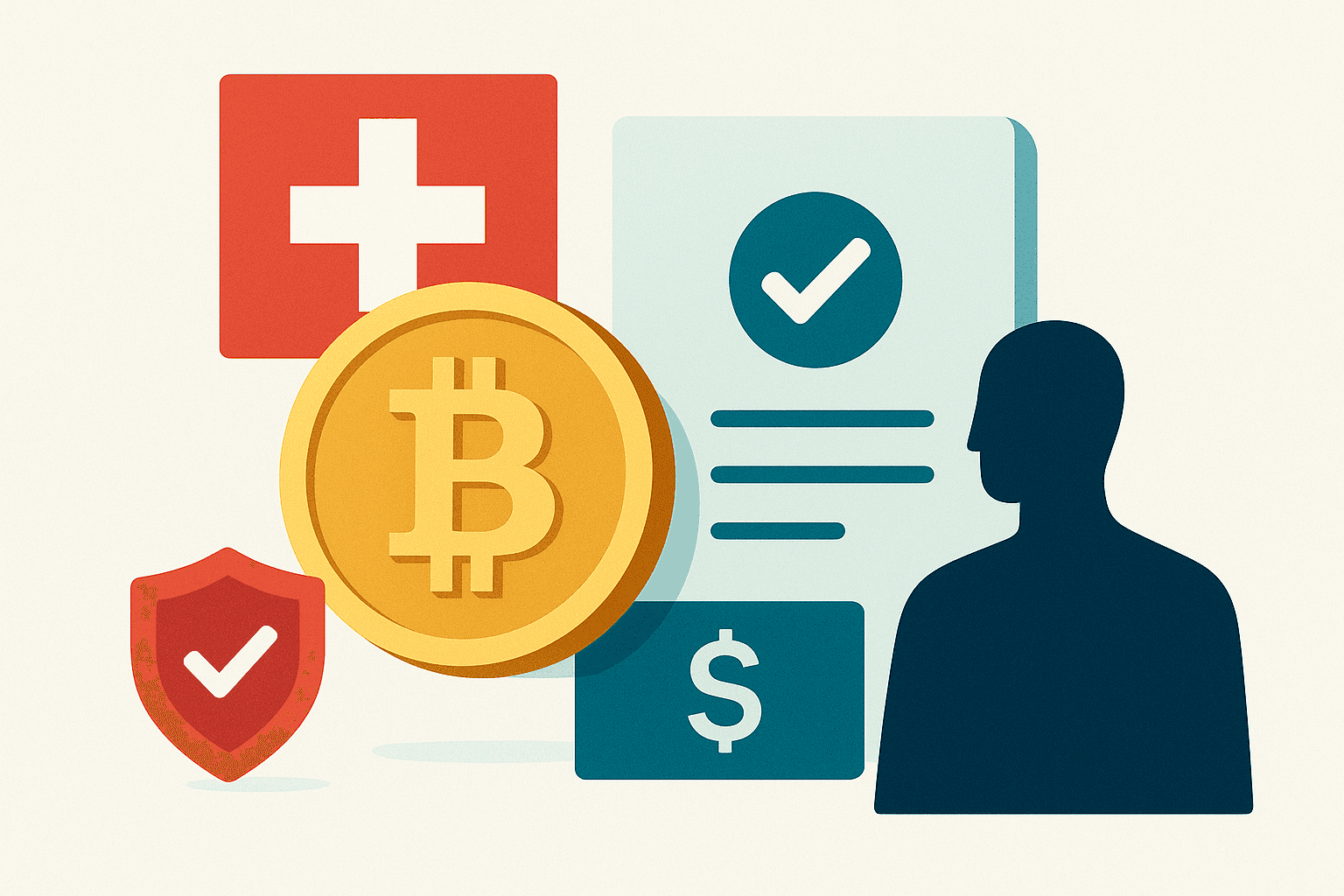
Yes. Holding and exchanging crypto assets is permitted under Swiss law. For anyone asking whether cryptocurrency is legal in Switzerland, the country treats it as a form of digital asset within a supportive legal framework. Switzerland emphasizes a token-centric model rather than focusing solely on market participants. The Distributed Ledger Technology Act (Dlt Act) improves legal certainty around the ownership and transfer of digital assets. To advance the tokenization of rights, it also introduced a new type of negotiable digital security commonly referred to as uncertificated securities.
In practice, bank “acceptance” of crypto varies by institution. Some Swiss banks allow clients to buy, sell, and hold selected crypto assets directly (typically via custody accounts or integrated trading), while many traditional banks do not accept crypto as a deposit in the same way as fiat and may apply tighter checks or restrictions to crypto-related transfers. Examples of Swiss banks and bank-like providers known for offering crypto-related services include Sygnum Bank, AMINA Bank, and Swissquote.
Crypto is also subject to Swiss taxation rules. Individuals generally need to declare crypto holdings for wealth tax purposes, while income tax can apply to crypto received as compensation, mining proceeds, or trading activity that qualifies as professional. Businesses typically account for crypto as part of their business assets, with resulting profits treated under ordinary corporate taxation. Guidance and administration are handled through the Swiss Federal Tax Administration and the cantonal tax authorities, and taxpayers are generally expected to report holdings and taxable events in their regular filings.
Regulatory Bodies Overseeing Crypto in Switzerland
Finma —The Swiss Financial Market Supervisory Authority (Finma) is the independent regulator charged with enforcing the Swiss Financial Markets Act. Its remit covers banks, insurance companies, stock exchanges, securities dealers, and other financial intermediaries operating in the Swiss financial market.
Beyond financial market rules, crypto businesses typically also need to consider general Swiss legal requirements such as company law under the Swiss Code of Obligations, data protection obligations under Swiss data protection law, and consumer protection and marketing rules where services are offered to the public. Depending on the business model and physical presence (for example, offices, staff, or infrastructure), certain requirements can also arise at the cantonal or municipal level, such as commercial registration, local tax administration, and operational permits tied to premises or utilities.
How Switzerland Classifies Digital Assets
Under Finma guidance, how regulation applies depends on the specific token type. In its Ico framework, Finma distinguishes three main categories: payment tokens, utility tokens, and asset tokens.
| Token Type | Definition | Regulatory Treatment | Examples |
|---|---|---|---|
| Payment tokens | Primarily used as a means of exchange for goods or services. | Generally outside Swiss securities laws where they do not create claims against an issuer or third parties. | Bitcoin, Ether, Litecoin |
| Utility tokens | Provide digital access to an application or service on a blockchain infrastructure. | May be treated as securities if issued to raise investment, if they grant enforceable rights, or if the platform is not operational at sale. | Siacoin |
| Asset tokens | Represent a debt or equity claim on the issuer and can entitle holders to future earnings or cash flows. | Regulated as securities if standardized and suitable for mass trading, represent uncertificated securities, or amount to a derivative. | Economically similar to shares, bonds, or derivatives |
Payment tokensfunction primarily as a means of exchange for goods or services. Examples include Bitcoin, Ether, and Litecoin. Because they do not create claims against an issuer or third parties, they generally fall outside the scope of Swiss securities laws.
Utility tokensare designed to grant digital access to an application or service on a blockchain infrastructure. The underlying service must be live at the time of sale. A practical example is Sia’s native token, Siacoin, which renters use to pay for decentralized storage. Utility tokens may be treated as securities if they are issued to raise investment, if they grant enforceable rights against an issuer or third parties, or if the platform is not yet operational when the tokens are sold.
To qualify as anasset token, a token must represent a debt or equity claim on the issuer. Such tokens can entitle holders to future earnings or future cash flows. Economically, they resemble shares, bonds, or derivatives. Asset tokens are regulated as securities if they are standardized and suitable for mass trading, represent uncertificated securities, or amount to a derivative.
The Dlt Act also introduced the tokenized rights category “Registerwertrecht,” known asuncertificated register securities. These are digital securities that can be transferred without relying on banks or brokers, unlike traditional certificated instruments. The Dlt framework enables these rights to be issued and transferred directly as uncertificated register securities.
Licensing Requirements
Banking License —Under the Swiss Banking Act, any platform that accepts deposits from the public must obtain a banking license, subject to limited exemptions. Only licensed banks may accept deposits on a professional basis. A crypto custodian that merely safekeeps payment tokens for clients without lending them can trigger a banking license requirement. Crypto trading platforms that accept fiat money from clients and act as the direct counterparty to client cryptocurrency transactions typically also require a banking license.
Fintech License —The Fintech license relaxes deposit insurance and minimum capital and liquidity requirements, but it imposes accounting and audit obligations under the Swiss Code of Obligations. Under the Dlt Act, crypto custodians offering pooled custody of crypto-based assets must obtain a Fintech license.
Dlt Trading License for Crypto Exchanges —The Blockchain/Dlt laws created a dedicated license for Dlt trading facilities (i.e., crypto exchanges). This “token securities exchange” authorization presupposes that Dlt securities are traded, and potentially held in custody, cleared, and/or settled on the licensed platform. Beyond Dlt securities, such facilities may also list utility and payment tokens.
While the details depend on the business model, the licensing process typically involves (1) a pre-assessment of whether activities qualify as regulated services, (2) preparation of a licensing concept and governance setup, and (3) submission of an application with evidence of compliance controls. Applicants commonly need to provide documentation covering ownership and group structure, internal policies and procedures (including risk management and Amla compliance where relevant), organizational charts and key personnel, custody and safeguarding arrangements, and audits or assurances required for the license type. Expected timelines and fees vary by license and complexity, and can be influenced by the scope of activities, the completeness of submitted documentation, and the need for follow-up questions during the review.
For banking and fintech licenses, an applicant generally needs to demonstrate appropriate capital, governance, accounting, and audit readiness, along with a compliant operating model for deposits and custody. For a Dlt trading facility authorization, the application typically focuses on market structure rules, participant onboarding, custody/settlement processes (if offered), and the platform’s controls for orderly trading and compliance.
Aml, Kyc, and Cft Obligations
Crypto exchanges, trading venues, and custodians acting as financial intermediaries must comply with the Anti-Money Laundering Act (Amla). Entities supervised by Finma are required to meet the following obligations:
- Verify the identity of each contracting counterparty.
- Identify controlling persons and beneficial owners.
- Detect higher-risk relationships and transactions, and apply enhanced due diligence.
- Comply with Kyc and Aml requirements set out in the Amla.
For crypto apps and exchanges used in Switzerland, the key compliance question is whether the provider is operating as a financial intermediary under Swiss rules. Where Swiss requirements apply, providers typically need to be supervised by Finma or affiliated with an Amla-recognized self-regulatory organization, and they must implement customer onboarding, monitoring, and reporting controls consistent with Swiss anti-money laundering standards.
Travel Rule Requirements
On August 26, 2019, Finma introduced Article 10 Amlo-Finma, which requires originator and beneficiary information to accompany payment orders. The Travel Rule has applied since January 1, 2020.
Under the 2019 guidance, intermediaries supervised by Finma must transmit customers’ personal identifying information. They must also identify transferees in line with Swiss Amla standards when clients use external, non-custodial wallets, and they must verify that the transferee can control the wallet address through appropriate technical measures defined by the intermediary.
Required personal data for the crypto Travel Rule includes:
- Client’s full name.
- Client’s account number.
- Transaction reference number (if no account number exists).
- Client’s address.
- Originator’s date and place of birth, customer number, or national ID number (in place of address).
- Beneficiary’s name.
- Beneficiary’s address.
- Originator Vasp must ensure information is accurate and complete.
Stablecoin Regulation in Switzerland
Finma applies its existing token classification to stablecoins. Depending on the attached rights and their function, a stablecoin may be treated as a hybrid token or an asset token. Where a stablecoin is backed by a pool of fiat currencies or cryptocurrencies, it can be deemed a deposit under banking law, and the issuer must secure a banking license.
Crypto mining is generally legal in Switzerland, but it is typically treated as an ordinary commercial activity that must comply with applicable laws and rules. Depending on scale and setup, mining operators may need to consider local requirements such as zoning and building rules, electricity and grid-connection terms, and environmental or noise constraints, alongside ordinary corporate, accounting, and tax obligations.
Many widely used crypto apps and exchanges are accessible to Swiss residents, but practical availability depends on the provider’s onboarding policies and compliance checks. Examples of services commonly used in the Swiss market include Swissquote, Bitcoin Suisse, Sygnum Bank, AMINA Bank, Kraken, and Coinbase. Where a provider conducts regulated activities in or from Switzerland, it may need Finma supervision or self-regulatory organization affiliation under the Amla framework, and it must meet Swiss standards on customer due diligence and related controls.