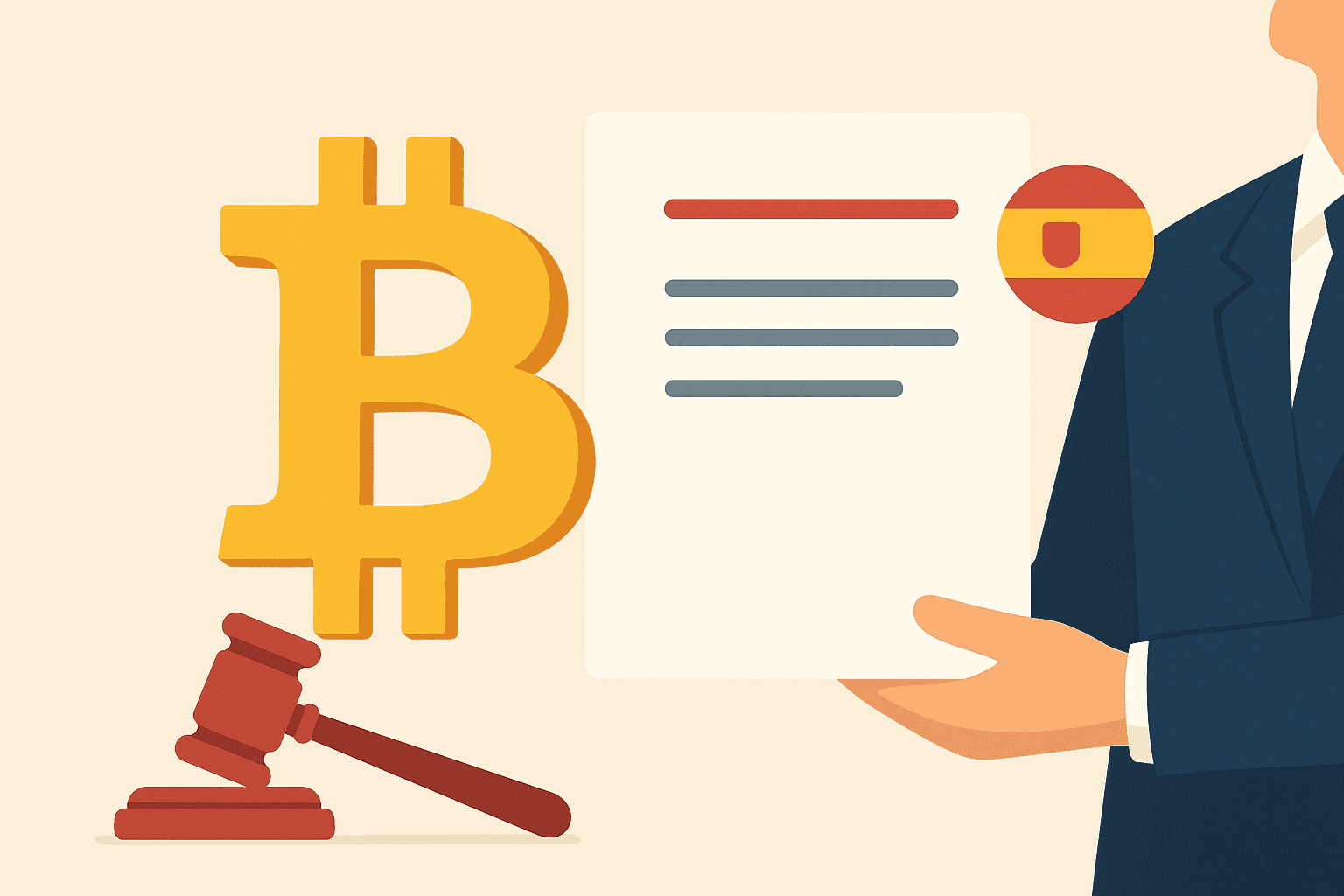
Wondering if crypto is legal in Spain? This concise guide explains the current legal status, who regulates cryptocurrency activity, and what residents and businesses must do to stay compliant. You will learn how Spain treats crypto assets versus legal tender, how rules apply to service providers, and what tax authorities expect.
Table of Contents:
- What Crypto Means Under Spanish Law.
- How Spain Handles Crypto Regulation Without a Dedicated Law.
- How Spain Taxes Crypto and Digital Assets.
- Verifying Users and Following Anti–Money Laundering Rules in Spain.
Cryptocurrency use has expanded across payments, remittances, and experimentation in Spain’s tech scene. Clear guidance matters as crypto trading and exchange activity grow and the European Union framework advances.
How Spanish Law Defines Crypto Assets
Spain assigns the euro exclusive status as legal tender, so virtual currencies are not money in the same sense. Law 46/1998 confirmed the euro as Spain’s official currency from 1999, and crypto is generally treated as a digital asset or, in certain contexts, a financial instrument under cryptocurrency law. This distinction anchors domestic crypto regulation.

Spain’s framework expects virtual currency service providers to operate under anti–money laundering supervision, strengthening market integrity and public confidence.
The Bank of Spain has supported experimentation through the national sandbox. A notable pilot with Monei tested a tokenized “digital euro” (Eurm) on Ethereum 2.0 for peer-to-peer transfers. This did not replace the euro; it explored how blockchain could support everyday transactions under supervision, signaling a willingness to regulate rather than ban emerging payment rails in line with European Union policies.
Consumer protection drives this approach. Past fraud cases led lawmakers to frame cryptocurrencies as products that must meet strict standards. As a result, cryptocurrency exchanges and wallet custodians face safety, governance, and eligibility requirements. Oversight supports fair treatment for users and prepares the ground for accurate crypto tax treatment when activity is visible and lawful.
In 2021, a Royal Decree updated Spain’s 2010 anti–money laundering regime. It defined virtual currencies and specified in-scope service providers, establishing a clearer perimeter for supervision. The measures align with European Union directives, reflecting a maturing market where authorities can trace transactions and apply tax laws with greater precision.
Spain’s Layered Rules for Crypto Without a Single Code
Although there is no all-in-one crypto statute, Spain regulates activity through existing financial and anti–money laundering frameworks. This layered model keeps cryptocurrency within the rule of law while allowing flexibility as technology evolves.
Royal Decree 7/2021 clarified how core crypto activities are treated under Spain’s existing frameworks:
- Crypto service providers must register and comply with anti–money laundering rules.
- Peer-to-peer exchange can be treated as property.
- Public token offerings may qualify as securities or other financial instruments.
Residents and visitors can legally buy crypto in Spain, typically through regulated exchanges or broker apps that serve Spanish users. Popular options used by people in Spain include Binance, Coinbase, Kraken, Bitstamp, and Bit2Me, alongside fintech apps that offer crypto access. Binance is available in Spain, but its available features and product offerings can change as European Union and local requirements evolve, and users should ensure any platform they choose is operating within the rules that apply in Spain.
Crypto can also be used in real estate deals in Spain if the seller accepts it, but the transaction still needs to be documented and completed through the standard property process (for example, contract terms, notary execution, and tax settlement). In practice, many purchases are priced in crypto but settled in euros at completion, and international buyers should be prepared to provide transaction documentation to support lawful funds and correct tax treatment.
Spain also leverages the Securities Market Law, reinforced in 2023, empowering the National Securities Market Commission to supervise token sales and investor information. In parallel, authorities are preparing for the Markets in Crypto-Assets Regulation, tightening standards around promotion, disclosures, and how crypto fits into the broader financial system. This coordination informs how taxation, advertising, and prudential rules work together under crypto regulation in Spain.
Crypto Taxes and Digital Asset Reporting in Spain
Royal Decree 249/2023, effective April 2023, requires individuals and companies to declare crypto holdings and activities starting in 2024. These declarations aim to capture cryptocurrency transactions for tax purposes within a clear, enforceable framework.

Spain introduced structured disclosures for balances, transfers, and foreign-held crypto. Form 721 replaces 720 for overseas assets, and service providers submit annual information statements, improving visibility for tax authorities and aligning with European Union standards.
| Form Number | Purpose | Who Must File | Frequency |
|---|---|---|---|
| 721 | Declaration of crypto held abroad (overseas holdings) | Individuals and companies meeting the applicable thresholds/criteria | Annual |
| 172 | Information statement on client balances held in crypto custody | Crypto service providers within scope in Spain | Annual |
| 173 | Information statement on crypto transfers and transactions handled for clients | Crypto service providers within scope in Spain | Annual |
Crypto is not tax free in Spain. Gains and income linked to crypto activity can be subject to tax, while simply holding crypto (without disposing of it) generally does not create a gain on its own, though holdings may still trigger disclosure duties depending on where assets are held and how you use them.
For individuals, crypto outcomes are typically handled through the annual personal income tax filing process: determine which events created taxable gains or income during the year, calculate values in euros using consistent documentation, and include the results in the relevant sections of your return within the tax agency’s annual filing window (generally submitted electronically). For companies, comparable outcomes are reflected through corporate tax filings, with additional disclosure duties potentially applying when assets are held or serviced through in-scope providers.
Profits from cryptocurrency trading or conversions to fiat can be recognized for personal income tax and capital gain treatment. Mining rewards are typically treated as taxable income when received (valued in euros at the time of receipt), with an additional gain or loss possible when the mined crypto is later sold or exchanged. Staking rewards are generally treated as taxable income when credited or received, and subsequent disposals may also create gains or losses.
Know-Your-Customer and Anti–Money Laundering: Verifying Users in Spain
Since 2021, Spanish anti–money laundering rules explicitly cover virtual currencies as a digital asset class with economic value. This clarified who must comply and set the stage for more consistent taxation as participation widens.
For exchanges and custodial wallets, core compliance duties include:
- Customer due diligence for anti–money laundering onboarding and risk checks.
- Recordkeeping to support supervisory review and internal controls.
- Regulatory submissions required under anti–money laundering rules.
Non-compliance can trigger serious consequences, including administrative fines, operating restrictions, removal from the ability to offer regulated services, and—where conduct crosses into fraud or laundering—potential criminal exposure. For businesses, these outcomes can also include disruption of banking relationships and an inability to maintain lawful access to payment rails.

These controls also support tax enforcement by limiting the ability to conceal assets. Spain seeks growth with accountability, ensuring licensed actors meet defined duties while market adoption increases.
Regulatory Outlook and Next Steps
Spain continues to balance innovation with supervision.
Spain’s direction is pragmatic: enable responsible crypto adoption, require clear disclosures and strong controls for intermediaries, and align local enforcement with broader European Union standards.
Through 2026, expect deeper coordination between crypto regulation and taxation, safer adoption, and opportunities in regulated exchanges, tokens, and Bitcoin—subject to securities regulator oversight. Consistent legal tools and European Union alignment position Spain among Europe’s most forward-looking crypto environments.