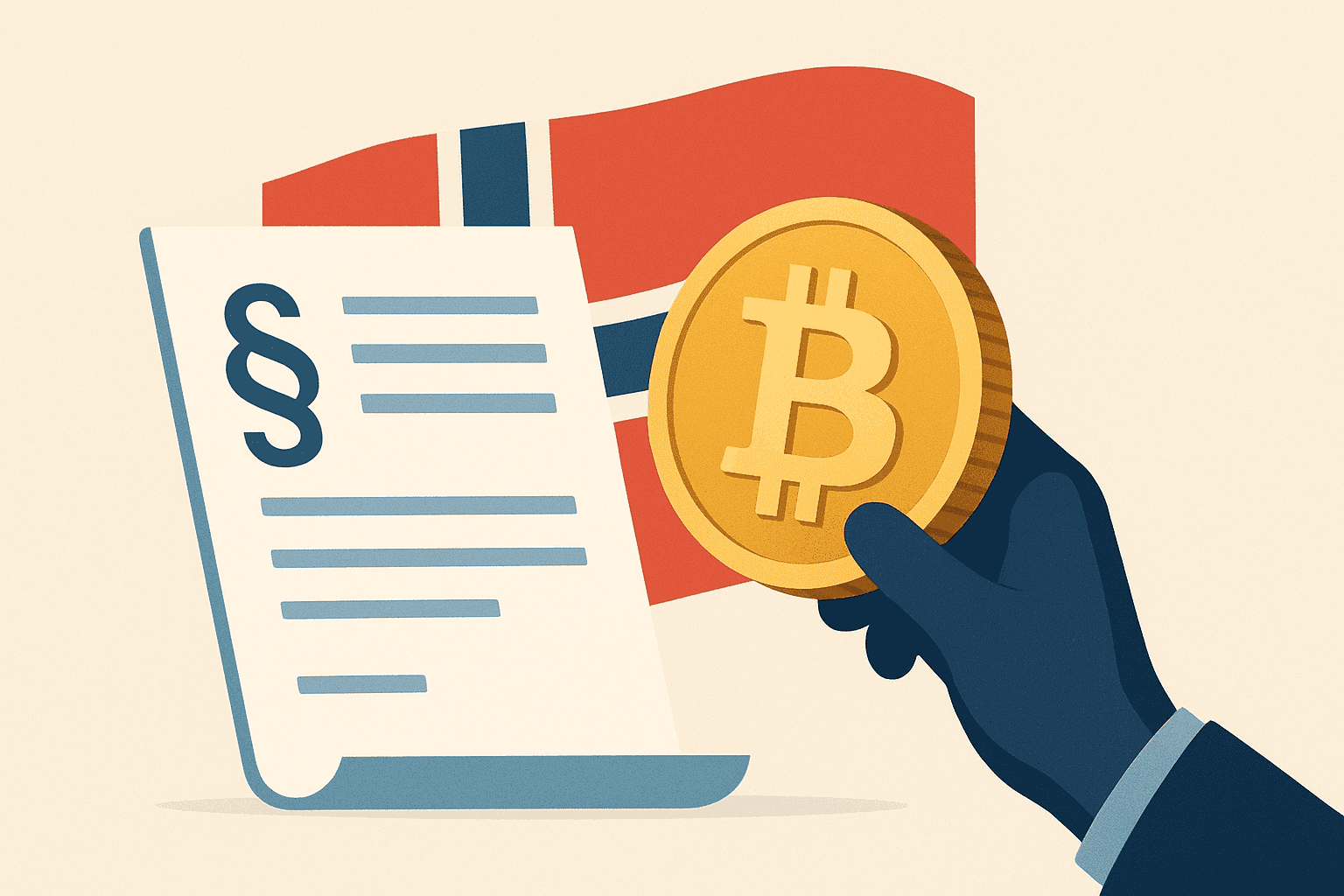
Global Legal Insight publishes a yearly print-and-digital series that investigates urgent themes in business and law with contributions from legal experts worldwide. In the 2025 volume on Blockchain and Cryptocurrency, Ernst & Young Tax and Law Norway wrote the country chapter, which addresses whether cryptocurrency is lawful in Norway and surveys how cryptoassets are positioned domestically under Norwegian regulation.
Norway generally permits cryptoasset ownership and trading, while placing the strongest compliance expectations on intermediaries that exchange, safeguard, or facilitate transfers for others.
Cryptocurrency Regulation in Norway: Institutions and Policy Signals
The chapter presents perspectives from the Financial Supervisory Authority of Norway, the Ministry of Finance, and the Norwegian Central Bank on current market conditions and responsible approaches to a fast‑moving sector. It also distills the operative legal framework and key tax rules for digital assets. In practice, the Financial Supervisory Authority of Norway is the primary supervisory body for many compliance questions that arise when a business provides crypto-related services (for example, exchange services or custody-like safeguarding for clients), while tax reporting and assessment are handled by the Norwegian Tax Administration.
For crypto businesses, the most relevant requirements typically relate to anti-money laundering compliance, including customer due diligence, transaction monitoring, and internal controls. Businesses that provide exchange services between cryptoassets and fiat currency, or that provide services for holding or administering cryptoassets on behalf of others, may need to register with the Financial Supervisory Authority of Norway before offering services, and should be prepared to document ownership and management, governance arrangements, risk assessments, routines for customer checks, and recordkeeping. If you are looking for a “crypto license” in Norway, the practical path is usually a registration-based process tied to anti-money laundering obligations rather than a single, universal license for all crypto activity.
Legal Status and Compliance Overview
This piece is a practical reference for readers seeking clarity on how Norway governs crypto asset activity. It delivers a concise, trustworthy roundup of regulation in Norway, touching on consumer protection and practical themes for participants in digital finance. For individuals, that often means understanding which activities are permitted, how to document transactions, and which authorities oversee intermediaries versus taxation.
From a consumer-use perspective, self-custody wallets such as Trust Wallet are generally available in Norway through standard app distribution channels, and individuals commonly use them as they do in other markets. Using a self-custody wallet does not typically require registration by the individual, but it does not remove tax obligations or documentation expectations; users should keep clear records of purchases, transfers, swaps, and disposals so gains, losses, and income can be reported correctly. Some banks and payment providers may apply their own risk controls around transfers to and from crypto platforms, so users may encounter practical friction even when the underlying activity is lawful.
PayPal availability for purchasing Bitcoin in Norway depends on the specific service route. Some crypto platforms may support PayPal-funded purchases or deposits in certain cases, but many do not due to chargeback and fraud-risk controls, and availability can vary by provider and user verification status. Where PayPal is supported, users should expect identity checks, potentially higher fees, and limits that depend on the platform’s compliance and risk settings.
To buy Tether in Norway, individuals typically use a crypto exchange or broker that lists the stablecoin and supports onboarding for Norwegian residents. The usual flow is to complete identity verification on the platform, fund the account using the supported payment method (commonly bank transfer or card, depending on the provider), and then place an order for the stablecoin. Practical banking considerations can matter, including a bank’s willingness to process payments to particular platforms and the platform’s own requirements for source-of-funds information.
Bitcoin mining is generally lawful in Norway, but it can trigger ordinary business, tax, and local compliance considerations depending on scale (for example, zoning, noise, and commercial electricity arrangements). Norway’s electricity pricing is market-based and can be attractive in some regions, but miners should not assume dedicated government subsidies specific to crypto mining; any favorable power costs typically come from standard industrial contracts, local grid conditions, or general schemes that are not exclusive to mining and may change based on policy and eligibility criteria.
On taxation, cryptoassets are generally treated as taxable assets in Norway, and taxpayers are expected to report disposals and income tied to crypto activity. As a rule of thumb, gains and losses on sales, exchanges between cryptoassets, and spending crypto can be taxable events, while income-like receipts (such as rewards that function like compensation or yield) may be taxed when received, with later disposal potentially creating an additional gain or loss based on value changes. The applicable tax rate will typically follow the ordinary income tax rate for individuals, and accurate recordkeeping is essential for cost basis, acquisition dates, fees, and fair value at the time of each taxable event.
Legal ways to reduce crypto-related taxes in Norway tend to be documentation- and planning-driven rather than loophole-driven. Common approaches include ensuring all allowable losses are captured and reported, deducting eligible transaction costs where permitted, maintaining consistent cost-basis tracking so gains are not overstated, and planning disposals with an eye to offsetting gains with realized losses when that matches the taxpayer’s broader financial situation. For higher-activity traders or mining operations, it can also be important to assess whether the activity resembles a business in substance, since that can affect how income, expenses, and reporting are treated under Norwegian rules.