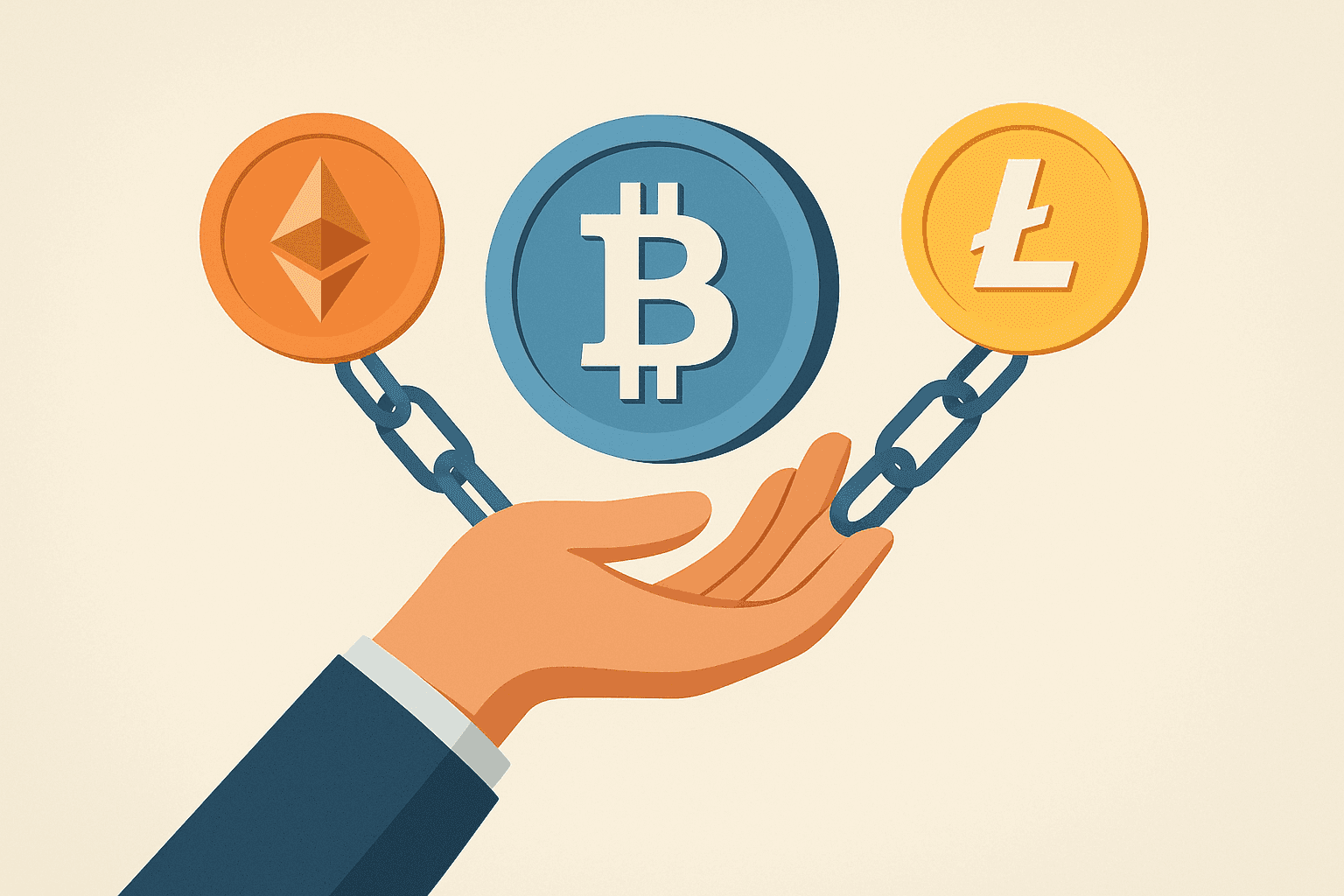
In simple terms, interoperability means different blockchains or crypto systems can work together and share information or assets easily. In practical terms, this phrase describes how separate blockchain networks exchange messages, move digital assets, and coordinate transactions without intermediaries. Think of it as letting independent chains interact directly, so one ledger can communicate with another across different blockchain platforms.
Today, most chains resemble isolated islands. Bitcoin, Ethereum, and Solana each run with their own rules, tokens, and ecosystems. Interoperability serves as the bridge-and-translator layer that enables assets and data to travel smoothly between multiple blockchains.
This connectivity reduces fragmentation, unlocks cross-chain use cases, and helps build a cohesive crypto economy where applications collaborate instead of living in silos.
In the real world, this shows up in cross-chain decentralized exchanges and aggregators that route swaps across multiple networks in a single flow, as well as NFT bridges that let collectors move NFTs between chains (for example, from Ethereum to Polygon) to access different marketplaces and lower fees. It also powers multi-chain DeFi strategies where users provide collateral on one network while borrowing, trading, or yield-farming on another.
Interoperability is foundational infrastructure for Web3: it lets applications coordinate across networks so users can focus on what they want to do, not where it happens.
How Cross-Chain Communication Works
Several approaches enable interactions across different blockchains:
| Solution Type | Description | Example |
|---|---|---|
| Cross-Chain Bridges | Protocols that move tokens or information from one network to another. They are widely used but can introduce security risk. | Sending ETH value to BNB Chain |
| Wrapped Assets | Representations of a coin on a new chain, enabling it to be used in that chain’s apps and contracts. | wBTC mirroring Bitcoin on Ethereum |
| Oracles | Services that deliver off-chain inputs to smart contracts and, in some designs, relay verified events between chains. | Oracle-reported events used to trigger cross-network actions |
| Native Interoperable Frameworks | Architectures that embed cross-chain communication at the protocol level. | Cosmos and Polkadot |
| Atomic Swaps | Peer-to-peer, trust-minimized exchanges of assets across chains, typically using hash time-locked contracts. | Swapping BTC for ETH without a centralized exchange |
| Sidechains | Separate chains linked to a main network that can move assets via pegs, extending features or throughput. | Liquid Network as a Bitcoin sidechain |
| Messaging Protocols | Cross-chain messaging layers that deliver verified instructions or state between networks. | IBC, Chainlink CCIP, LayerZero |
Under the hood, solutions may use smart contract messaging, consensus relays, light-client verification, or middleware layers that reconcile state and transaction intent across networks.
Why Interoperability Matters
- Improved User Journeys: Move value and data across chains without juggling multiple apps and manual steps.
- Deeper Liquidity: Capital can flow across ecosystems, strengthening DeFi markets and trading activity.
- Scale by Specialization: Projects can split workloads — a fast chain for throughput, a secure chain for settlement, and another for storage.
- Composability Across Ecosystems: dApps can combine features from several platforms to deliver richer functionality.
Risks and Trade-Offs
| Challenge | Description |
|---|---|
| Security Exposure | Bridges remain a prime target for exploits and need rigorous audits and monitoring. |
| System Complexity | More moving parts introduce new failure modes and operational overhead. |
| Lack of Standards | Heterogeneous designs and tooling mean not every chain integrates cleanly yet. |
| Regulatory Uncertainty | Cross-network flows can complicate compliance, oversight, and jurisdictional expectations. |
| Scalability Constraints | Verification and relaying can add latency and costs, especially as more chains and messages are involved. |
| User Experience Hurdles | Multiple networks, fees, confirmations, and failure states can still feel confusing or fragile for everyday users. |
The interoperability trilemma is the challenge of improving cross-chain security, scalability, and decentralization at the same time — strengthening two often puts pressure on the third.
The field is advancing quickly, but teams must balance ease of use with robust threat models and verification.
FAQs
Is Interoperability the Same as Cross-Chain?
Cross-chain usually refers to direct actions like token transfers. Interoperability is the broader umbrella covering messaging, data exchange, and ecosystem-level compatibility.
Which Efforts Focus on This Problem?
Cosmos, Polkadot, Chainlink CCIP, Avalanche Subnets, and LayerZero each pursue distinct cross-network communication designs. Cosmos is especially known for interoperability because its Inter-Blockchain Communication (IBC) protocol standardizes how chains in the ecosystem pass messages and move value. Polkadot is known for its relay chain and parachains model, where multiple specialized chains connect through shared security and coordinated communication.
Can One Wallet Work on Many Blockchains?
Multi-network wallets like MetaMask or Rabby support numerous chains, but true seamlessness still depends on the underlying interoperability stack.