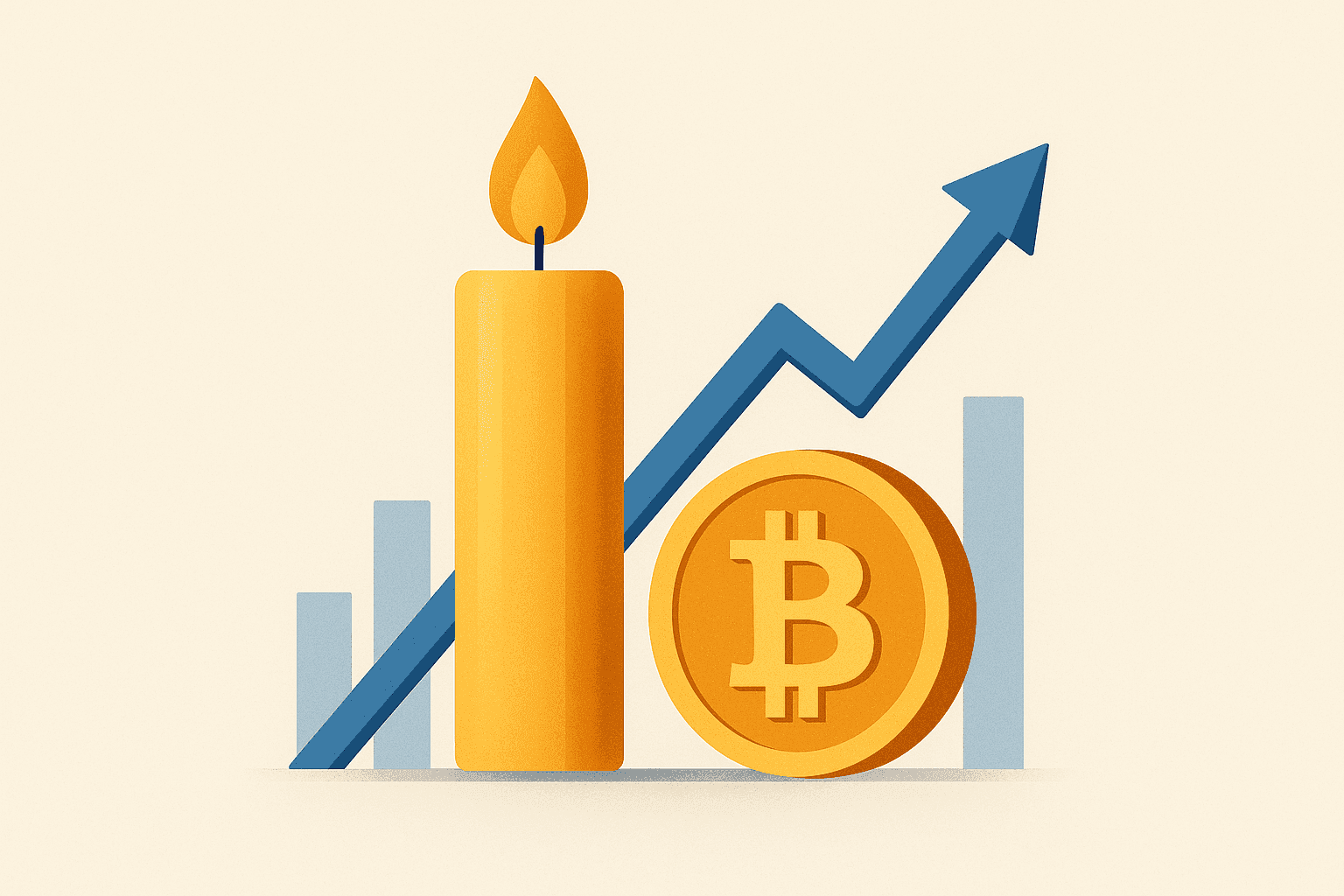
A god candle describes an outsized green candlestick on a crypto price chart that records a rapid surge in a very short window. These vertical moves attract attention across the crypto market, signaling strong buying pressure that can flip sentiment quickly.
Picture a routine Bitcoin session when a single bar prints three to four times taller than recent candles. Price rips roughly 15% within sixty minutes, immediately standing out. That’s the phenomenon traders love to spot—one of the most electrifying moments in cryptocurrency trading.
What Crypto Candles Represent
A candlestick summarizes price action over a chosen time frame (such as 1 minute, 1 hour, or 1 day). Each candle shows the open (where price started for that interval), the high (the peak), the low (the trough), and the close (where it ended).
Color reflects direction. A green candle typically means the close finished above the open (bullish), while a red candle typically means the close finished below the open (bearish).
Are God Candles Always Bullish?
No. Traders often talk about the green version, but an equally dramatic red candle can occur as well. A bearish god candle is a sharp, oversized downside move that can signal aggressive selling, forced liquidations, or a sudden shift in positioning that catches late buyers off guard.
Defining Traits of a God Candle
These events share several hallmarks that set them apart from ordinary price movement:
- The range dwarfs nearby candles. A 2% uptick is not exceptional if the prior bars moved only about 0.5%.
- Trading volume explodes, at times 10x typical levels, confirming real participation. Thin volume on a big move often signals weak conviction.
- Momentum is one-sided, with price climbing consistently during the candle’s formation. Hesitation and pullbacks are minimal because buyers dominate.
Catalysts Behind These Vertical Moves
Several forces can light the fuse:
- Major market news (e.g., exchange-traded fund approvals, regulatory shifts, partnership announcements, macroeconomic headlines).
- Institutional flows and large trades.
- Broad sentiment swings (fear to greed).
- Whale activity.
- Market sentiment.
How to Trade Them With Discipline
Managing these patterns requires strict rules. Avoid chasing while the candle is still forming. Wait for the close and then judge whether follow-through is likely.
Strong moves are easy to notice; the harder skill is confirming whether bids can defend the move after the first volatility wave.
Begin with participation checks. Elevated trading volume backing the candle supports the price action’s credibility.
Next, map resistance and overall chart context. Breakouts through key levels often continue, while failed breaks typically reverse. Use a few technical tools to frame risk and filter false signals:
| Technical Tool | Purpose | How to Use with God Candles |
|---|---|---|
| Moving averages | Trend bias and dynamic support/resistance | Favor long setups when price holds above the relevant average; treat a clean reclaim or rejection as a structure check after the spike. |
| Relative strength index | Momentum and overbought/oversold context | Watch for momentum divergence or extreme readings that suggest follow-through risk; use it as a filter, not a standalone entry trigger. |
| Fibonacci levels | Potential retracement and reaction zones | Plan entries on pullbacks to common retracement levels and define invalidation below the level that should hold if the move is real. |
| Volume profile | Where trading activity clustered | Identify high-volume nodes that may act as magnets or support; avoid entries directly into heavy supply zones created during the spike. |
| Bollinger Bands | Volatility and mean-reversion pressure | Note when price expands far beyond the band; consider waiting for volatility contraction or a retest of the mid-band before committing size. |
| Support and resistance zones | Key decision levels and breakout validation | Prefer break-and-retest behavior over immediate continuation buys; treat failed retests as a warning that the candle may unwind. |
Define risk before entry. Place stop-loss orders in advance because these spikes can unwind as fast as they appeared.
Handling Fear of Missing Out When Price Spikes
Such towering green candles stir powerful emotions. Fear of missing out intensifies when you watch the surge live, leading some traders to buy impulsively. Set entry and exit rules before volatility hits, use alerts to avoid staring at every tick, and require a specific confirmation (such as a close above a level or a clean retest) before you act. Journaling these moments also helps you spot repeat impulse patterns and stick to your plan the next time the market goes vertical.
If you feel rushed, you’re already late—planned trades beat fast trades when candles start stretching.
That impulse carries real danger. Post-spike pullbacks are common as early participants take profits. Late entries that chase the move can see instant losses when the retrace starts.
Core Risk Management Rules
- Limit position size to 2% of account equity.
- Scale out profits as price advances.
- Avoid over-concentration in one asset.
- Assess whether the move is market-wide or isolated to a single token before trading.
Placement within the market cycle changes the signal. After extended declines, a powerful single candlestick can hint at a potential reversal, suggesting bears are losing control and bulls may return. In that scenario, many traders look for evidence that the spike can hold—such as a higher low on the pullback or a reclaim of a prior breakdown level—before treating it as more than a short squeeze.
Inside a healthy uptrend, a large green candle often points to continuation with renewed strength. A common approach is to avoid buying the very top of the bar and instead stalk a retest of the breakout area, then trail risk under the most recent swing structure as the trend resumes.
Near all-time highs, the same pattern can warn of exhaustion risk. When the candle is followed by immediate stalling, wick-heavy bars, or failed continuation, traders often tighten stops, take partial profits sooner, and treat a break back below the breakout zone as a sign the move may be fading.
Key Takeaways
These single-candle spikes can deliver notable gains over short periods, yet the same volatility can erase capital if risk controls are ignored.
Prioritize signal over noise. Look for confirmation before deploying meaningful size, and remember the crypto market will offer more opportunities—missing one is fine if you protect capital for the next setup.