Looking for real market reps without torching your bankroll? Futures trading simulators give you a risk-free place to practice trading, refine strategies, and build confidence before you put cash on the line.
A strong trading simulator can turn scattered losses into consistent execution. Not every simulation tool is equal, though—and that difference can decide whether you learn quickly or pay costly tuition to the market.

This guide shows how a simulated trading environment lets you analyze volatility, test ideas, and speed up learning. You will see why simple paper trading differs from market replay—and why platforms like Tradingsim help serious day traders get evaluation-ready.
Part 1: What a Futures Simulator Does
A futures trading simulator is a practice platform that lets you place futures orders in a simulated account using live or historical market data, so you can learn execution and risk control without using real money. A modern trading simulator mirrors real futures exchanges such as CME, NYMEX, and ICE. You can simulate trading the E-mini S&P 500 (ES), Nasdaq 100 (NQ), Crude Oil (CL), and Gold (GC) with zero financial risk.
Most simulators start you with a virtual account balance (often in the $50,000 to $100,000 range, though some default higher), and many let you customize the starting balance to match your goals or a prop-style evaluation. If you blow up the virtual account, you typically reset the funds and run it back—useful for reps, but also a reminder to practice with rules so resets do not become a bad habit.
At a basic level, the workflow is straightforward: pick a contract and a day/session, set your simulated account parameters, place orders (market, limit, stop), get simulated fills, then review the results (P&L, drawdown, win rate, and execution notes) to tighten your process on the next replay.
A realistic simulator builds repeatable habits you can carry into live markets; a shallow demo only builds comfort with clicking buttons.
Unlike a static chart, the right platform is built to make your practice transfer to live execution.
- Order execution simulation:Practice placing and managing orders under moving prices.
- Margin logic:See how leverage, buying power, and risk limits affect what you can do.
- Tick value accuracy:Understand how each tick translates into dollars on the contract you trade.
- Real-time price action:Train decision-making on continuously updating bars and tape.
- Backtesting capability:Review outcomes and patterns across repeated samples.
- Market replay functionality:Run past sessions on demand so you can repeat the same scenario.
- Risk analytics and reporting:Track performance metrics so improvement is measurable, not vibes.
The Paper Trading Pitfall
Many new traders blur the line between paper trading and true market replay. Knowing the difference can compress your learning curve from years to months.
Standard Paper Trading: The Waiting Game
Broker platforms such as Thinkorswim, Webull, and Interactive Brokers offer paper accounts tied to a live market data stream.
Virtual buying power varies by platform, but it is common to see paper accounts funded with tens of thousands to hundreds of thousands of “practice dollars.” Many brokers also let you adjust the balance or reset it if you want to start over.
- The Problem:You are locked to the clock. To practice the open at 9:30 a.m. ET, you must be present at 9:30 a.m. ET. If the session chops for hours, you wait for hours to see the outcome.
- The Result:Skill development crawls because you get only one real-time session per day.
Market Replay: The Time Machine
Tradingsim provides market replay with years of historical, tick-level market data you can play back as if live.
In most simulators, the price feed can be highly accurate for training purposes, but it is not identical to live trading: fills are simulated, liquidity and partial fills may be simplified, and you will not feel real-world latency, routing differences, or broker-specific slippage the same way you will with real orders.
- The Advantage:Trade the opening drive multiple times in one hour. Fast-forward through dead zones and rewind to rework a breakout until the setup is second nature.
- The Result:You can compress years of practice into a weekend—true deep practice, like athletes reviewing and simulating game film.

Part 2: Feature Showdown—Tradingsim vs. Alternatives
Here is a concise comparison to highlight how Tradingsim differs from common broker simulators.
On the AI question: some platforms and trade journals now market “AI-powered” insights (like auto-tagging trades, summarizing patterns, or flagging rule breaks), but most futures simulators are still driven by traditional performance stats and replay—meaning you get analysis and reporting, not a true AI coach making decisions for you.
Comparison Overview: Tradingsim vs. Broker Simulators
| Feature | Tradingsim | Broker Simulators |
|---|---|---|
| Data Type | Multi-year, tick-by-tick history | Often live streams only (paper modes) |
| Market Replay | 24/7 replay | Typically not available; OnDemand-style tools can be limited |
| Weekend Practice | Train any time | Live-tied paper accounts sit idle when exchanges are closed |
| Fast-Forward Controls | Skip chop and dead zones | Often not available |
| Risk Analytics | Advanced stats (P&L, drawdown, win rate) | Usually basic reporting |
| Setup Time | Browser-based access | May require installs and extra steps |
| Cost | Predictable subscription pricing | Paper accounts may be free; prop evaluations can cost $150+ monthly |
The Bottom Line:Broker demos teach button clicks. Tradingsim is designed to teach profitability.
Part 3: Why Futures Demand a Specialized Simulator
Futures are not stocks. They are leveraged, react to macro data, and each contract behaves differently. A stock-only sandbox will not prepare you for futures execution or risk.
Understanding Contract Specs
In Tradingsim you trade the contract, not just a ticker. You internalize tick size, margin impact, and instrument behavior.
- ES (S&P 500):$12.50 per tick. A 4-point swing equals $200 per contract. Hitting $200 in a session is easy to “do” in a simulator because the dollars are virtual; doing it consistently in real life depends on having a repeatable edge, proper sizing, and risk control—and the same leverage that makes $200 possible can also make losses stack quickly.
- NQ (Nasdaq 100):$5.00 per tick. Highly volatile, with lightning-fast 50-point bursts.
- CL (Crude Oil):$10.00 per tick. Often respects technical levels and intraday structure.
- GC (Gold):$10.00 per tick. Sensitive to risk appetite, inflation, and the dollar.
Simulated trading builds respect for leverage. A 10-point NQ loss is roughly $200 on one contract and $2,000 on ten. Feel the consequences in the simulator instead of your bank account.
Futures-First Indicators
Futures traders lean on specific tools. Tradingsim includes core indicators used across pro desks.
- VWAP (Volume-Weighted Average Price):A key institutional reference for trend and mean reversion.
- Pivot Points:Classic floor levels that still influence algorithmic behavior.

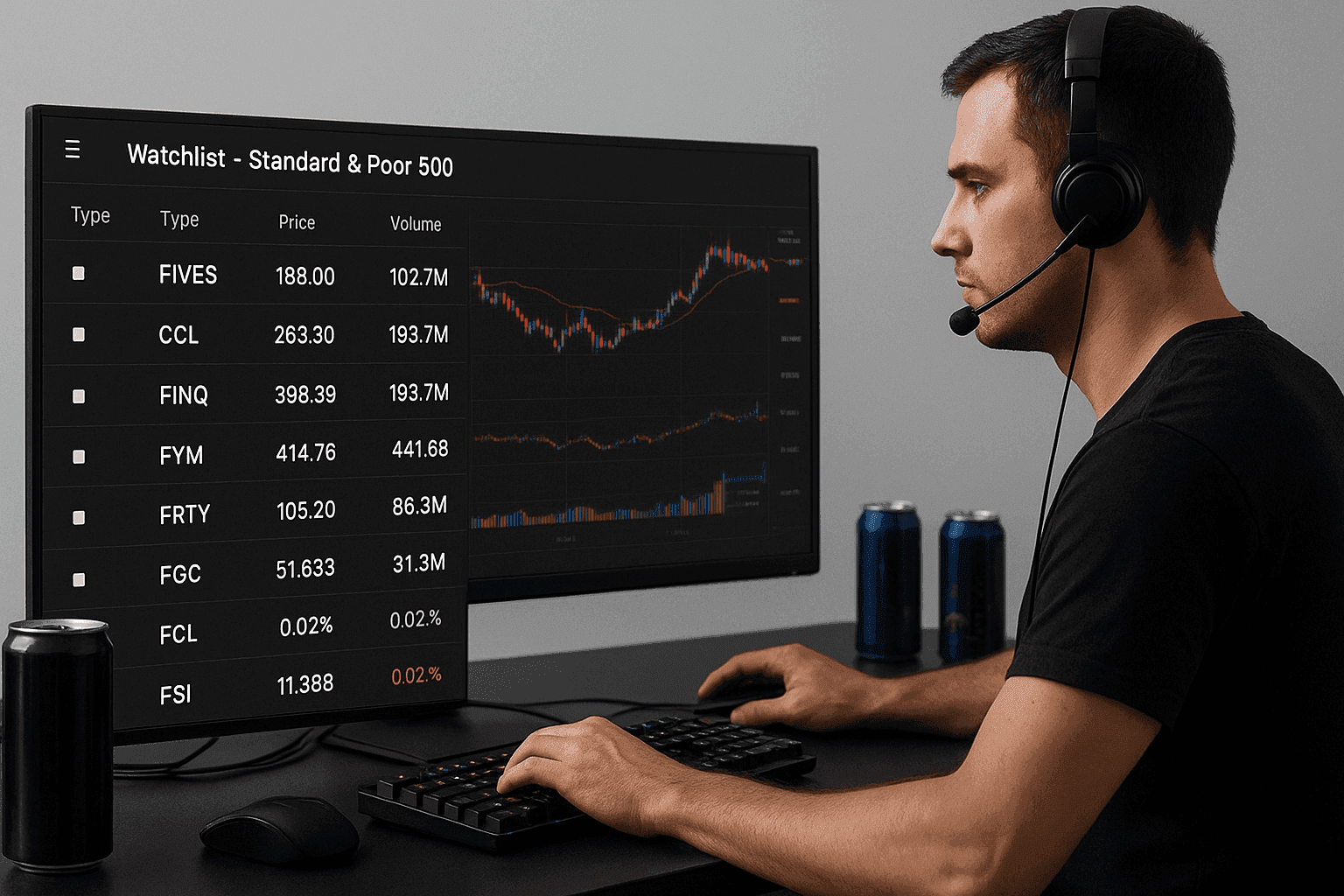
Professional-grade futures simulator interface.
Part 4: The Prop Firm Shortcut—How to Get Funded
In 2026, prop firms such as Topstep, Apex Trader Funding, and MyFunded Futures will back you with buying power—often $50,000 to $150,000—if you pass their evaluation.
The Catch:You must follow strict risk parameters.
- Profit Target:Typically $3,000 to $9,000, tied to account size.
- Daily Loss Limit:For example, no more than $1,000 down in a single session.
- Trailing Drawdown:You cannot dip below your high-water mark by the specified amount.
How Tradingsim Helps You Pass
Many candidates burn cash by paying monthly fees to “practice” the test itself. That is expensive trial-and-error.
Smart Approach:
- Run a Mock Combine:Configure Tradingsim to mirror evaluation rules and track every trade.
- Honor the Limits:If your simulated trading account hits the daily loss cap, stop for the day. No exceptions.
- Train Around News:Use replay near 8:30 a.m. CPI releases to experience slippage and volatility in a safe environment.
Pro Tip: Do not pay for a Topstep evaluation until you have passed the same rules three times in a row on Tradingsim. This discipline can save thousands in reset fees.
Part 5: Strategies for Effective Practice
The fastest way to sharpen trading skills is to treat simulated capital like real money. Try these focused drills inside Tradingsim.
Drill 1: Opening Range Breakout
A time-tested futures play with clear structure and rules.
- Setup:Load the Nasdaq 100 (NQ) on a one- to five-minute chart.
- Process:Observe the first 15 minutes after the open, 9:30 to 9:45 a.m. ET.
- Trigger:Mark the high and low of that range. Go long on a break of the high or short on a break of the low.
- Replay:Review the last 30 sessions of the open and log results.
- Lesson:NQ often fakes out before the real move. Only repetition reveals the nuance.
Drill 2: Trend Pullback
- Setup:Load Crude Oil (CL) for intraday trade.
- Indicator:Add a 20-period moving average.
- Process:Fast-forward until a clear uptrend forms with price riding above the 20MA.
- Trigger:Buy the first pullback to the 20MA. Place a stop under the prior candle’s low.
- Replay:Practice exits. Compare quick partials vs. trailing stops.
Drill 3: Disaster-Day Risk Management
- Setup:Choose a high-volatility day, such as March 2020 or a recent CPI morning.
- Goal:Survive the session while following rules.
- Drill:Trade the swings without blowing the simulated trading account.
- Lesson:Sometimes the best trade is no trade. Experiencing crash-speed tape in replay reduces fear later.

Part 6: Developing the Trader’s Mindset
A simulator can train psychology when you add consequences and structure to your routine.
The Simulated Emotion Technique
Demo trading often lacks emotional stakes. Add real-world penalties for broken rules to wire in discipline.
- The Rule:If you move a stop or break your plan, skip entertainment that night or complete 50 pushups.
- The Effect:Tangible consequences make simulated risk feel meaningful and reinforce process.
Beating FOMO
Chasing a ripping green candle is a common mistake. Use replay to freeze the tape and study context.
- Tradingsim Tactic:Pause, rewind, and inspect the chart before the move. Identify valid signals versus randomness.
- You will often see no setup existed. Letting random moves pass builds patience and selectivity.
Part 7: Transitioning to Live Markets
Graduate from simulation when objective metrics confirm your edge and risk control.
- 100-Trade Sample:Execute one defined strategy for 100 trades in Tradingsim and review outcomes.
- Profit Factor:Aim for gross profits at least 1.5 times gross losses.
- Drawdown Test:Endure a losing streak without revenge trading or size creep.
The Micro Step
When you go live, start small. Trade Micro E-mini contracts before scaling to full-size.
- ES:$50 per point.
- MES:$5 per point. Same chart and market data, one-tenth the risk. Trade your plan on Micros for three months, then scale.
Conclusion
Think of a simulator as a flight deck for markets. Pilots train in sims before passengers; traders should do the same before risking savings.
Yes, you can practice futures trading without risking real money by using a simulator with a virtual account balance. Simulation prepares you for turbulent tape without financial damage. Whether you scalp NQ, trade ES, or swing CL, starting on a platform like Tradingsim helps you navigate volatility and solidify an edge.
Skip toy paper accounts. Build a career with market replay and deliberate practice.