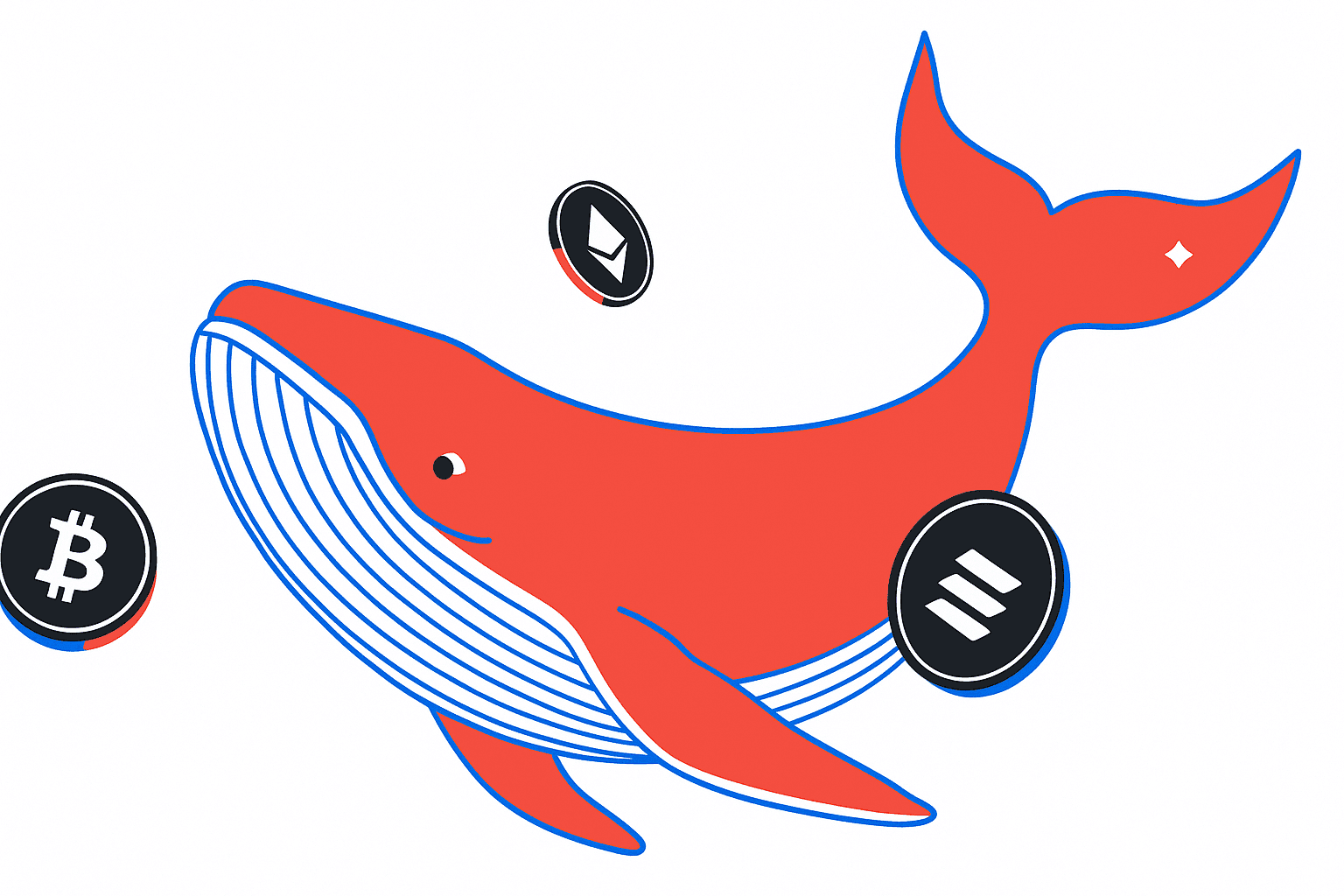
Crypto whales are market participants with outsized cryptocurrency balances whose moves can affect price, liquidity, and short-term sentiment across the crypto market.
| Aspect | Description |
|---|---|
| Crypto Whales | Individuals or organizations that hold large amounts of crypto and control significant portions of an asset’s circulating supply. |
| Market Impact | Their decisions to buy or sell can move price, shift liquidity, and increase volatility. |
| Community Attention | Traders and analysts closely watch these holders because their activity can reshape market dynamics. |
Who Are Crypto Whales?
The term describes investors with wallets big enough to influence the market. Borrowed from casino slang, a “whale” is a high roller whose bets can sway the house’s results; in crypto, the concept maps to accounts that hold substantial digital asset positions.
There is no universal cutoff for who qualifies. In practice, a person or entity is labeled a whale when their stake in a specific coin is large enough that their transactions can noticeably affect price.
As for the biggest whale in crypto, the true identity is often unknown or pseudonymous because the largest balances typically show up as wallet addresses, not named individuals. Notable examples of very large holders frequently cited include Satoshi Nakamoto (widely believed to control a significant amount of Bitcoin) as well as large exchange and custodian wallets, plus major funds and early ecosystem participants that hold sizable treasuries.
- BTC: 1,000+ coins.
- Other cryptocurrencies: thresholds vary by asset and market depth.
How Large Holders Influence the Market?
Because they control meaningful quantities of an asset, substantial sell orders can add supply to the order book and pressure price lower in the near term.
Likewise, aggressive accumulation can increase demand, reduce available float, and contribute to upward price moves as liquidity tightens.
Whether whales are “good” or “bad” depends on their incentives and behavior. On the positive side, large holders can provide liquidity during active markets, support long-term development by funding teams or participating in ecosystems, and act as committed stakeholders when they hold through downturns. On the negative side, concentrated ownership can increase volatility, intensify sharp moves around key levels, and create conditions where smaller participants feel at a disadvantage.
Some large players may also attempt market manipulation tactics such as spoofing (placing orders they don’t intend to fill), wash trading (trading with themselves to inflate volume), pump-and-dump campaigns (manufacturing hype and then selling into it), or stop-loss hunting (pushing price into zones that trigger forced selling).
Liquidity Effects of Whale Concentration
Liquidity reflects how easily an asset can be traded without causing major price changes. When a high share of coins is parked in a few big wallets, active float shrinks, and even modest transactions can move the market.
If those holders remain inactive, fewer units are available on exchanges, which can amplify slippage and volatility when larger orders hit.
Monitoring Whale Activity
- Track on-chain data for large transactions. Use a block explorer such as Etherscan to review transfers and follow relevant addresses over time.
- Use real-time platforms to monitor transfers between addresses, exchanges, and wallets. Tools such as Whale Alert and Nansen can help surface large movements and provide wallet labels in some cases.
Watching large-holder activity can help you understand where liquidity is shifting before it shows up clearly in price.
For traders and investors, shifts in large-holder activity can matter because they may precede volatility and reflect changes in market sentiment. Sustained net buying often aligns with accumulation, while persistent selling can resemble distribution and add downside pressure.
Large holders may also try to reduce attribution by splitting funds across multiple wallets, routing activity through exchanges or custodians, using OTC execution, or using privacy tools such as mixers and privacy-focused coins. These approaches can make it harder to link balances and movements to a single entity, even when activity remains visible at the network level.
Governance Power in Proof-of-Stake Blockchains
In PoS systems, voting weight frequently scales with stake size. Large holders can materially influence proposals, parameter changes, and roadmap priorities through governance.
Because their tokens grant greater voting power, these participants can shape rules and development paths that affect network economics and user incentives.
In sum, whales are pivotal actors across digital asset markets: they sway pricing, shape liquidity conditions, and can influence blockchain governance. Their activity and positioning can offer early signals about potential market direction and structural shifts.
This material is provided “as is” for general information and education only. It is not financial, legal, or other professional advice, nor a recommendation to buy or use any product or service. Seek guidance from qualified advisors for your specific situation.