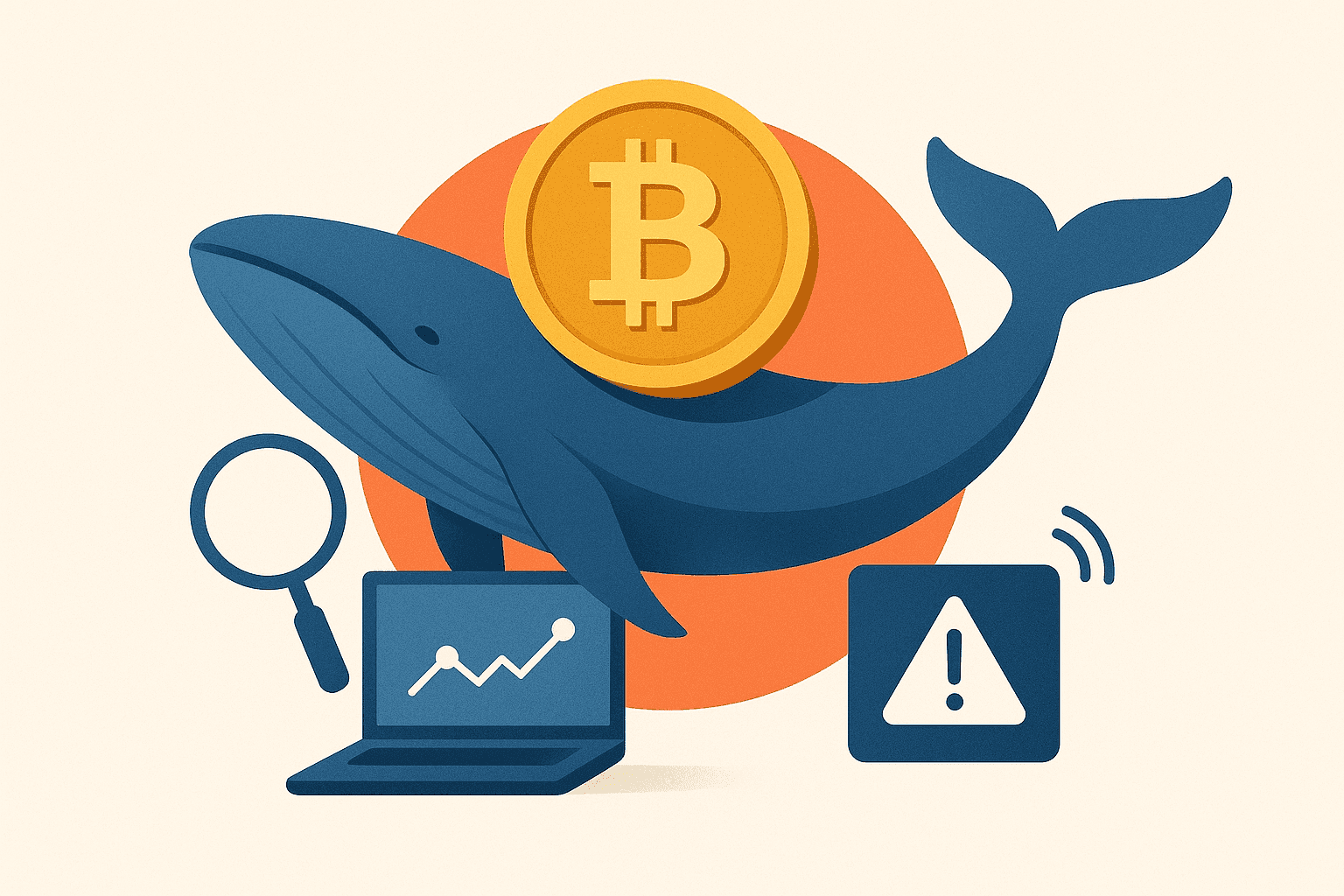
A crypto whale is an entity—an individual, fund, company, or state—holding enough of a coin to sway its global price. The term echoes casinos, where “whales” are high-rollers wagering large sums. As a rough rule of thumb, whale territory is often discussed as 500–1,000+ BTC for Bitcoin, 10,000–50,000+ ETH for Ethereum, and (for major large-cap altcoins) positions large enough to dominate a token’s daily liquidity rather than a single universal number. “Whale activity” also goes beyond a single big transfer: it can include coordinated accumulation or distribution across many linked addresses, repeated exchange inflows/outflows, market-moving spot execution, liquidity shifts in DeFi, and hedging behavior that shows up through derivatives positioning.
To shift size, whales typically use centralized or decentralized exchanges, where deep liquidity can absorb big orders without severe slippage.
Even so, a wallet moving 1,000+ BTC can jolt price across markets. For instance, when the U.S. government transferred about 10,000 BTC from Silk Road seizure wallets to exchanges in 2023–2024, Bitcoin slid 2–5% as traders raced to front-run a potential sale.
What Does Whale Activity Mean?
Whale behavior can represent routine storage operations or clear buy/sell positioning.
Crypto Whale Wallet-to-Wallet Transfers
Most large transfers are housekeeping: redistributing funds across addresses for security or organization. A single whale can control thousands of addresses, so “unknown to unknown” moves often have limited market impact.
Some address-to-address transfers do reflect private deals, treasury reshuffles, investment rounds, or custody vault movements. The very largest (for example, 20,000 BTC or more) are commonly handled by institutions, miners, early adopters, or authorities relocating seized coins.
Accumulation (Buy Signal)
Exchanges provide the order depth whales need to transact size efficiently.
When big holders withdraw assets from exchanges, they are usually locking in longer-term positions. A consistent pattern of outflows by multiple large addresses signals conviction through noise and reduces immediate circulating supply.
Distribution (Sell Signal)
When funds flow back to exchanges, owners are positioning where they can sell fast.
On an exchange, they can swap into stablecoins, exit to fiat, or settle large over-the-counter trades without spraying orders on open books.
Steady exchange inflows from big wallets over several days often indicate quiet preparation to sell, not a sudden panic dump.
Market tops are frequently slow, controlled distribution—whales offload to enthusiastic buyers while price action still appears healthy.
Why Tracking Whale Activity in Crypto Matters?
Ever scrolled crypto Twitter and seen an ominous alert post?
If your first thought is, Okay, what does this whale alert mean—are my bags safe?, you may already be late.
Seeing 43,033 BTC (roughly $3.9B) move during the 2025 holiday period may look rare, but whales exploit thin holiday liquidity to reposition while most people are distracted. By the time memes spread, the move is done.
That is the gap between reacting and interpreting. Following whales reveals where smart capital is rotating ahead of headlines, narratives, and liquidity breaks.
With consistent monitoring, you learn where supply is tightening, where distribution is forming, and which assets serious money is entering or exiting.
So how do you actually observe whales in motion?
Top Tools to Track Crypto Whale Activity
No single tracker is perfect. Understand each tool’s strengths and how they fit together.
| Tool Name | Key Features | Supported Chains | Alert Options | Unique Selling Point |
|---|---|---|---|---|
| Whale Alert | Real-time large-transfer monitoring; labeled entity tags; configurable thresholds | Bitcoin, Ethereum, Ripple, and other major networks | Social feeds; mobile notifications; chat integrations; API | Fast, simple “what moved and where” radar |
| Arkham Intelligence | Entity-level wallet identification; flow visualizations; tracing across time and chains | Bitcoin, Ethereum, Solana, Avalanche, Tron, and more | Wallet/entity notifications | Deep labeling and deanonymization of onchain activity |
| Nansen | Smart-money classification; portfolio tracking; performance analytics | Dozens of networks, including Ethereum, Solana, Arbitrum, and Polygon | Custom alerts; signals for unusual activity | Tracks profitable wallets and sector rotation behavior |
| Glassnode | Cohort metrics; exchange balance trends; cycle indicators | Bitcoin, Ethereum, and expanding multi-chain support | Dashboards; threshold alerts | Institutional-grade cycle and cohort analytics |
| Dune Analytics | Community-built dashboards; custom queries; interactive visualizations | 100+ networks | Embeds; API; dashboard-driven monitoring | Build-your-own analytics from public onchain datasets |
If you want a free starting point, the best “no-pay” stack is usually a mix: Whale Alert’s public feed for raw pings, Dune’s public dashboards for token- and protocol-specific views, and whatever basic onchain metrics a platform exposes without a subscription. The trade-off is depth and convenience—free tiers tend to limit historical lookbacks, advanced labeling, high-frequency alerts, and institutional-grade cohort breakdowns.
Whale Alert: Real-Time Transfer Alerts
Whale Alert is a well-known real-time transaction monitor covering major chains such as Bitcoin, Ethereum, Ripple, and more to flag large value transfers.
Think of it as an early-warning radar: it pings you when big amounts move between wallets and exchanges, often tagging known addresses.
Its edge is speed and simplicity—it surfaces the what and where in seconds so you can decide which transactions deserve deeper analysis.
Top Features:
- Real-time tracking across 10+ major blockchains.
- Labeled addresses for exchanges, custodians, and recognized entities.
- Multi-channel alerts via social feeds, mobile apps, or chat platforms.
- Custom thresholds to filter by transaction size.
- Public API access for bots and integrations.
Arkham Intelligence: Entity-Level Wallet Identification
Arkham Intelligence specializes in deanonymizing wallets and converting raw transfer data into entity-level profiles.
Its Ultra system maps hundreds of millions of labels across hundreds of thousands of entity pages, linking addresses to exchanges, funds, traders, institutions, and notable crypto personalities.
That turns “10,000 BTC moved from unknown wallet” into “10,000 BTC moved from MicroStrategy treasury to Coinbase custody.”
The platform includes customizable dashboards, a Visualizer for flow diagrams, a Tracer to follow funds over time and chains, and an Alerter for instant wallet-level notifications.
In 2025, Arkham added key opinion leader tagging to track influencer wallets with large audiences.
Top Features:
- Ultra artificial intelligence labeling engine with extensive entity identification.
- Multi-chain monitoring across BTC, ETH, Solana, Avalanche, Tron, and more.
- Tracer to follow chronological fund flows across chains.
- Entity pages with holdings, history, and balance changes.
- Custom alerts for any wallet or entity activity.
- Key opinion leader tracking for prominent crypto figures.
Nansen: Smart-Money Wallet Analytics
Nansen is an artificial intelligence-driven onchain analytics suite built to follow “smart money”—wallets with verifiable profitability and strong performance.
Instead of raw address watching, Nansen classifies entities by behavior (institutions, skilled traders, whales) and tracks their portfolio moves, win rates, and realized profit and loss in real time.
You can follow clusters of outperformers to see which tokens they accumulate, which DeFi protocols they enter, and when they rotate between sectors.
Top Features:
- Smart Money tracking across hundreds of millions of labeled wallets with performance stats.
- Coverage across 30+ chains, including ETH, Solana, Arbitrum, and Polygon.
- Custom alerts and artificial intelligence signals highlighting unusual onchain activity.
- Token God Mode for deep token analytics and holder distribution.
- NFT and DeFi dashboards for collections, liquidity, and protocol flows.
- Exchange Flow insights showing capital entering or leaving centralized exchanges.
Glassnode: Cycle and Cohort Analytics
Glassnode delivers institutional-grade cycle analytics, with a focus on Bitcoin and Ethereum and growing multi-chain support. It aggregates cohorts—long-term holders, short-term traders, exchange balances, miners—to gauge accumulation versus distribution.
Top Features:
- 3,500+ onchain metrics, including proprietary indicators such as spent output profit ratio, market value to realized value, and network value to transactions.
- Cohort analysis by holder age, wallet size, and behavior.
- Exchange flow analytics for net inflows, outflows, and balance trends.
- High-resolution data with updates as frequent as every 10 minutes.
- Custom dashboards and alerts for targeted thresholds.
- Weekly research from leading onchain analysts.
Dune Analytics: Custom Onchain Dashboards
Dune is a community platform for querying and visualizing onchain data with a query language across 100+ networks. Rather than prebuilt metrics, it offers a build-your-own layer for custom dashboards.
Over one hundred thousand public dashboards cover whale tracking, DEX volumes, NFTs, and protocol health. You can fork and adapt them, making it ideal for specific tracking such as a fund’s flows or niche stablecoin rotations.
Top Features:
- Support for 100+ chains via a unified query interface.
- Custom queries without managing blockchain APIs.
- Real-time visualization with interactive charts and dashboards.
- Collaboration tools and API access for embedding and automated alerts.
How to Track Crypto Whales?
There is no single correct approach. Decide whether you want to react in real time or detect broader positioning early.
Regardless of method, the core read is consistent: outflows from exchanges to wallets typically indicate buying or holding; inflows back to exchanges usually imply preparation to sell.
If your goal is to find whale wallets (not just whale transactions), start by working backward from labels and clusters. Use Arkham Intelligence or Nansen to pull up labeled entities (exchanges, funds, market makers), then look for large withdrawal destinations that repeatedly receive size and do not quickly recycle funds back to deposit addresses. Platforms surface these wallets by labeling and clustering—grouping addresses that behave like one entity through patterns such as repeated interactions, shared funding sources, deposit/withdraw flows, and address-linking heuristics—so you can build a watchlist around entities rather than isolated addresses.
To see what cryptocurrencies whales are buying, focus on net accumulation rather than a single headline transfer. In many recent rotations, large-wallet clusters concentrate first in Bitcoin and Ethereum, then add high-liquidity large caps such as Solana, and rotate into blue-chip DeFi assets such as Uniswap when risk appetite returns; when de-risking, they often park capital in major dollar-pegged stablecoins such as Tether. You can identify the “being bought” side by tracking which token balances rise across the same entity clusters (Nansen portfolios, Arkham entity pages) and by checking whether exchange balances for that asset are trending down while large holders’ balances trend up.
Use these three playbooks to set up your monitoring.
Method 1: Use Whale Alert Notifications
Capture breaking moves and immediate market reactions with this stack:
- Begin with Whale Alert notifications for large transactions.
- When an alert fires, pivot to Arkham to identify the wallet or entity.
- Check Glassnode for broader exchange flow context. Rising exchange balances can signal building sell pressure.
- Cross-check Nansen to see if other smart money addresses are mirroring the move.
Formula: Alert fires → identify entity → confirm trend → trade or ignore.
Weakness: You are often a step behind, and price may move before you finish verification.
Method 2: Follow a Few Proven Traders
Shadow consistently successful wallets to move earlier and with more conviction:
- Bookmark high-conviction wallets in Nansen or Arkham, such as venture capital funds, funds, or whales with strong histories.
- Set targeted alerts on those specific entities.
- When they accumulate, you get notified before broader alert noise hits social feeds.
- Use Dune to confirm repeatable behaviors, such as recurring buys on dips over time.
Formula: Identify winners → monitor their wallets → move when they move → ignore distractions.
Weakness: Past performance can mislead, and even smart money may be exit liquidity for larger players.
Method 3: Filter for Insider Information
Anchor decisions in macro context before reacting to single transactions:
- Start with Glassnode to place the market in a cycle phase: accumulation, distribution, or capitulation.
- Filter Whale Alert pings through that lens. Ignore routine sells during accumulation; pay close attention during distribution.
- Use Arkham to investigate only if a move contradicts the macro trend, since outliers can be valuable contrarian signals.
Formula: Know the cycle → filter noise → investigate outliers → act on divergence.
Weakness: Macro shifts slowly, so sharp reversals led by a few large players can be missed.
How to Interpret Whale Activity: Crypto Transactions That Matter Most?
Suppose you receive an alert about a major flow like this:
In late November and early December 2025, crypto Twitter warned: $7.5 billion in whale inflows to Binance over 30 days—the highest since March, when Bitcoin fell 30%.
Many retail traders sold. Using a reactive playbook, you could have read the signal differently. Here is how that process might unfold in real time.
Reactive Tracking: How to Read This Signal?
Step 1: Do Not Panic at Headlines
When you see alarming exchange inflow stats, do not smash the sell button. Open Glassnode or Santiment and check how whale wallet balances are changing.
Source: Glassnode Studio
The data tells a different story: $7.5B did move to exchanges, yet Glassnode’s Accumulation Trend Score printed 0.99 out of 1.0—among the highest since 2024. That implies whales were not distributing; they were aggressively buying. The clustering near $92,132 shows smart money buying the dip after the pullback from $108K.
You can cross-check with artificial intelligence-driven dashboards that show similar accumulation patterns.
Source: Perplexity Finance
Takeaway: Exchange inflows alone are not always sell pressure. Whales were repositioning, not liquidating.
Step 2: Compare Exchange Inflows to History
Once you know whales are stacking in cold storage, ask why $7.5B moved to exchanges.
Source: Perplexity Finance
Two similar $7.5B inflow periods, different outcomes:
- March 2025: Inflows preceded a drop from $102,000 to $70,000, a 30% decline.
- November–December 2025: Inflows coincided with stabilization near $89,000–$94,000.
Same nominal size, very different intent.
March activity represented whales selling to exit. December activity likely reflected over-the-counter settlement, treasury rebalancing, or parking liquidity for trading—not a panic dump.
Step 3: Validate With Market Cycle Position
Final check: identify where we were in the cycle.
- Bitcoin had fallen 15% from the December 2024 high of $108,000.
- The Fear & Greed Index was in extreme fear (11–30 out of 100).
- Mid-tier whale cohorts (100–1,000 BTC) increased holdings by 0.47% over two weeks, with 91 new whale entities.
- Retail wallets under 0.1 BTC were capitulating.
Final result: Whales buying while retail sells is a classic contrarian buy signal.
Can whale orders predict price movements? Sometimes—but mostly in the narrow sense that size interacts with liquidity. Large spot orders (or large flows into venues where selling can happen quickly) can precede volatility because they force the market to absorb inventory; however, they are not a reliable standalone directional predictor. A visible buy wall can be pulled, a large sell can be offset by derivatives hedges, and “big” flows can be operational (custody, settlement, internal exchange reshuffles) rather than a trade. Treat whale-sized orders and transfers as a probability shift, then look for follow-through in price response, liquidity conditions, and whether the entity’s balances actually change after the move.
Whale alerts are observations; the edge comes from testing what the flow implies before treating it as a trade.
Best Practice Checklist: What to Know When Tracking Crypto Whales
- Require confirmation from more than one large-holder cluster before treating a move as meaningful.
- Interpret a large sell differently depending on whether the market is risk-off or risk-on.
- Let onchain balance changes outweigh social narratives when the two conflict.
- Track net positioning changes, not isolated transfers that can be operational noise.
- Use social media to gauge crowding and sentiment, not to time entries.
What Are the Risks and Limitations of Whale Tracking?
Whale tracking is not foolproof.
Large players can manufacture false signals via spoofing—placing outsized orders to provoke panic or fear of missing out, then canceling to gain better fills. Another limitation is delay: by the time a transaction is visible, price may have already adjusted.
Blindly following whales is risky because their strategies, time horizons, and risk tolerance differ from retail. Interpreting onchain data also takes practice; some large transfers are exchanges or funds, not whales, and misreads can lead to bad trades.
There are also visibility and privacy constraints: whales can route activity through custodians, split flows across many addresses, or use mixers and privacy-focused assets to obscure origin and destination. In addition, tagging and deanonymization can bring regulatory scrutiny to certain flows, and labels are not always accurate or up to date.
Finally, this approach shines in trending markets but loses power in choppy ranges, where even big holders struggle to set direction. Treat whale data as one input among many.
Conclusion
Tracking whales helps you see where capital is moving before retail reacts. By the time alerts trend on social feeds, smart money has usually finished. In practice, whale data can sharpen your read on liquidity, positioning, and rotation when you combine it with other signals.
Institutions such as MicroStrategy, Tether, governments, and major funds sign transactions with offline hardware because convenience at exchanges does not equal safety.
On an exchange, you do not control private keys. A hack, freeze, insider abuse, or bankruptcy can erase gains overnight, regardless of how sharp your entries were.
If you want to protect profits earned from reading whale activity, keep private keys offline. Self-custody removes counterparty risk and surprise account locks—your assets remain yours.
Ledger touchscreen hardware signers provide institutional-grade protection with a proven security model that safeguards a significant share of global crypto value.
With Ledger signers, Clear Signing shows exactly what you approve on a secure screen. Pin-code protection and optional passphrases add privacy, and the Security Key app protects your digital identity with passkeys.
Connect your signer to the Ledger Wallet app to buy, sell, swap, stake, and manage assets seamlessly.
Worried about backups? Ledger signers support simple recovery options such as a Ledger Recovery Key with the touchscreen range, plus the optional Ledger Recover service for worst-case scenarios.
Trade like a whale and secure like one. Consider a Ledger signer today.
Frequently Asked Questions
1) How Much BTC Makes You a Whale?
A: There is no hard line, but roughly 500–1,000+ BTC is commonly viewed as whale territory. The threshold depends on liquidity, market cap, and supply concentration.
2) When Are Crypto Whales More Active?
A: Weekends and Asian night hours tend to be quiet, where bots can distort low-liquidity signals. Activity typically picks up on Mondays when institutions return.
The London–New York overlap (13:00–16:00 Coordinated Universal Time) is prime time as banks, over-the-counter desks, and market makers are active. Macroeconomic events like inflation releases or central bank meetings also add cover for executing size.
3) What Is the Best Whale Tracking App?
A: There is no single best app. Combining tools—such as Whale Alert for pings and Glassnode for context—lets you build a tracking strategy aligned with your goals.
4) How Much Crypto Do Whales Own?
Whale status varies by token due to differences in market cap, liquidity, and holder concentration.
Remember, thresholds are situational. In thin markets, far smaller BTC balances can exert whale-like influence depending on context.