Technical analysis in crypto shows beginners how to read price charts and market behavior so you can trade based on evidence instead of buzz. Rather than chasing headlines, you study recurring structures, price zones, and indicators to estimate where momentum could move next.
If you are new to cryptocurrency trading, this chart-first approach cuts through noise and reins in emotion. With a few core tools and a simple playbook, you can spot higher-quality trade opportunities in volatile markets.
What Is Technical Analysis?
Technical analysis evaluates cryptocurrencies by examining historical market data, especially price and volume. Unlike fundamental analysis, which reviews teams, whitepapers, and technology, technical analysis looks at crowd behavior expressed on the chart and assumes publicly known information is already embedded in the price.
| Aspect | Technical Analysis | Fundamental Analysis |
|---|---|---|
| Primary data | Price, volume, and market structure on charts | Project details, adoption, tokenomics, and broader narratives |
| Main goal | Identify trends, levels, momentum shifts, and trade timing | Estimate longer-term value and whether an asset looks over/undervalued |
| Typical use case | Planning entries, exits, and risk controls | Deciding what to hold or avoid, and why |
| Strength | Clear, repeatable rules based on observable behavior | Context for why a move might be sustainable (or not) |
| Common limitation | Signals can fail in choppy, news-driven conditions | Can be slow to reflect sudden market shifts and sentiment changes |
The central idea is that prices often move in trends and recognizable formations driven by human psychology—fear, greed, and reactions to news. By detecting these repeating behaviors, you can make measured decisions grounded in what price has already done.
Think of learning to surf: you do not forecast the month’s weather; you learn to read the swell. You watch how waves form, where they break, and how wind shapes them. With practice, you know which setups are worth paddling for. Technical analysis works the same way—it will not promise the next candle, but it helps you ride the market’s “waves” with better timing and confidence.
Why Traders Use Technical Analysis in Crypto
Market participants rely on charts, indicators, and drawing tools to find trends, plan entries and exits, and anticipate reversals. Technical analysis is not certainty; it is probability management. When applied consistently, it offers a repeatable framework instead of gut feelings or hype-driven trades.
Technical analysis does not predict the future; it helps you manage probabilities.
Key Concepts in Chart Analysis
Build your foundation on four pillars: trend, support and resistance, volume, and volatility. Mastering these helps you interpret price action and react to changing market conditions.
Trend
A trend is the dominant direction of price over time: up (bullish), down (bearish), or sideways (range-bound). Aligning your trades with that bias is crucial. Many traders use moving averages to confirm direction and avoid fighting the prevailing move.
Support & Resistance
Support is a zone where buyers often slow declines; resistance is an area where sellers tend to cap advances. These regions act as psychological barriers. Price frequently bounces or breaks at these levels. Marking them improves entries, exits, and stop-loss placement.
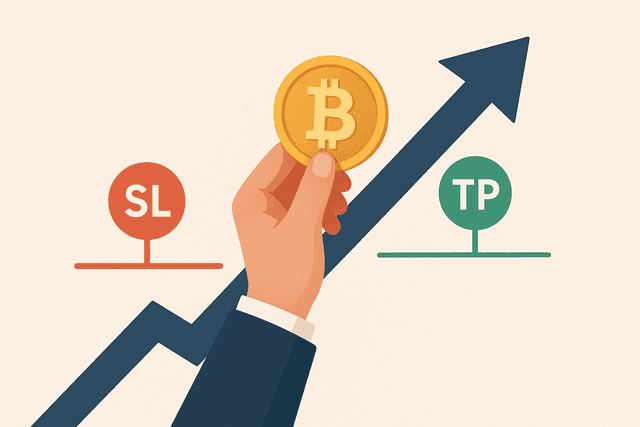
A practical entry/exit example: if price is in an uptrend and pulls back into a clearly marked support zone, you can wait for a bullish candle close to reclaim that level as a potential entry trigger. A common confirmation is that momentum does not collapse (for example, it stabilizes instead of accelerating downward) and participation improves on the bounce. A straightforward risk plan is placing a stop just beyond the support zone that invalidates your idea, then targeting the next resistance area for an initial exit or partial take-profit.
Volume
Volume measures how much of a crypto asset trades in a given period. Strong turnover supports the credibility of a move; thin activity can hint at hesitation. Sudden surges often precede large swings and can confirm breakouts or reversals, adding crucial context to price.
Volatility
Volatility reflects the speed and size of price changes. Crypto is famously volatile, creating both risk and opportunity. Understanding it guides position sizing, stop distances, and strategy choice. Tools such as Bollinger Bands are designed to monitor volatility.
Timeframes: Comparing 1-Minute, 1-Day, and 1-Week Charts
Timeframes define how much data each candle or bar compresses. Short windows reveal more detail but also more noise, while longer windows produce sturdier signals that require patience.
Here is a concise comparison:
- 1-Minute: Best for scalping and ultra-short trades. Extremely detailed but noisy, suited to rapid decisions in fast conditions.
- 1-Day: Good for swing and mid-term views. A balanced picture that helps identify trends and major levels.
- 1-Week: Ideal for long-term positioning. Low detail yet strong trend clarity for mapping big market cycles.
Many traders stack timeframes. Find the macro bias on the weekly, refine a plan on the daily, then fine-tune timing on the 1-hour or 15-minute chart.
Widely Used Indicators and Tools
Indicators distill price behavior and market psychology. They spotlight trend, momentum, and potential entry or exit zones for cryptocurrency trading.
| Indicator | Purpose | Typical Usage |
|---|---|---|
| Moving averages (simple, exponential) | Smooth price to clarify trend direction and structure | Use as dynamic support/resistance and trend filters; watch crossovers and slope changes for momentum shifts |
| Relative Strength Index | Gauge momentum on a bounded scale and spot potential exhaustion | Use overbought/oversold zones as context; look for momentum failures or divergences to time reversals |
| Moving Average Convergence Divergence | Measure trend momentum via the relationship between moving averages | Use signal-line crosses and divergences to confirm trend continuation or warn of weakening momentum |
| Bollinger Bands | Frame volatility and potential overextension around a moving average | Watch squeezes for breakout potential; use band rides and mean-reversion behavior as context for entries/exits |
| Volume-based tools | Assess whether participation supports the move | Confirm breakouts with rising activity; treat low-participation moves with caution and compare volume to recent averages |
Essential Chart Types for Beginners
Choosing a chart style shapes how you see trends and swings. Each format reveals different aspects of behavior and can sharpen entries and exits.
Line Charts
A line chart connects closing prices over time, offering a clean overview of direction. It omits highs and lows but excels at showing long-term trajectory and quick comparisons across cryptocurrencies.
Bar Charts
Bar charts present open, high, low, and close for each period. The bar’s range reveals volatility and price strength, delivering more detail than a line chart while staying readable.
Candlestick Charts
Candlesticks also show open, high, low, and close, but bodies and wicks make sentiment easier to read. Candle patterns can hint at reversals, continuations, and timing. This is the most common chart type in technical analysis.
Find out how to read candlestick charts in detail in our dedicated article.
Point and Figure Charts
Point and Figure focuses on price movement and ignores time, marking advances with Xs and declines with Os. It filters minor noise, highlights trend and key levels, and uses a distinctive format less common among beginners.
Common Chart Patterns to Know
Once you pick a chart style—often candlesticks—you can start spotting recurring formations. These structures help anticipate likely behavior, improving timing, exits, and risk control.
| Pattern | Description | Typical Implication |
|---|---|---|
| Head and Shoulders | Three peaks with a higher middle peak; a neckline acts as the trigger level | Often signals a bearish reversal. Entry is commonly considered on a neckline break and close; a typical stop is beyond the right shoulder; targets are often estimated using the pattern’s height |
| Inverse Head and Shoulders | Three troughs with a lower middle trough; neckline break is the trigger | Often signals a bullish reversal. Entry is commonly considered on a neckline break and close; a typical stop is below the right shoulder; targets are often estimated using the pattern’s height |
| Double Top | Price fails twice at a similar resistance area | Often warns of trend exhaustion. A common trigger is a breakdown below the midpoint support between the peaks; a typical stop is above the second top; targets are often projected by the pattern’s height |
| Double Bottom | Price holds twice at a similar support area | Often suggests upside potential. A common trigger is a breakout above the midpoint resistance between the troughs; a typical stop is below the second bottom; targets are often projected by the pattern’s height |
| Ascending Triangle | Flat resistance with rising lows compressing into the level | Often resolves upward. Traders frequently wait for a breakout and close above resistance; a typical stop is below the most recent higher low; volume often strengthens on the breakout |
| Descending Triangle | Flat support with falling highs compressing into the level | Often resolves downward. Traders frequently wait for a breakdown and close below support; a typical stop is above the most recent lower high; volume often expands on the breakdown |
| Symmetrical Triangle | Converging trendlines showing consolidation and indecision | Can break either way. Traders often wait for direction via a confirmed breakout; a typical stop is placed on the opposite side of the structure; targets are often based on the triangle’s widest range |
| Flag | A small channel that pauses after a sharp impulse move | Often signals continuation. Traders commonly look for a breakout in the original direction; a typical stop is beyond the opposite side of the flag; targets are often based on the prior impulse length |
| Pennant | A compact, tightening structure after a sharp impulse move | Often signals continuation. Traders commonly look for a breakout in the original direction; a typical stop is beyond the pennant’s opposite side; targets are often based on the prior impulse length |
| Cup and Handle | Rounded base followed by a smaller pullback (“handle”) near resistance | Often signals bullish continuation on higher timeframes. A common trigger is a breakout above the handle’s ceiling; a typical stop is below the handle low; targets are often estimated using the cup’s depth |
How to Start Doing Technical Analysis
- 1) Pick one exchange and focus on 2–3 coins. Start with liquid, well-known assets like BTC or ETH so charts are cleaner and signals are more reliable.
- 2) Use a capable charting platform. Choose tools with solid indicator support and customization. Default to candlesticks for the richest per-candle detail.
- 3) Stick with a consistent timeframe. Match the chart to your goals. For starters, 1-day and 4-hour work well. Always check higher timeframes for context.
- 4) Add only one or two indicators. Try the Relative Strength Index for momentum and an exponential moving average for trend. Keep the screen uncluttered so decisions stay clear.
- 5) Mark support and resistance zones. Draw horizontal levels where price often stalls or reverses. Use them to plan entries, targets, and stops.
- 6) Define the current trend. Use moving averages and structure (higher highs/lows or lower highs/lows) to determine bias. Avoid trading against it.
- 7) Confirm with volume. Favor breakouts and moves that occur on strong turnover. Weak volume can flag fakeouts.
- 8) Practice on historical charts. Scroll back, apply your rules, and review outcomes. Build skill without risking capital.
Tips for New Crypto Traders
- Avoid reacting to every tick. Focus on high-quality setups.
- Do not cover the chart with indicators. Less is more.
- Always factor in volume when validating a move.
- Do not chase pumps or trade on hype.
- Never skip risk management or position sizing.
- Respect the prevailing trend.
- Review each trade and extract lessons.
- Start small, then scale with consistency.
Beginner Mistakes to Avoid
| Mistake | Consequence |
|---|---|
| Overtrading | Treating every fluctuation as a signal leads to poor choices, higher fees, and more emotional decisions. |
| Indicator overload | Too many tools create clutter and conflicting signals, making it harder to act consistently. |
| Ignoring volume | Without participation, moves can lack credibility and breakouts may be more likely to fail. |
| Chasing spikes (fear of missing out) | Buying after vertical runs often means paying the top and taking poor risk-to-reward entries. |
| Skipping risk controls | Trading without stops or sizing rules can quickly damage capital even if your analysis is occasionally correct. |
You do not need more indicators. You need more discipline.
Final Thoughts
Chart tools can outline scenarios, but they cannot convert uncertainty into certainty.
Chart analysis does not predict the future. It uses past price behavior, trends, and volume to manage risk and improve decisions. For newcomers, keep it simple—choose suitable charts, focus on a few major indicators, and follow a structured plan. With practice and discipline, you will read the market with greater confidence and less guesswork.
FAQ
Is Technical Analysis Really Reliable for Crypto Trading?
It can be when used correctly. Technical analysis estimates probabilities from price data and market behavior, helping you make better decisions rather than exact predictions.
Do I Need to Learn All the Indicators to Start Trading?
No. Begin with one or two core tools such as the Relative Strength Index or moving averages, master them, then add more only if needed.
Can I Use the Same Technical Analysis for All Coins?
Generally yes, but small-cap or thinly traded assets can generate less reliable signals due to volatility and potential manipulation.
What Timeframes Should Beginners Focus On?
Use the 1-day and 4-hour charts. They reduce noise, show clearer trends, and give you time to plan without rushing.
Which Technical Analysis Approach Is Best for Crypto?
There is no single “best” method that works for every coin and every market phase, but many crypto traders lean on a simple core set: trend structure, support and resistance zones, volume confirmation, and one momentum tool (often the Relative Strength Index) paired with moving averages. What ends up being “best” depends on market conditions (trending vs. choppy), your timeframe, your experience level, and the liquidity of the asset you trade—liquid markets tend to respect levels and signals more consistently than thin, easily whipped markets.
What Is the 3-5-7 Rule in Crypto?
The 3-5-7 rule is commonly used as a short-term moving-average approach that watches three fast lookback windows (3, 5, and 7 periods) to gauge momentum and trend alignment. A typical interpretation is bullish alignment when the 3-period average is above the 5, and the 5 is above the 7; bearish alignment is the reverse.
For context, some traders use it as a quick filter on lower timeframes: wait for the averages to stack in one direction, then look for a pullback toward the short averages and a renewed push to consider an entry. A common “invalid” signal is when the stack breaks (for example, the fastest average crosses back through the others), which some traders use as an exit cue or a warning to tighten stops.
Can ChatGPT Predict Crypto Prices Using Technical Analysis?
No. ChatGPT cannot reliably predict crypto prices, and technical analysis itself cannot guarantee future outcomes. An AI language model can help you learn concepts, outline a process, explain how indicators are typically used, or help you turn rules into a checklist—but it does not produce certain forecasts, and any analysis is only as good as the inputs and the risk plan behind it.
Can I Make $100 a Day From Crypto Using Technical Analysis?
It is possible to have days where you make $100, but it is not a dependable daily outcome and it comes with real risk. Whether that goal is realistic depends heavily on your account size, fees and slippage, market volatility, risk management, and your experience executing a strategy under pressure.
Daily profit targets can also push beginners into overtrading or taking low-quality setups. A more sustainable focus is building a process that controls downside first (position sizing, stops, and discipline), then measuring results over many trades instead of day by day.