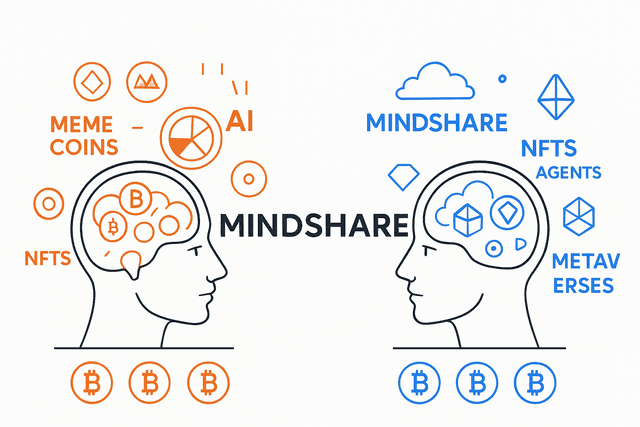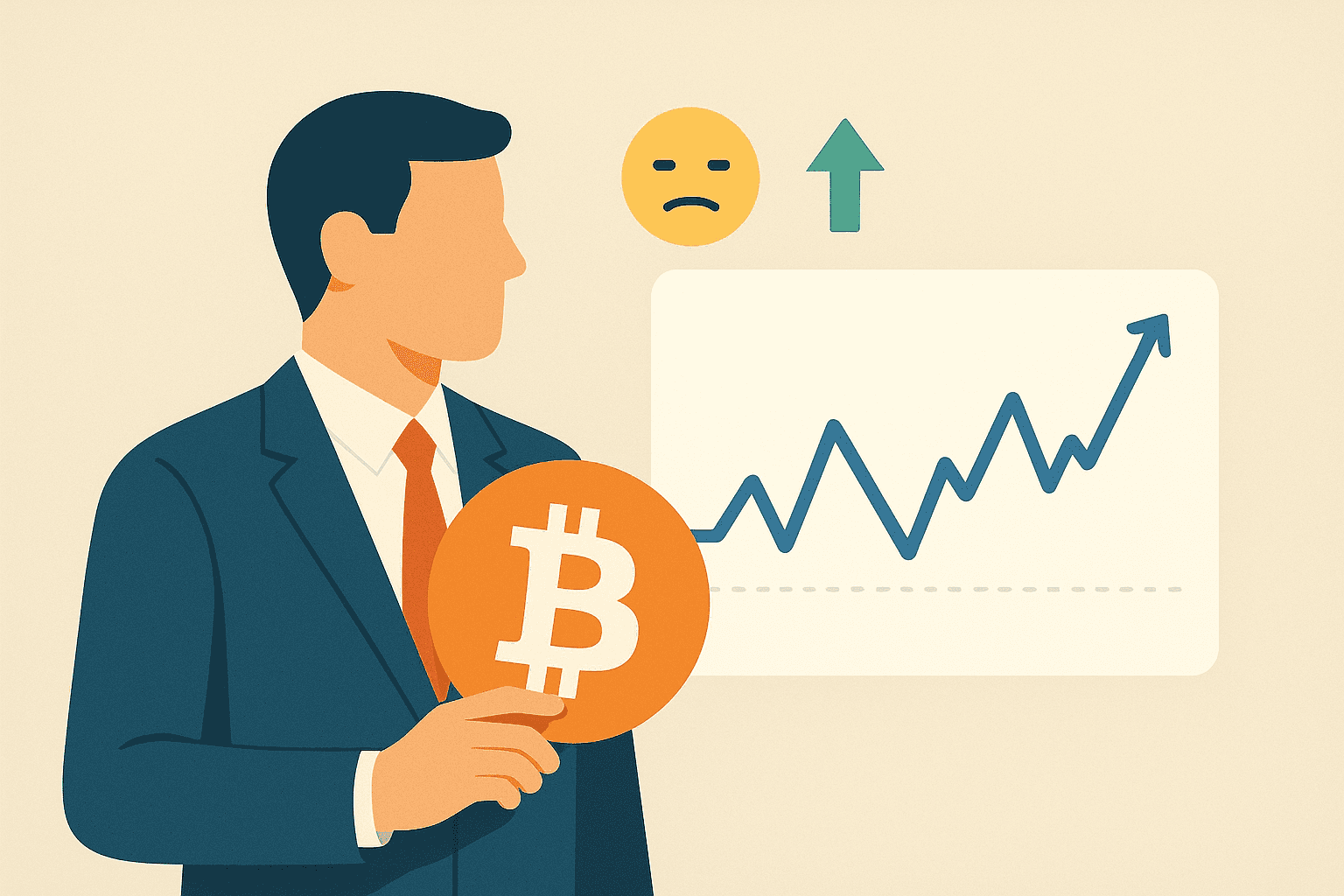
Crypto market sentiment reflects the crowd’s outlook and emotions, and it can propel prices far beyond what fundamentals or technical signals alone would suggest. Used together with other analysis, it clarifies where momentum may be tilting and how the crypto market could behave next.
Understanding sentiment helps traders separate short-term noise from genuine conviction and adjust risk before the crowd turns.
A striking illustration of emotion-driven pricing occurred on April 2, 2019, when Elon Musk mentioned Doge. In a little over two years after that post, Dogecoin surged about 24,500%, fueling one of the most memorable memecoin rallies.
Traders assess the mood in several ways to refine entries and exits: watching social chatter and headlines, and consulting composite gauges such as the Fear and Greed Index to spot trends and anticipate potential moves.
To judge whether sentiment is bullish, bearish, or neutral at any given moment, traders typically triangulate a few “live” reads, such as the latest Fear and Greed Index level and direction, derivatives positioning (funding rates and open interest), and whether price breakouts are being confirmed by broad participation rather than a handful of large coins.
Whether cryptocurrency is going up or down depends on timeframe, but a common way to define the overall trend is to look at the total market capitalization (or a broad market index), compare it to recent highs and lows, and confirm direction with longer-term moving averages. A sustained sequence of higher highs and higher lows usually signals an upward trend, while lower highs and lower lows points to a downward trend; choppy range behavior suggests sideways conditions.
The current status of the crypto market is often best described by its regime—trending, consolidating, or volatile—because crypto can switch regimes quickly. Major influences that frequently tilt the market from one regime to another include macroeconomic expectations (liquidity and interest-rate sensitivity), regulatory developments, security incidents, and large narrative shifts driven by influential personalities or market-cycle psychology.
How Is Crypto Market Sentiment Measured?
In digital assets, the collective attitude of participants can sway valuations, so recognizing the prevailing tone helps traders make more informed choices.
Sentiment is commonly driven by a mix of news headlines, social media narratives, macroeconomic conditions, regulatory developments, influential personalities, and where the market sits in a broader cycle.
- Tracking social conversations
- Reviewing news and media coverage
- Applying sentiment-focused indicators and metrics
Social Media Analysis
Platforms like Twitter, Discord, and Telegram act as real-time forums where ongoing chatter signals the current mood among market participants.
Observers examine how often a token is mentioned, whether posts lean bullish or bearish, and which topics are rising in visibility.
Specialized tools and APIs convert this stream into actionable datasets that can be filtered and compared over time.
News and Media Monitoring
Newsflow—and especially punchy headlines—can swiftly reshape perception across the crypto market.
| Event Type | Effect on Sentiment |
|---|---|
| Regulatory approvals | Often lifts sentiment by reducing uncertainty and expanding perceived legitimacy. |
| Institutional adoption | Often lifts sentiment by signaling demand, credibility, and deeper liquidity. |
| Security breaches | Often depresses sentiment by raising fear around custody, protocols, or counterparty risk. |
| Aggressive enforcement | Often depresses sentiment by increasing uncertainty about market access and compliance. |
Technical Indicators
While built for chart work, several indicators double as windows into crowd psychology.
The Crypto Fear and Greed Index is a composite score that rolls multiple inputs into a single 0–100 reading (lower scores imply fear, higher scores imply greed). The calculation is typically done by normalizing each component against its recent history and then combining the weighted results into one number.
| Index Component | Description | Impact on Score |
|---|---|---|
| Volatility | Measures how sharply prices are swinging versus recent baselines. | Higher volatility typically pulls the score down toward fear; calmer action tends to lift it. |
| Momentum and volume | Tracks the strength of price moves and how much participation (volume) supports them. | Strong, rising momentum with healthy volume tends to push the score up; weak participation can pull it down. |
| Social media sentiment | Assesses tone and intensity of crypto-related discussions. | More optimistic tone and higher engagement tends to push the score up; pessimistic tone tends to pull it down. |
| Bitcoin dominance | Looks at whether capital is concentrating in Bitcoin or rotating into higher-beta assets. | Rising dominance can reflect risk-off behavior and may reduce the score; falling dominance can reflect risk-on behavior and may raise it. |
| Search trends | Measures public interest via crypto-related search activity and topic direction. | Surging interest around “buy” narratives can lift the score; panic-driven interest can pull it down. |
As a practical rule, many traders treat extreme readings as a context signal rather than a trade trigger: they look for confirmation (price structure, volume, and invalidation levels), scale risk instead of going all-in, and avoid assuming that “fear” must immediately mean a bottom or that “greed” must immediately mean a top.
Moving averages offer similar cues: a golden cross—50-day moving above the 200-day—may signal rising optimism, whereas a death cross can imply fading confidence and a possible bearish reversal.
The Impact of Sentiment on Crypto Prices
The market’s mood can dominate price behavior and sometimes override both chart signals and fundamental drivers.
When enthusiasm and fear of missing out build, demand can accelerate and lift prices. During the 2017 advance, Bitcoin (BTC) climbed nearly 2,000% amid exuberant participation.
On the flip side, negative sentiment—fear, uncertainty, and doubt—can spark broad selling. In the 2023 correction, the failures at Terra Network and Ftx intensified fear and drove heavy liquidation across cryptocurrencies.
Sentiment often translates into price through liquidity and positioning effects: as traders crowd into the same direction, order books can thin out, slippage can rise, and forced liquidations (from leveraged positions) can amplify both drops and rallies.
Because traders react to one another, sentiment often becomes self-reinforcing: buying triggers more buying, selling invites more selling, and feedback loops can produce outsized swings.
How to Use Sentiment Analysis in Crypto Trading
Reading the crowd is one element of a complete process, and skilled traders pair it with other tools to frame the broader crypto market.
Two common playbooks are moving with the dominant trend or taking contrarian positions when extremes are evident.
- Pick a timeframe and market “basket” to track (for example, total market cap, a broad index, or a watchlist that reflects your trading universe).
- Check a composite gauge (such as the Fear and Greed Index) and note both the level and whether it is rising or falling.
- Cross-check narrative heat by scanning headlines and major social channels for what is dominating attention.
- Validate (or invalidate) the mood with price action and positioning (breakouts, failed breakouts, funding rate shifts, and liquidation spikes).
- Define the trade plan: entry, stop, and risk size that matches the sentiment regime, then reassess when sentiment flips or price invalidates the setup.
- Helps identify crowded trades and potential turning points when optimism or pessimism becomes extreme.
- Adds context to breakouts and breakdowns by showing whether participation and narrative support the move.
- Improves risk management by highlighting periods when volatility and reflexive behavior are more likely.
- Supports timing by pairing “mood shifts” with clearer entry and exit criteria.
- Can be noisy and easy to misread, especially during meme-driven bursts or headline cascades.
- May lag fast-moving price changes, causing signals to arrive after the market has already moved.
- Is vulnerable to manipulation, coordinated posting, and distorted engagement metrics.
- Works poorly as a standalone signal because markets can stay fearful or greedy longer than expected.
Following the Herd
Many market participants aim to align with the prevailing direction and capitalize on ongoing momentum.
By closely tracking social feeds, news, and relevant indicators, they judge whether conditions skew bullish or bearish and then select long or short exposure to ride the wave.
The Contrarian Approach
A familiar maxim advises caution when crowds chase and courage when they panic.
This method seeks opportunities where optimism or pessimism appears stretched, taking the opposite side of consensus.
Extreme euphoria can hint at overvaluation, while severe gloom may reveal undervalued setups worth investigating.
Combining Sentiment With Technical and Fundamental Analysis
- Technical analysis: price structure and patterns
- Fundamental analysis: technology, adoption, and intrinsic drivers
- Sentiment analysis: crowd psychology and market mood
Blending these disciplines provides both short- and long-term context, helping traders fine-tune entries and exits and improve their odds of success.